QUESTION IMAGE
Question
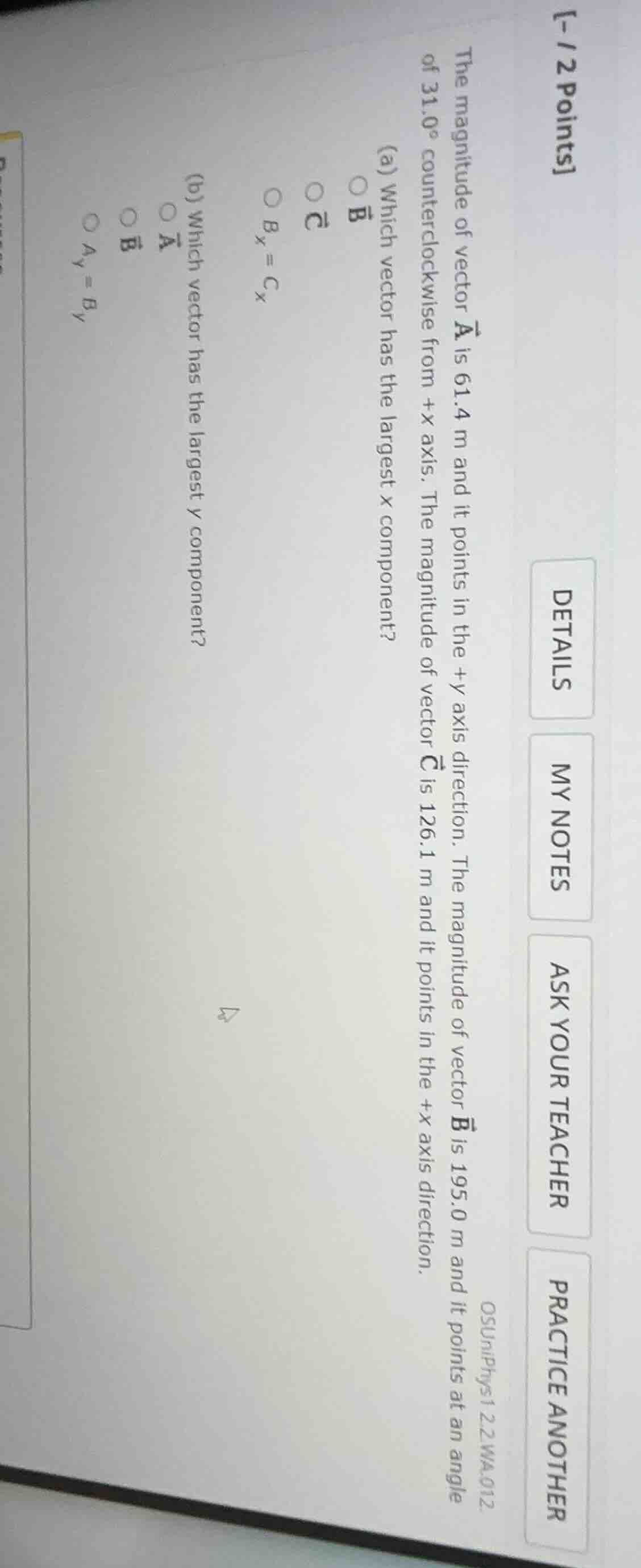
the magnitude of vector \\(\vec{a}\\) is 61.4 m and it points in the +y axis direction. the magnitude of vector \\(\vec{b}\\) is 195.0 m and it points at an angle of 31.0° counterclockwise from +x axis. the magnitude of vector \\(\vec{c}\\) is 126.1 m and it points in the +x axis direction.\\(\\ \\) (a) which vector has the largest x component?\\(\\ \\) \\(\vec{b}\\)\\(\\ \\) \\(\vec{c}\\)\\(\\ \\) \\(b_x = c_x\\)\\(\\ \\) (b) which vector has the largest y component?\\(\\ \\) \\(\vec{a}\\)\\(\\ \\) \\(\vec{b}\\)\\(\\ \\) \\(a_y = b_y\\)
Step1: Define vector components formula
For a vector $\vec{V}$ with magnitude $V$ and angle $\theta$ from +x-axis:
$V_x = V\cos\theta$, $V_y = V\sin\theta$
Step2: Calculate $\vec{A}$ components
$\vec{A}$ points along +y-axis, so $\theta_A = 90^\circ$:
$A_x = 61.4\cos(90^\circ) = 0$
$A_y = 61.4\sin(90^\circ) = 61.4$ m
Step3: Calculate $\vec{B}$ components
$\vec{B}$ has $\theta_B = 31.0^\circ$, $B=195.0$ m:
$B_x = 195.0\cos(31.0^\circ) \approx 195.0\times0.8572 = 167.15$ m
$B_y = 195.0\sin(31.0^\circ) \approx 195.0\times0.5150 = 100.43$ m
Step4: Calculate $\vec{C}$ components
$\vec{C}$ points along +x-axis, so $\theta_C = 0^\circ$:
$C_x = 126.1\cos(0^\circ) = 126.1$ m
$C_y = 126.1\sin(0^\circ) = 0$
Step5: Compare x-components (part a)
$A_x=0$, $B_x\approx167.15$ m, $C_x=126.1$ m. $B_x$ is largest.
Step6: Compare y-components (part b)
$A_y=61.4$ m, $B_y\approx100.43$ m, $C_y=0$. $B_y$ is largest.

Snap & solve any problem in the app
Get step-by-step solutions on Sovi AI
Photo-based solutions with guided steps
Explore more problems and detailed explanations
(a) $\vec{B}$
(b) $\vec{B}$