QUESTION IMAGE
Question
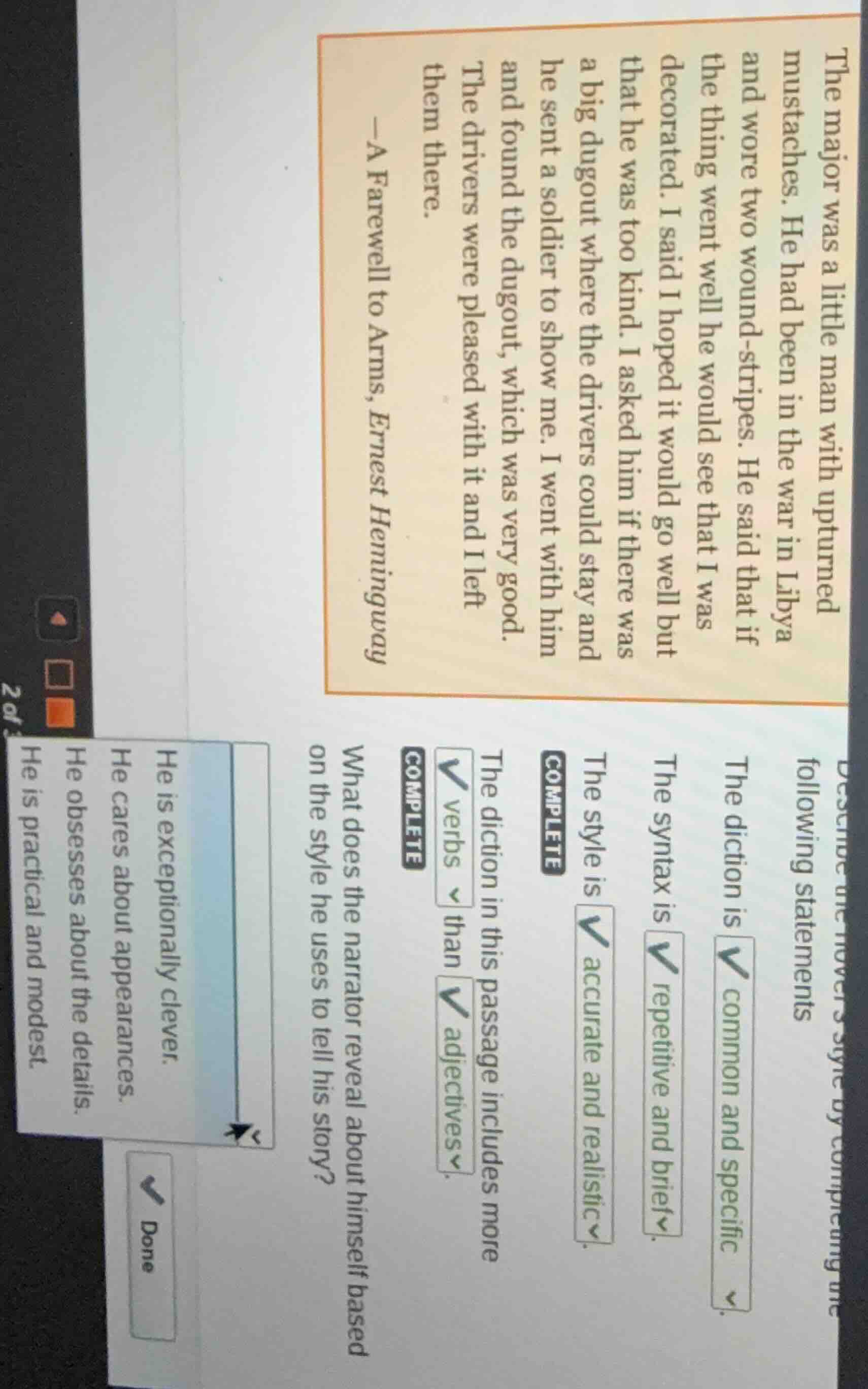
the major was a little man with upturned mustaches. he had been in the war in libya and wore two wound - stripes. he said that if the thing went well he would see that i was decorated. i said i hoped it would go well but that he was too kind. i asked him if there was a big dugout where the drivers could stay and he sent a soldier to show me. i went with him and found the dugout, which was very good. the drivers were pleased with it and i left them there.
—a farewell to arms, ernest hemingway
describe the novel’s style by completing the following statements
the diction is
the syntax is
the style is
the diction in this passage includes more
what does the narrator reveal about himself based on the style he uses to tell his story?
he is exceptionally clever.
he cares about appearances.
he obsesses about the details.
he is practical and modest.
- The passage uses simple, everyday language (common diction) with specific details like "upturned mustaches" and "wound-stripes", short repetitive sentence structures, and factual, unembellished descriptions of events, matching the accurate, realistic style typical of Hemingway's work. There are far more action verbs (e.g., "was", "had been", "wore", "said", "sent") than descriptive adjectives.
- The narrator focuses on practical, functional details (the dugout for drivers) and has a humble, unassuming tone, showing he is practical and modest, rather than fixated on cleverness, appearances, or excessive details.

Snap & solve any problem in the app
Get step-by-step solutions on Sovi AI
Photo-based solutions with guided steps
Explore more problems and detailed explanations
- The diction is common and specific
- The syntax is repetitive and brief
- The style is accurate and realistic
- The diction in this passage includes more verbs than adjectives
- He is practical and modest.