QUESTION IMAGE
Question
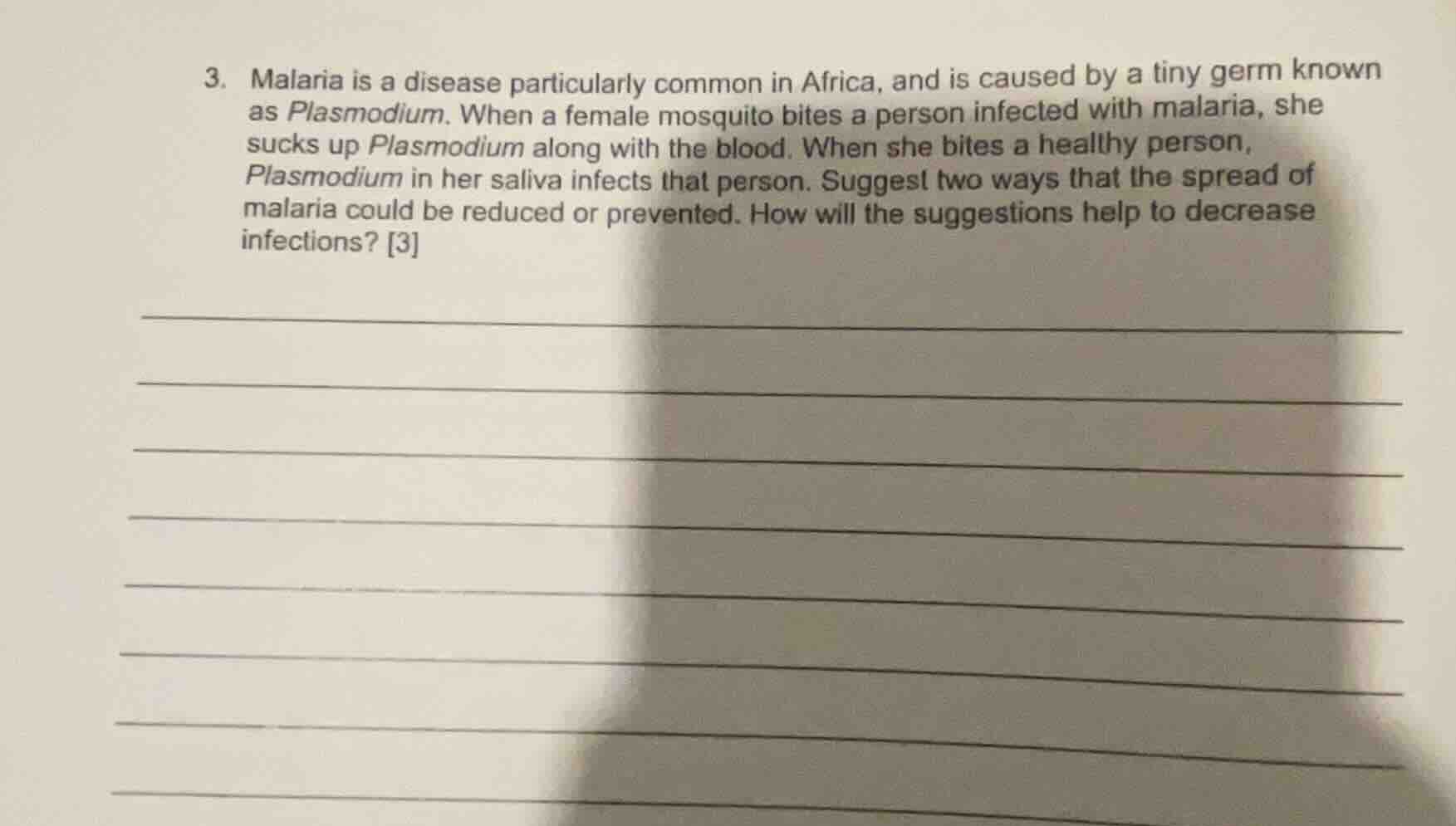
- malaria is a disease particularly common in africa, and is caused by a tiny germ known as plasmodium. when a female mosquito bites a person infected with malaria, she sucks up plasmodium along with the blood. when she bites a healthy person, plasmodium in her saliva infects that person. suggest two ways that the spread of malaria could be reduced or prevented. how will the suggestions help to decrease infections? 3
Brief Explanations
- Using Insecticide - Treated Bed Nets: Female mosquitoes (the vectors of malaria) are less likely to bite people sleeping under these nets. The insecticide on the nets either kills the mosquitoes or repels them, reducing the number of mosquito - human interactions. This breaks the transmission cycle as the mosquitoes can't pick up the Plasmodium from infected people or transmit it to healthy people.
- Eliminating Mosquito Breeding Sites: Mosquitoes breed in stagnant water. By draining standing water (like in puddles, old tires, or unused containers), we reduce the number of mosquito larvae that develop into adult mosquitoes. With fewer adult mosquitoes, there are fewer vectors available to transmit the Plasmodium from infected individuals to healthy ones, thus decreasing the spread of malaria.

Snap & solve any problem in the app
Get step-by-step solutions on Sovi AI
Photo-based solutions with guided steps
Explore more problems and detailed explanations
- Suggestion 1: Use insecticide - treated bed nets
- How it helps: Insecticide - treated bed nets repel or kill mosquitoes. Since female mosquitoes (malaria vectors) bite at night, people sleeping under these nets have fewer mosquito bites. This reduces the chance of mosquitoes picking up Plasmodium from infected people and transmitting it to healthy people, breaking the transmission cycle.
- Suggestion 2: Eliminate mosquito breeding sites
- How it helps: Mosquitoes breed in stagnant water (e.g., puddles, old tires, unused containers). Draining or removing stagnant water reduces the number of mosquito larvae that mature into adult mosquitoes. With fewer adult mosquitoes, there are fewer vectors to transmit Plasmodium, decreasing malaria infections.