QUESTION IMAGE
Question
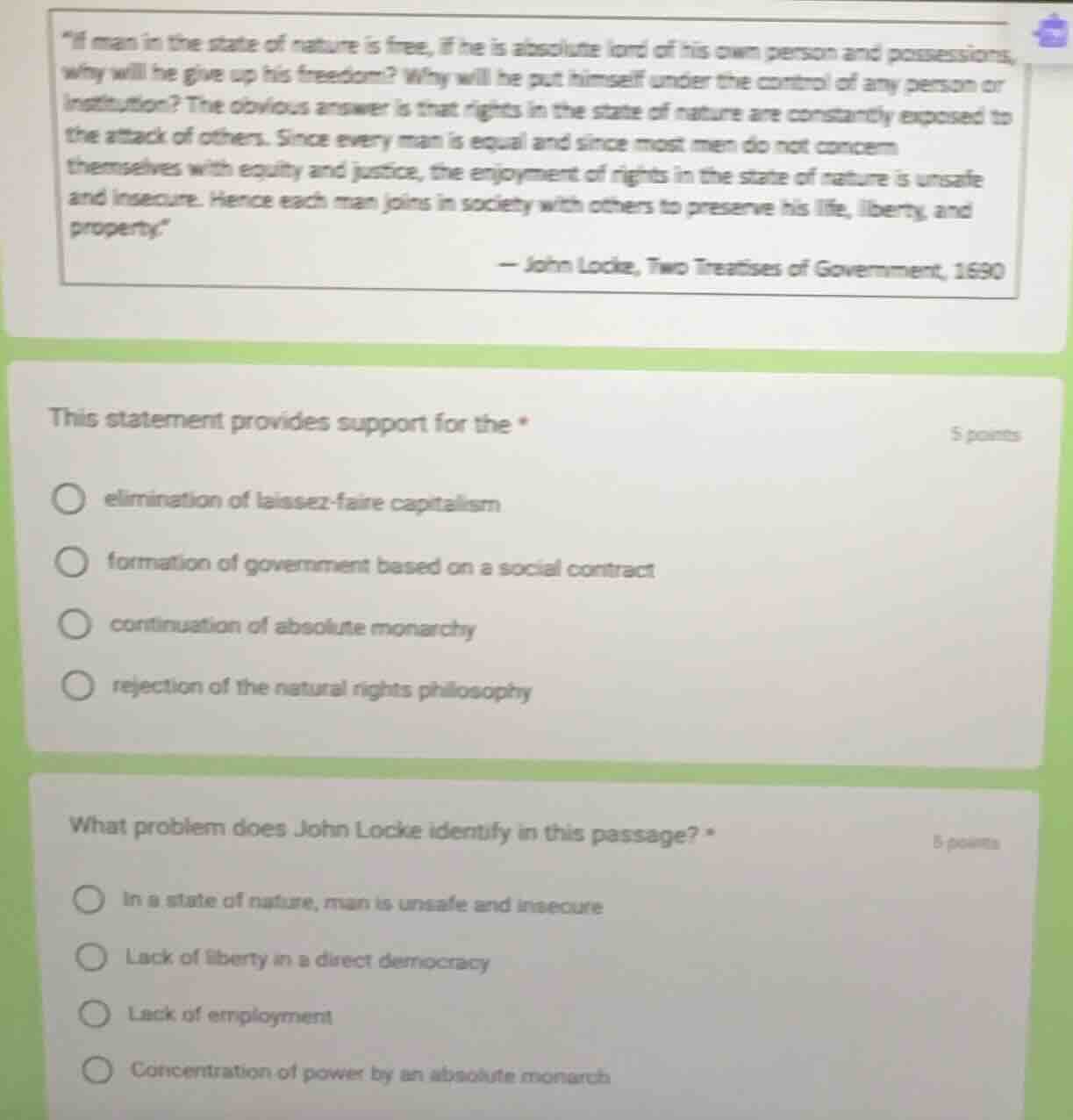
“if man in the state of nature is free, if he is absolute lord of his own person and possessions, why will he give up his freedom? why will he put himself under the control of any person or institution? the obvious answer is that rights in the state of nature are constantly exposed to the attack of others. since every man is equal and since most men do not concern themselves with equity and justice, the enjoyment of rights in the state of nature is unsafe and insecure. hence each man joins in society with others to preserve his life, liberty, and property.”
— john locke, two treatises of government, 1690
this statement provides support for the *
○ elimination of laissez - faire capitalism
○ formation of government based on a social contract
○ continuation of absolute monarchy
○ rejection of the natural rights philosophy
what problem does john locke identify in this passage? *
○ in a state of nature, man is unsafe and insecure
○ lack of liberty in a direct democracy
○ lack of employment
○ concentration of power by an absolute monarch
First Question (This statement provides support for the *):
John Locke's quote explains that in the state of nature, rights are unsafe, so people join society (form government) via social contract to protect life, liberty, property. The first option (elimination of laissez - faire capitalism) is unrelated. The third (continuation of absolute monarchy) is wrong as Locke opposed absolute monarchy. The fourth (rejection of natural rights philosophy) is wrong as he supports natural rights. So the correct option is about social contract - based government formation.
The passage says “the enjoyment of rights in the state of nature is unsafe and insecure”. The second option (lack of liberty in direct democracy) is off - topic. The third (lack of employment) is not mentioned. The fourth (concentration of power by absolute monarch) is not the problem here. The problem is the insecurity in the state of nature.

Snap & solve any problem in the app
Get step-by-step solutions on Sovi AI
Photo-based solutions with guided steps
Explore more problems and detailed explanations
B. formation of government based on a social contract