QUESTION IMAGE
Question
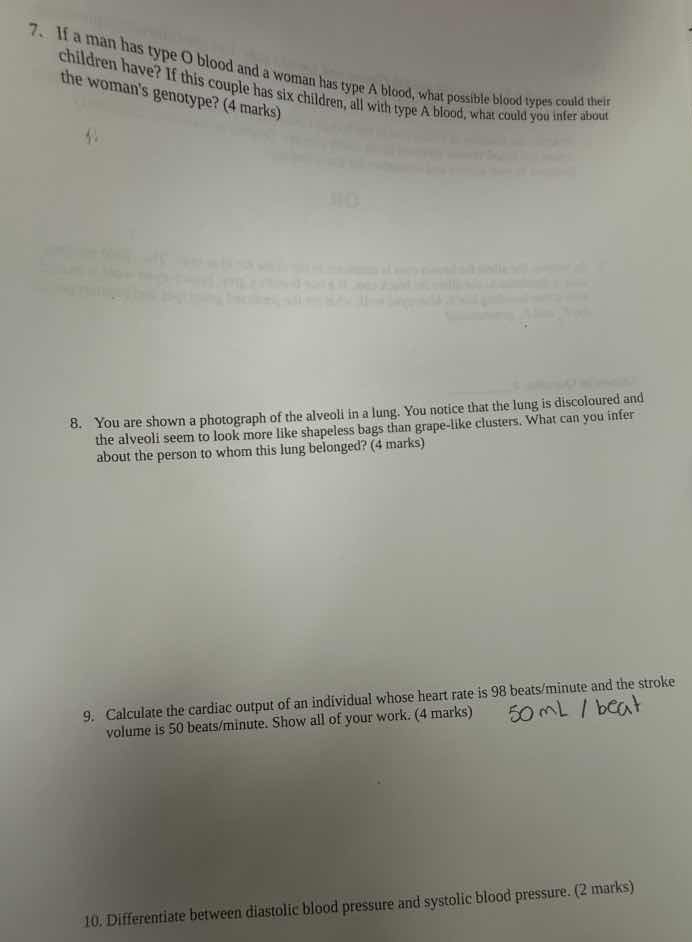
- if a man has type o blood and a woman has type a blood, what possible blood types could their children have? if this couple has six children, all with type a blood, what could you infer about the woman’s genotype? (4 marks)
- you are shown a photograph of the alveoli in a lung. you notice that the lung is discoloured and the alveoli seem to look more like shapeless bags than grape - like clusters. what can you infer about the person to whom this lung belonged? (4 marks)
- calculate the cardiac output of an individual whose heart rate is 98 beats/minute and the stroke volume is 50 ml/beat. show all of your work. (4 marks)
- differentiate between diastolic blood pressure and systolic blood pressure. (2 marks)
Response
Question 7
Brief Explanations
- Blood Type Genetics Basics: Blood type is determined by alleles. Type O blood has the genotype \( ii \) (homozygous recessive for the O allele). Type A blood can have two genotypes: \( I^A I^A \) (homozygous dominant for A) or \( I^A i \) (heterozygous, with A and O alleles).
- Possible Offspring Blood Types (First Part):
- If the woman is \( I^A I^A \): The man ( \( ii \)) can only contribute \( i \), and the woman can only contribute \( I^A \). So all offspring will have genotype \( I^A i \), which is type A blood.
- If the woman is \( I^A i \): The man contributes \( i \), and the woman can contribute either \( I^A \) or \( i \). So the possible genotypes of offspring are \( I^A i \) (type A) and \( ii \) (type O). Thus, the children could have type A or type O blood.
- Inferring the Woman’s Genotype (Second Part): The couple has six children, all with type A blood. If the woman were \( I^A i \), there would be a 50% chance of having a child with type O blood (since \( i \) from the man and \( i \) from the woman would result in \( ii \)). Having six children all with type A blood is highly unlikely if she were \( I^A i \) (the probability of six consecutive type A children in that case would be \( (0.5)^6 = 1/64 \approx 1.56\% \)). However, if she is \( I^A I^A \), all children will definitely be type A (probability 1 for each child, so for six children, it's \( 1^6 = 1 \)). So we can infer that the woman’s genotype is most likely \( I^A I^A \).
Brief Explanations
- Normal Alveoli Structure: Healthy alveoli are small, thin - walled sacs arranged in grape - like clusters. They are involved in gas exchange, and their structure is crucial for efficient diffusion of oxygen and carbon dioxide.
- Abnormal Structure Observed: The lung is discolored, and the alveoli look like shapeless bags instead of grape - like clusters. This is consistent with the damage caused by smoking or chronic obstructive pulmonary disease (COPD). Smoking (or long - term exposure to other pollutants) can lead to the destruction of the alveolar walls (a condition called emphysema, which is a type of COPD). In emphysema, the alveolar walls break down, leading to larger, irregular - shaped air spaces (the “shapeless bags”) and a loss of the normal grape - like cluster appearance. The discoloration can be due to the accumulation of tar and other pollutants from smoking or the effects of chronic inflammation.
Step 1: Recall the formula for cardiac output
Cardiac output (\( CO \)) is calculated as the product of heart rate (\( HR \)) and stroke volume (\( SV \)). The formula is \( CO=HR\times SV \).
Step 2: Identify the given values
The heart rate (\( HR \)) is 98 beats/minute, and the stroke volume (\( SV \)) is 50 mL/beat (note: the original problem has a typo, it should be 50 mL/beat, not 50 beats/minute).
Step 3: Substitute the values into the formula
\( CO = 98\space beats/minute\times50\space mL/beat \)
\( CO=4900\space mL/minute \) (or we can convert it to liters per minute by dividing by 1000, so \( 4.9\space L/minute \))

Snap & solve any problem in the app
Get step-by-step solutions on Sovi AI
Photo-based solutions with guided steps
Explore more problems and detailed explanations
- Possible blood types of children: If the woman is \( I^A I^A \), all children have type A blood. If the woman is \( I^A i \), children can have type A ( \( I^A i \)) or type O ( \( ii \)) blood.
- Inference about the woman’s genotype: Given all six children have type A blood, the woman’s genotype is most likely \( I^A I^A \) (homozygous for the A allele).