QUESTION IMAGE
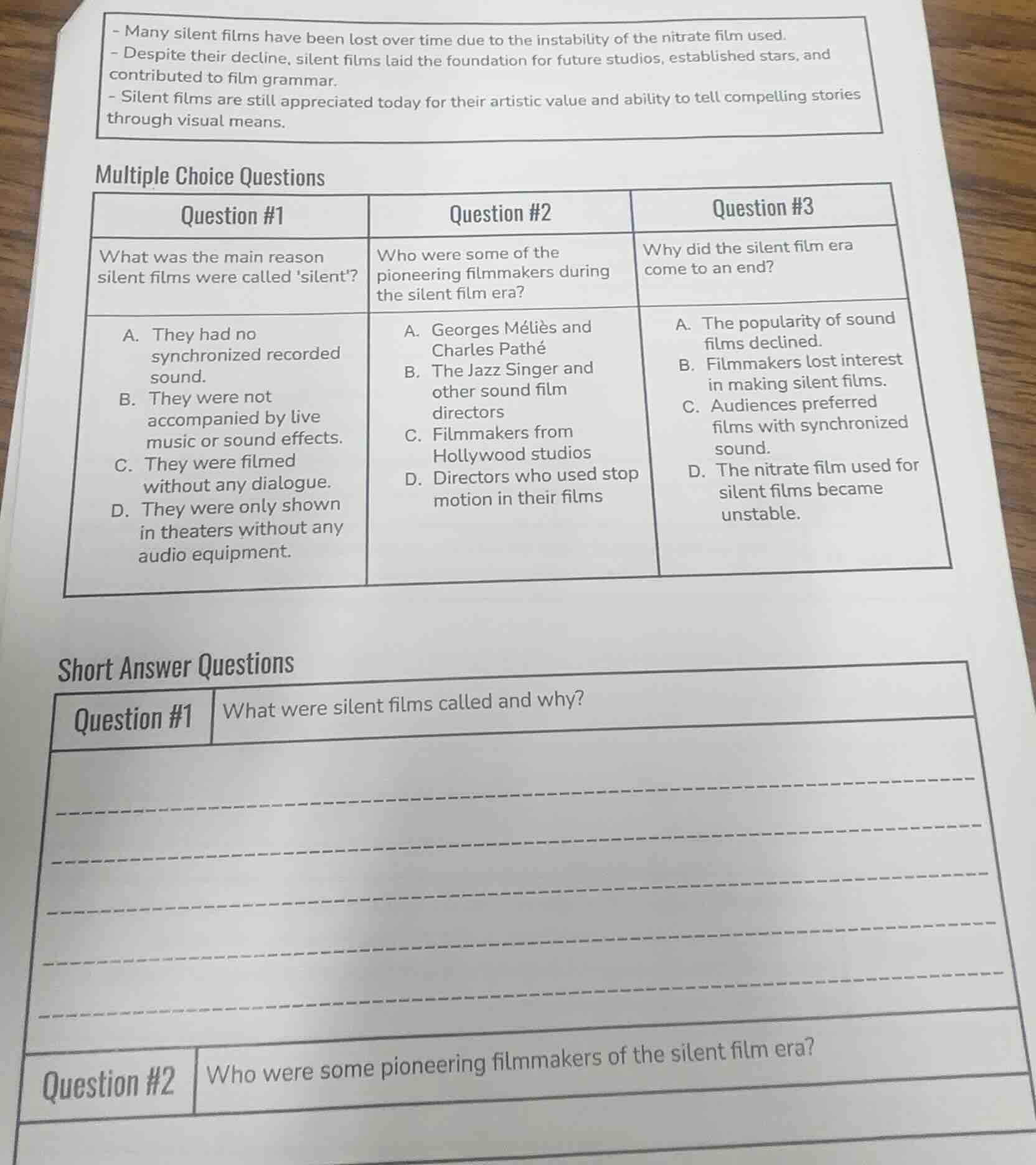
Question
- many silent films have been lost over time due to the instability of the nitrate film used.
- despite their decline, silent films laid the foundation for future studios, established stars, and contributed to film grammar.
- silent films are still appreciated today for their artistic value and ability to tell compelling stories through visual means.
multiple choice questions
| question #1 | question #2 | question #3 |
|---|
| a. they had no synchronized recorded sound.
b. they were not accompanied by live music or sound effects.
c. they were filmed without any dialogue.
d. they were only shown in theaters without any audio equipment. | a. georges méliès and charles pathé
b. the jazz singer and other sound film directors
c. filmmakers from hollywood studios
d. directors who used stop motion in their films | a. the popularity of sound films declined.
b. filmmakers lost interest in making silent films.
c. audiences preferred films with synchronized sound.
d. the nitrate film used for silent films became unstable. |
short answer questions
| question #1 | what were silent films called and why? |
|---|
| (blank lines for answer) |
| question #2 | who were some pioneering filmmakers of the silent film era? |
|---|
| (blank lines for answer) |
Multiple Choice Questions
Question #1
Silent films were called "silent" because they lacked synchronized recorded sound. Option A is correct as they often had live music or sound effects (so B is wrong), they could have dialogue in intertitles (so C is wrong), and the showing venue's audio equipment isn't the reason for the name (so D is wrong).
Georges Méliès and Charles Pathé were pioneering filmmakers in the silent film era. Option B refers to sound film directors, C is too vague about Hollywood studios' filmmakers in silent era, and D's stop - motion directors aren't the main pioneers of silent films.
The silent film era ended because audiences preferred films with synchronized sound (sound films). Option A is wrong as sound films became popular, B is not the main reason, and D is about film preservation/loss, not the end of the era.

Snap & solve any problem in the app
Get step-by-step solutions on Sovi AI
Photo-based solutions with guided steps
Explore more problems and detailed explanations
A. They had no synchronized recorded sound.