QUESTION IMAGE
Question
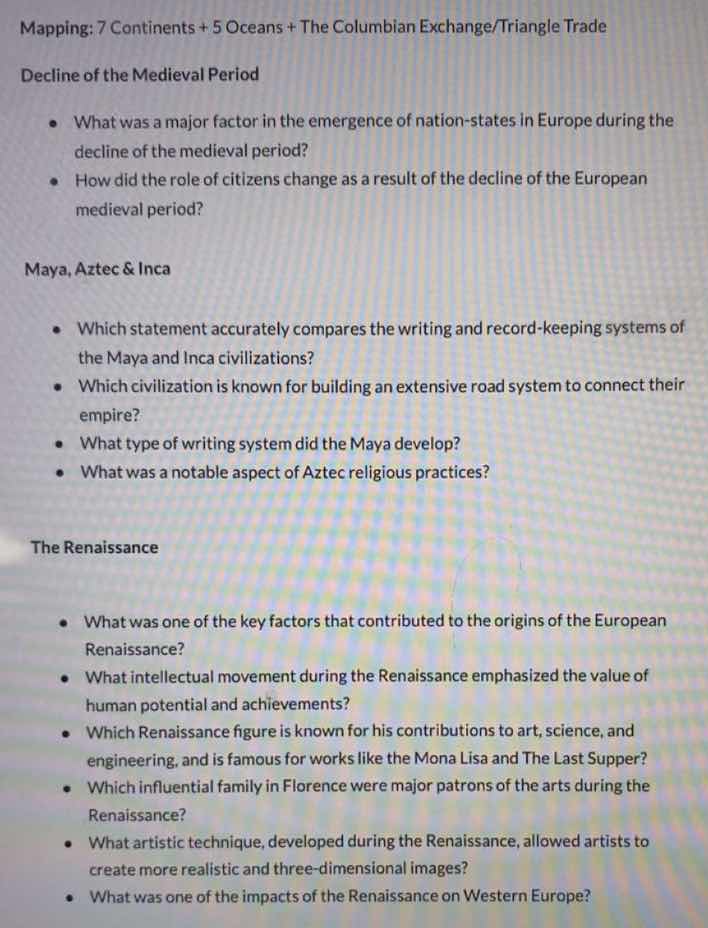
mapping: 7 continents + 5 oceans + the columbian exchange/triangle trade
decline of the medieval period
- what was a major factor in the emergence of nation - states in europe during the decline of the medieval period?
- how did the role of citizens change as a result of the decline of the european medieval period?
maya, aztec & inca
- which statement accurately compares the writing and record - keeping systems of the maya and inca civilizations?
- which civilization is known for building an extensive road system to connect their empire?
- what type of writing system did the maya develop?
- what was a notable aspect of aztec religious practices?
the renaissance
- what was one of the key factors that contributed to the origins of the european renaissance?
- what intellectual movement during the renaissance emphasized the value of human potential and achievements?
- which renaissance figure is known for his contributions to art, science, and engineering, and is famous for works like the mona lisa and the last supper?
- which influential family in florence were major patrons of the arts during the renaissance?
- what artistic technique, developed during the renaissance, allowed artists to create more realistic and three - dimensional images?
- what was one of the impacts of the renaissance on western europe?
Brief Explanations
Decline of the Medieval Period
- Nation-states factor: The growth of centralized royal power, which reduced the authority of feudal lords and the Catholic Church, allowed rulers to unify territories under a single government.
- Citizen role change: Shifted from being tied to feudal land (owing loyalty to a lord) to having direct ties to a central state, with emerging rights and obligations tied to national identity rather than feudal bonds.
Maya, Aztec & Inca
- Writing/record-keeping comparison: The Maya used a complex, phonetic-logographic writing system with glyphs, while the Inca used quipus (knotted string devices) for numerical records and no true writing system for language.
- Road system civilization: The Inca Empire built an extensive network of paved roads, suspension bridges, and waystations spanning over 40,000 km to connect their vast territory.
- Maya writing system: A logophonetic (glyph-based) system, combining symbols representing whole words (logograms) and symbols representing sounds (phonograms).
- Aztec religious aspect: Ritual human sacrifice, practiced to appease gods believed to sustain the sun, fertility, and the world's balance.
The Renaissance
- Renaissance origins factor: Increased trade and wealth from the Italian city-states (e.g., Florence, Venice) allowed wealthy patrons to fund artists, scholars, and thinkers.
- Human potential intellectual movement: Humanism, which focused on secular study of classical Greek and Roman texts, human achievement, and individual potential.
- Multi-disciplinary Renaissance figure: Leonardo da Vinci, a polymath known for artistic masterpieces and scientific/engineering studies.
- Florentine artistic patron family: The Medici family, whose wealth and support funded countless Renaissance artists, architects, and scholars.
- Realistic artistic technique: Linear perspective, developed by Filippo Brunelleschi, uses mathematical principles to create the illusion of depth on a flat surface.
- Renaissance impact: It sparked a shift from medieval theocentric thinking to a focus on secularism, individualism, and scientific inquiry, laying groundwork for the Enlightenment and modern Western thought.

Snap & solve any problem in the app
Get step-by-step solutions on Sovi AI
Photo-based solutions with guided steps
Explore more problems and detailed explanations
Decline of the Medieval Period
- The growth of centralized royal authority (reducing feudal and Church power)
- Citizens shifted from feudal lord loyalty to direct ties to a national state, gaining identity-based rights/obligations
Maya, Aztec & Inca
- The Maya used a glyph-based writing system; the Inca used quipus (knotted strings) for numerical records, no true writing system.
- The Inca Empire
- A logophonetic (glyph-based) system combining logograms and phonograms
- Ritual human sacrifice to appease deities
The Renaissance
- Increased trade and wealth in Italian city-states enabling artistic/scholarly patronage
- Humanism
- Leonardo da Vinci
- The Medici family
- Linear perspective
- It fostered secularism, individualism, and scientific curiosity, shaping modern Western intellectual foundations