QUESTION IMAGE
Question
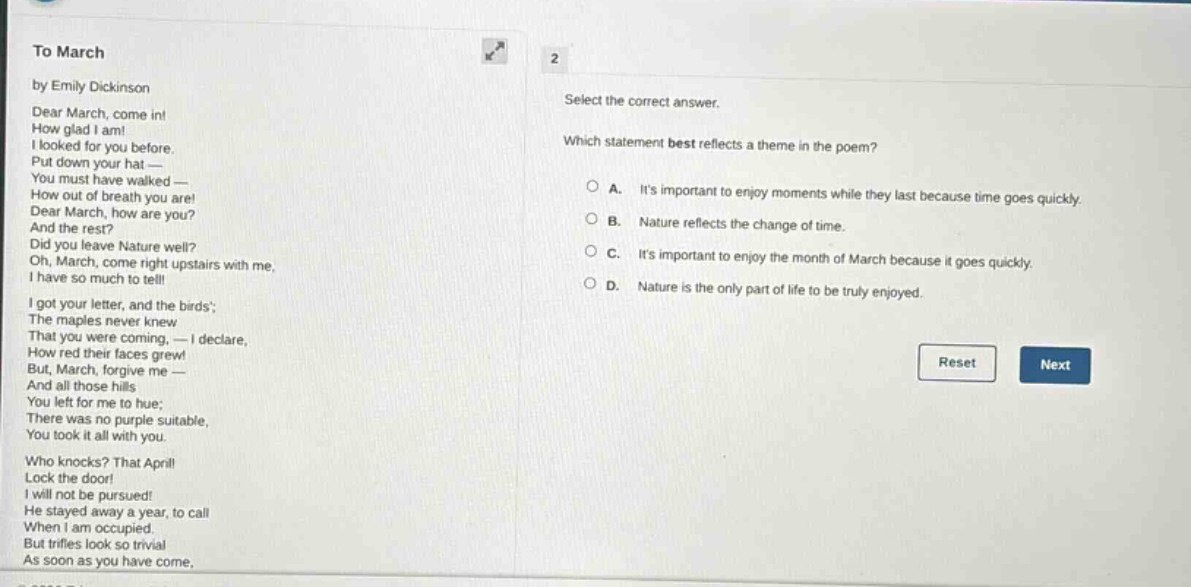
to march
by emily dickinson
dear march, come in!
how glad i am!
i looked for you before.
put down your hat —
you must have walked —
how out of breath you are!
dear march, how are you?
and the rest?
did you leave nature well?
oh, march, come right upstairs with me,
i have so much to tell!
i got your letter, and the birds;
the maples never knew,
that you were coming, — i declare,
how red their faces grew!
but, march, forgive me —
and all those hills.
you left for me to hue;
there was no purple suitable,
you took it all with you.
who knocks? that april!
lock the door!
i will not be pursued!
he stayed away a year, to call
when i am occupied.
but trifles look so trivial
as soon as you have come,
2
select the correct answer.
which statement best reflects a theme in the poem?
a. its important to enjoy moments while they last because time goes quickly.
b. nature reflects the change of time.
c. its important to enjoy the month of march because it goes quickly.
d. nature is the only part of life to be truly enjoyed.
- Option A: The poem focuses on March (a moment in time) and the speaker's eagerness to enjoy its presence, but the theme is broader about enjoying moments as time passes quickly, not just March. However, let's analyze other options.
- Option B: The poem uses March (a time marker) and nature (birds, maples) to show how nature (maples' red faces, birds' response) reflects the arrival of March (a change in time). The speaker interacts with March and notes nature's reaction to its coming, showing nature mirrors time's change.
- Option C: The poem's theme isn't limited to just March; it's about time and nature's reflection, not just enjoying March.
- Option D: The poem doesn't say nature is the "only" part to enjoy; it's an overstatement.
So the best theme is that nature reflects the change of time.

Snap & solve any problem in the app
Get step-by-step solutions on Sovi AI
Photo-based solutions with guided steps
Explore more problems and detailed explanations
B. Nature reflects the change of time.