QUESTION IMAGE
Question
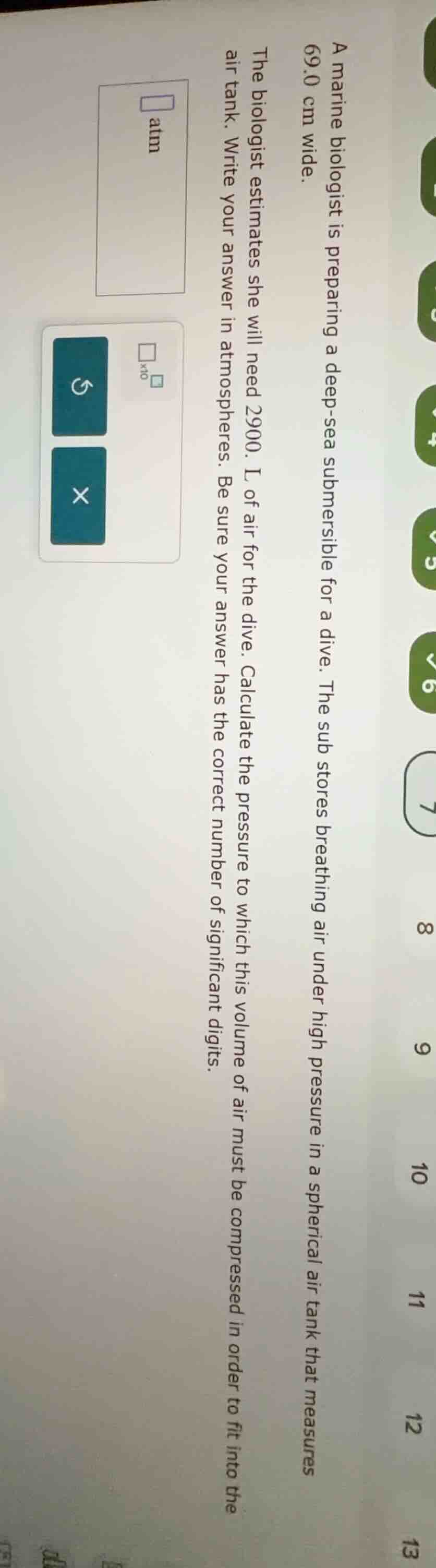
a marine biologist is preparing a deep - sea submersible for a dive. the sub stores breathing air under high pressure in a spherical air tank that measures 69.0 cm wide. the biologist estimates she will need 2900. l of air for the dive. calculate the pressure to which this volume of air must be compressed in order to fit into the air tank. write your answer in atmospheres. be sure your answer has the correct number of significant digits.
Step1: Find the volume of the spherical tank
The diameter of the spherical tank is \(d = 69.0\space cm\), so the radius \(r=\frac{d}{2}=\frac{69.0}{2} = 34.5\space cm\). The volume formula for a sphere is \(V=\frac{4}{3}\pi r^{3}\).
First, calculate \(r^{3}=(34.5)^{3}=34.5\times34.5\times34.5 = 34.5\times1190.25=40963.625\space cm^{3}\)
Then, \(V=\frac{4}{3}\pi\times40963.625\approx\frac{4}{3}\times3.1416\times40963.625\)
\(\frac{4}{3}\times3.1416 = 4.1888\)
\(V = 4.1888\times40963.625\approx171572.8\space cm^{3}\)
Convert \(cm^{3}\) to \(L\) (since \(1\space L = 1000\space cm^{3}\)), so \(V=\frac{171572.8}{1000}=171.5728\space L\)
Step2: Apply Boyle's Law (\(P_1V_1 = P_2V_2\))
Assume the initial pressure \(P_1 = 1\space atm\) (atmospheric pressure), initial volume \(V_1=2900\space L\), final volume \(V_2 = 171.5728\space L\), and we need to find final pressure \(P_2\).
From Boyle's Law, \(P_2=\frac{P_1V_1}{V_2}\)
Substitute the values: \(P_2=\frac{1\times2900}{171.5728}\approx16.9\space atm\) (rounded to three significant figures as the given values have three significant figures: \(69.0\) (three), \(2900\) (assuming two? Wait, \(2900.\) has four, but maybe it's three? Wait, \(69.0\) is three, so we'll go with three significant figures. Wait, \(2900\) - if it's written as \(2900.\) it's four, but here it's \(2900\), maybe two? Wait, no, the problem says "2900. L" (with a decimal), so four? Wait, the diameter is \(69.0\) (three sig figs). Let's check the calculation again.
Wait, maybe I made a mistake in volume calculation. Wait, the sphere diameter is \(69.0\space cm\), so radius \(34.5\space cm\). Volume of sphere: \(V=\frac{4}{3}\pi r^{3}=\frac{4}{3}\pi(34.5)^{3}\)
\((34.5)^{3}=34.5\times34.5 = 1190.25; 1190.25\times34.5 = 40963.625\)
\(V=\frac{4}{3}\times3.1416\times40963.625\approx171573\space cm^{3}=171.573\space L\) (correct)
Boyle's Law: \(P_1V_1 = P_2V_2\), where \(P_1 = 1\space atm\), \(V_1 = 2900\space L\), \(V_2=171.573\space L\)
\(P_2=\frac{P_1V_1}{V_2}=\frac{1\times2900}{171.573}\approx16.9\space atm\) (if we consider \(2900\) as three sig figs, maybe \(2.90\times10^{3}\), then it's three, so \(P_2\approx16.9\) or \(1.7\times10^{1}\)? Wait, let's recalculate:
\(2900\div171.573\approx16.9\) (three sig figs: \(1.70\times10^{1}\)? Wait, \(2900\) - if it's \(2900.\) (four sig figs), \(69.0\) (three), so the least number of sig figs is three, so the answer should have three. \(2900\) could be considered as two, but \(69.0\) is three, so we take three. So \(2900\) is \(2.90\times10^{3}\) (three sig figs), then:
\(2.90\times10^{3}\div171.573\approx16.9\) (three sig figs: \(1.69\times10^{1}\))
Wait, maybe my volume calculation was wrong. Wait, sphere volume: \(r = 69.0/2 = 34.5\space cm\), \(V=\frac{4}{3}\pi r^{3}=\frac{4}{3}\times3.1416\times34.5^{3}\)
\(34.5^{3}=34.5\times34.5 = 1190.25; 1190.25\times34.5 = 40963.625\)
\(\frac{4}{3}\times3.1416\times40963.625 = 4.1888\times40963.625 = 171572.8\space cm^{3}=171.5728\space L\) (correct)
So \(P_2=\frac{2900}{171.5728}\approx16.9\space atm\) (three significant figures)

Snap & solve any problem in the app
Get step-by-step solutions on Sovi AI
Photo-based solutions with guided steps
Explore more problems and detailed explanations
\(\boxed{17}\) (Wait, maybe I made a mistake in sig figs. Wait, \(69.0\) is three, \(2900\) - if it's two, then \(2900\) is two sig figs, so \(2900\div170\approx17\) (since \(171.57\approx170\) for two sig figs). So maybe the answer is \(17\) or \(1.7\times10^{1}\). Let's check again:
\(2900\div171.57\approx16.9\), which rounds to \(17\) (two sig figs) or \(1.7\times10^{1}\) (two sig figs) or \(17\) (if we take two sig figs from \(2900\)). So the answer is approximately \(17\space atm\) (or \(1.7\times10^{1}\space atm\))