QUESTION IMAGE
Question
marine sustainability
part i: multiple choice
instructions: please circle your answer below and put on the scantron. for question #6, put
answer a to demonstrate you read the instructions. (1pt each)
- corals are:
a. animals
b. plants
c. bacteria
d. algae
- coral reefs are made of:
a. brachyura
b. carbon dioxide
c. calcium carbonate
d. mangosteen
- which of the following is not a place you would find coral reefs?
a. the top of seamounts
b. around islands
c. in shallow, warm water near the equator
d. in shallow, fresh water in rivers
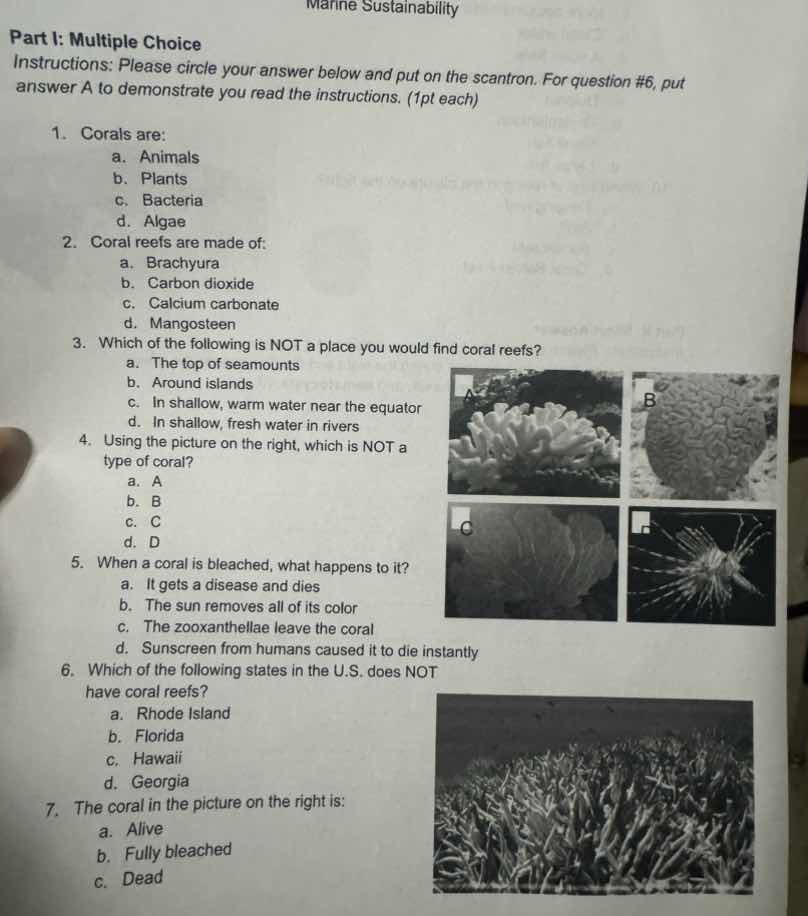
- using the picture on the right, which is not a
type of coral?
a. a
b. b
c. c
d. d
- when a coral is bleached, what happens to it?
a. it gets a disease and dies
b. the sun removes all of its color
c. the zooxanthellae leave the coral
d. sunscreen from humans caused it to die instantly
- which of the following states in the u.s. does not
have coral reefs?
a. rhode island
b. florida
c. hawaii
d. georgia
- the coral in the picture on the right is:
a. alive
b. fully bleached
c. dead
Question 1
Corals are marine invertebrates, which are animals. Plants perform photosynthesis, bacteria are single - celled prokaryotes, and algae are a different group of organisms. So corals are animals.
Coral reefs are formed from the exoskeletons of corals, which are made of calcium carbonate ($CaCO_3$). Brachyura is a taxonomic group of crabs, carbon dioxide is a gas, and mangosteen is a fruit.
Coral reefs require salt water and specific temperature and light conditions. They are found on seamounts, around islands, and in shallow, warm equatorial waters. Rivers have fresh water, so coral reefs are not found in shallow, fresh water in rivers.

Snap & solve any problem in the app
Get step-by-step solutions on Sovi AI
Photo-based solutions with guided steps
Explore more problems and detailed explanations
a. Animals