QUESTION IMAGE
Question
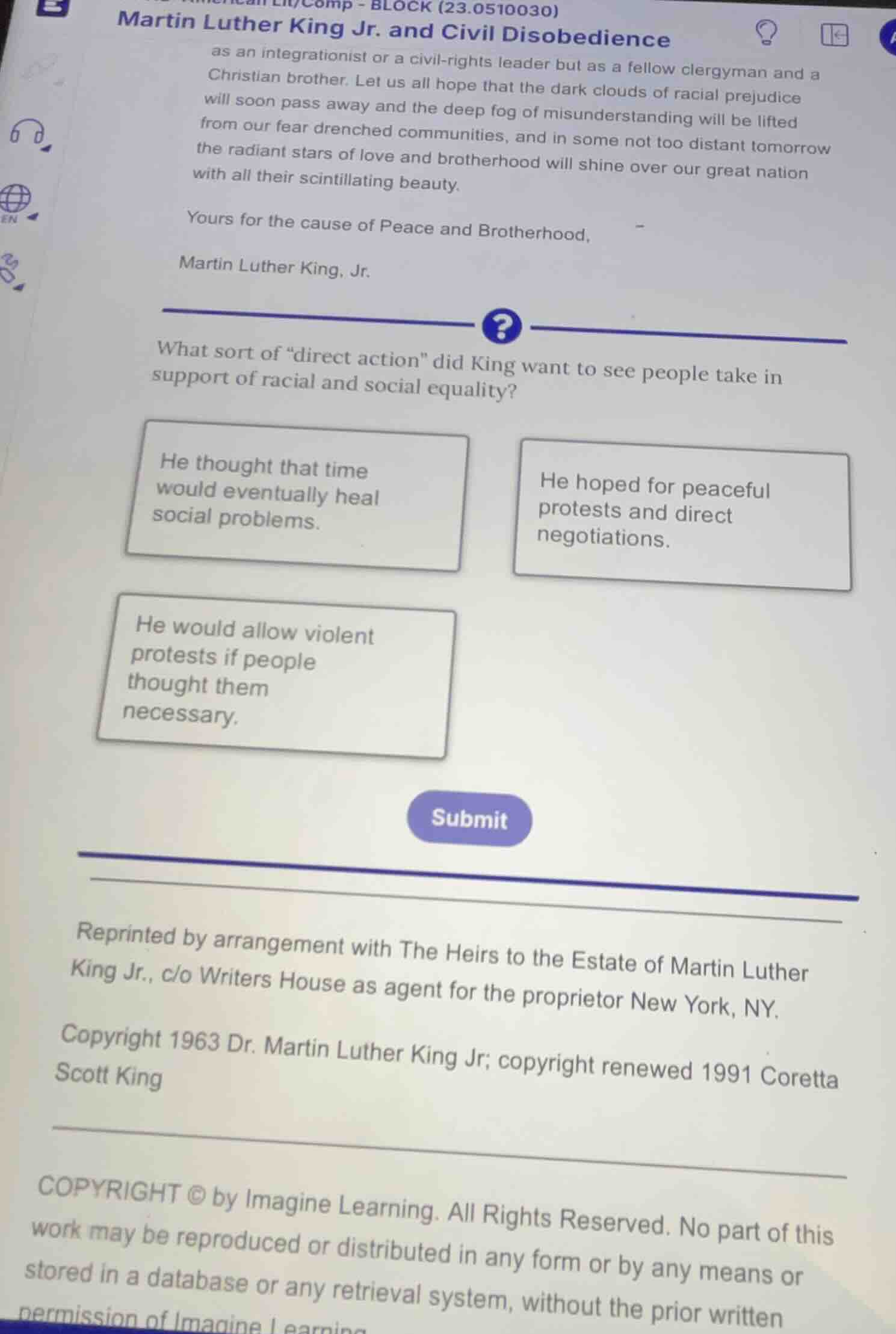
martin luther king jr. and civil disobedience as an integrationist or a civil - rights leader but as a fellow clergyman and a christian brother. let us all hope that the dark clouds of racial prejudice will soon pass away and the deep fog of misunderstanding will be lifted from our fear drenched communities, and in some not too distant tomorrow the radiant stars of love and brotherhood will shine over our great nation with all their scintillating beauty. yours for the cause of peace and brotherhood, martin luther king, jr. what sort of \direct action\ did king want to see people take in support of racial and social equality? he thought that time would eventually heal social problems. he hoped for peaceful protests and direct negotiations. he would allow violent protests if people thought them necessary. reprinted by arrangement with the heirs to the estate of martin luther king jr., c/o writers house as agent for the proprietor new york, ny. copyright 1963 dr. martin luther king jr; copyright renewed 1991 coretta scott king copyright © by imagine learning. all rights reserved. no part of this work may be reproduced or distributed in any form or by any means or stored in a database or any retrieval system, without the prior written
Martin Luther King Jr. was known for advocating non - violent civil disobedience. The option "He hoped for peaceful protests and direct negotiations" aligns with his philosophy of using peaceful means to achieve racial and social equality. The first option is incorrect as he believed in active efforts, not waiting for time to heal. The third option is incorrect as he was against violent protests.

Snap & solve any problem in the app
Get step-by-step solutions on Sovi AI
Photo-based solutions with guided steps
Explore more problems and detailed explanations
He hoped for peaceful protests and direct negotiations.