QUESTION IMAGE
Question
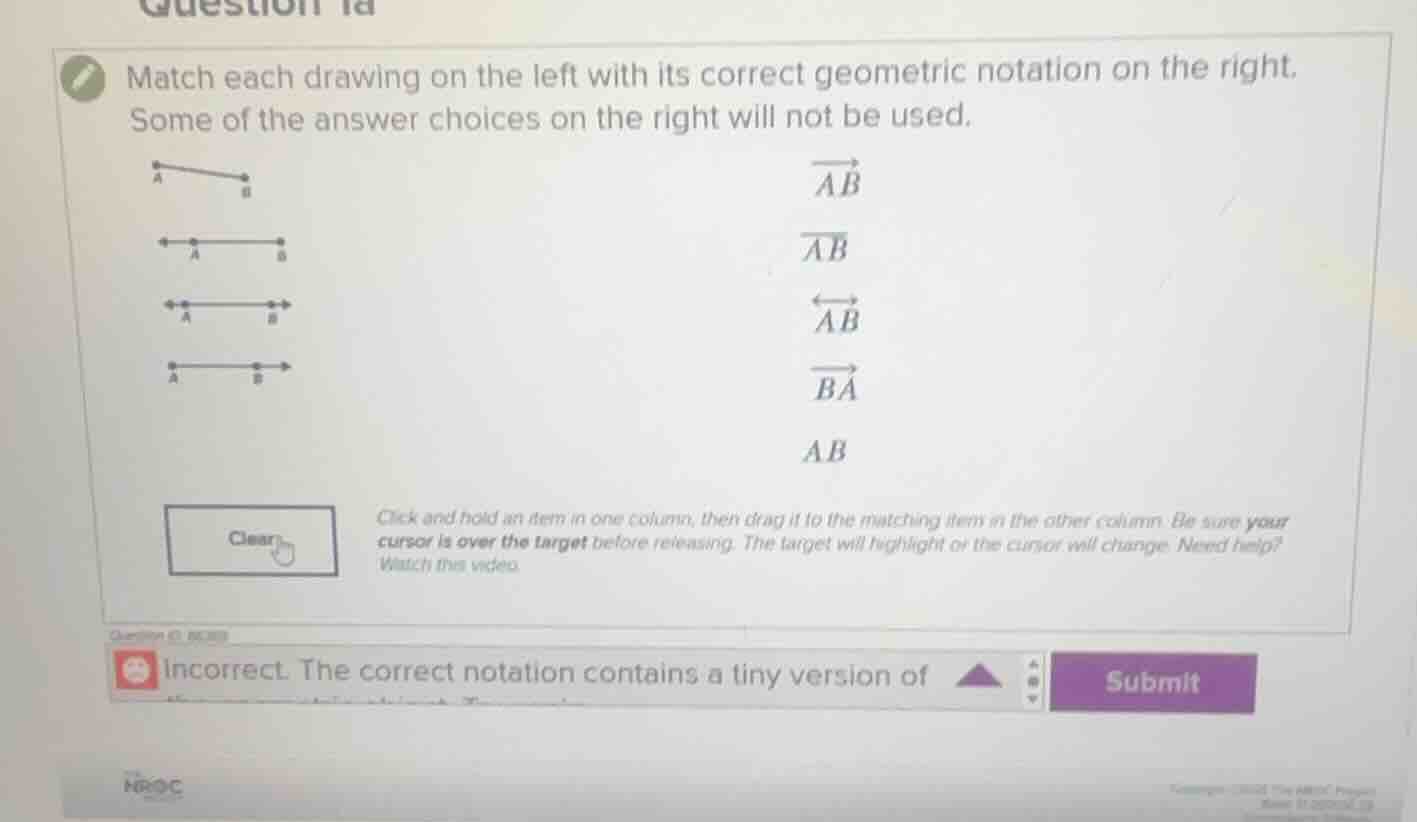
match each drawing on the left with its correct geometric notation on the right. some of the answer choices on the right will not be used.
click and hold an item in one column, then drag it to the matching item in the other column. be sure your cursor is over the target before releasing. the target will highlight or the cursor will change. need help? watch this video.
incorrect. the correct notation contains a tiny version of
submit
Step1: Analyze the first drawing (segment with endpoints A, B)
A segment with two endpoints (no arrows) is a line segment, denoted by \( \overline{AB} \) (or \( AB \) as a length, but here the notation with the bar is for the segment). Wait, the first left drawing: two endpoints, so it's a line segment. The right options: \( AB \) (length) or \( \overline{AB} \). Wait, the first left figure: points A and B with a segment (no arrows), so notation is \( \overline{AB} \) (line segment) or \( AB \) (length). But let's check each:
- First left drawing: two endpoints (A, B), no arrows. So it's a line segment. The notation for a line segment is \( \overline{AB} \) (or \( AB \) as the length, but in geometric notation, the segment is \( \overline{AB} \)). Wait, the right options include \( AB \) (maybe as the segment? Wait, no: \( \overline{AB} \) is segment, \( \overrightarrow{AB} \) is ray, \( \overleftrightarrow{AB} \) is line, \( \overrightarrow{BA} \) is ray opposite, \( AB \) is length. Wait, let's re-express:
- First left: segment AB (endpoints A, B, no arrows) → notation \( \overline{AB} \) (or \( AB \) if considering length, but in the options, \( AB \) is there. Wait, maybe the first left is a segment, so \( AB \) (length) or \( \overline{AB} \). Wait, the options: \( \overrightarrow{AB} \) (ray from A to B), \( \overline{AB} \) (segment), \( \overleftrightarrow{AB} \) (line), \( \overrightarrow{BA} \) (ray from B to A), \( AB \) (length).
Wait, let's list each left drawing:
- First left: A---B (two endpoints, no arrows) → line segment AB → notation \( \overline{AB} \) or \( AB \). But in the options, \( \overline{AB} \) is present, and \( AB \) is present. Wait, maybe the first is \( AB \) (length) or \( \overline{AB} \). Wait, the second left: A---B with an arrow on the left (so it's a ray? No, left arrow: the segment has a left arrow, meaning it's a ray? Wait, no:
Wait, standard geometric notations:
- Line segment: two endpoints, no arrows: \( \overline{AB} \)
- Ray: one endpoint, one arrow: \( \overrightarrow{AB} \) (starts at A, goes through B)
- Line: two arrows: \( \overleftrightarrow{AB} \)
- Ray opposite: \( \overrightarrow{BA} \) (starts at B, goes through A)
- Line segment: \( \overline{AB} \)
- Ray: \( \overrightarrow{AB} \) (A is endpoint, arrow at B)
- Line: \( \overleftrightarrow{AB} \) (arrows at both ends)
- Ray: \( \overrightarrow{BA} \) (B is endpoint, arrow at A)
Wait, let's re-express each left drawing:
- First left: A---B (no arrows) → line segment AB → notation \( \overline{AB} \) (or \( AB \) as length, but in the options, \( AB \) is there. Wait, the options include \( AB \) (maybe as the segment). Wait, the first left is a segment, so \( AB \) (length) or \( \overline{AB} \).
- Second left: A---B with an arrow on the left (so the line has a left arrow, meaning it's a ray? No, the left arrow: the segment is A---B with a left arrow, so it's a ray starting at B? No, wait, the arrow direction: if the left end has an arrow, that means the line extends infinitely to the left, so the segment is part of a line with a left arrow, so it's a ray? No, maybe it's a line with a left arrow, so the notation is \( \overleftrightarrow{AB} \)? No, \( \overleftrightarrow{AB} \) has arrows at both ends. Wait, the second left: A---B with a left arrow (so only left arrow), so it's a ray? No, a ray has one arrow. Wait, maybe the second left is a line with a left arrow, meaning it's a ray starting at B? No, I'm confused. Wait, let's check the options:
Options on the right:
- \( \overrightarrow{AB} \): ray from A…

Snap & solve any problem in the app
Get step-by-step solutions on Sovi AI
Photo-based solutions with guided steps
Explore more problems and detailed explanations
- First drawing (A---B, no arrows) → \( \overline{AB} \)
- Second drawing (A---B, left arrow) → \( \overrightarrow{BA} \)
- Third drawing (A---B, both arrows) → \( \overleftrightarrow{AB} \)
- Fourth drawing (A---B, right arrow) → \( \overrightarrow{AB} \)
(Note: The fifth option \( AB \) is not used as it represents the length of the segment, not the geometric figure notation.)