QUESTION IMAGE
Question
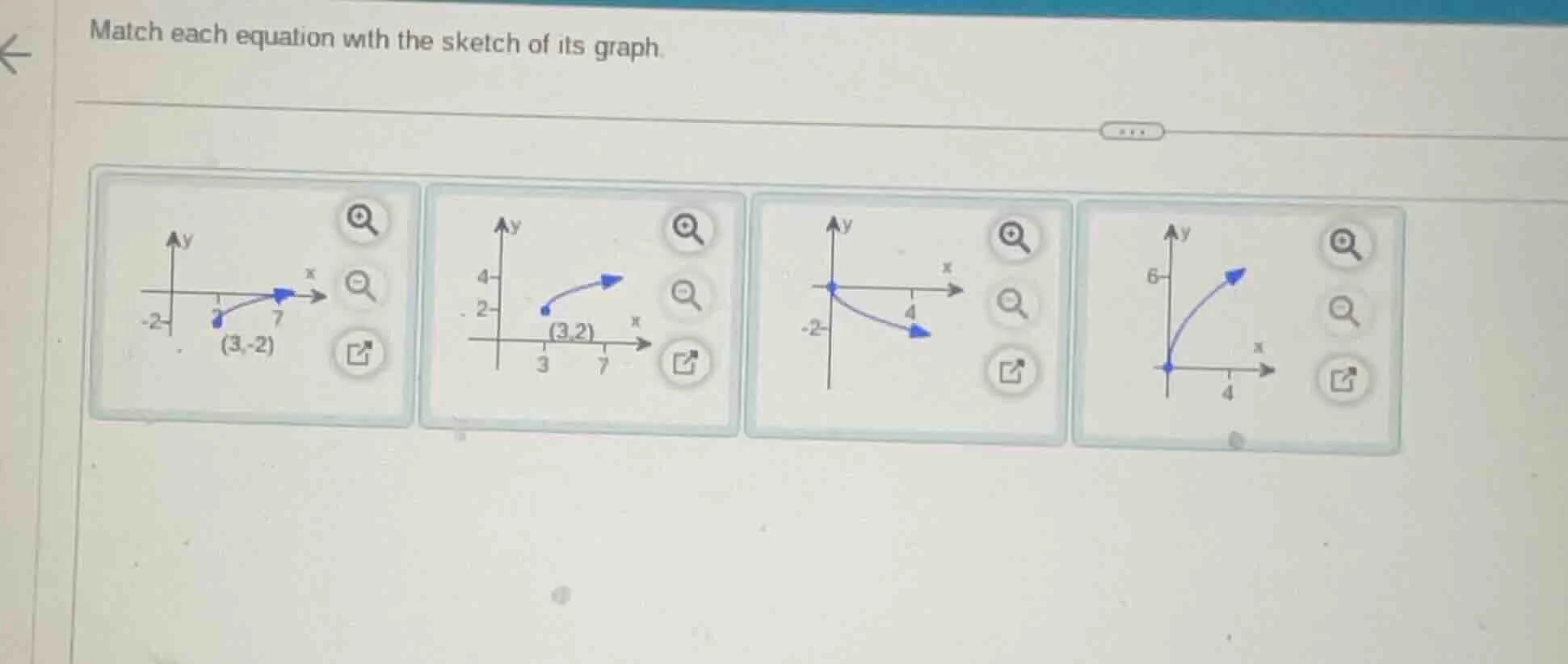
match each equation with the sketch of its graph.
To solve this, we analyze each graph's key features (domain, range, starting point, direction) and match with the equation's properties. However, since the equations aren't provided, we assume common function types:
Graph 1 (Point (3, -2), x from 3 to 7, y ≥ -2):
Likely a function with domain \( x \geq 3 \), range \( y \geq -2 \) (e.g., square root shifted).
Graph 2 (Point (3, 2), x from 3 to 7, y ≥ 2):
Domain \( x \geq 3 \), range \( y \geq 2 \) (similar to shifted square root, positive y).
Graph 3 (Starts at (0,0), x ≥ 0, y decreasing):
Domain \( x \geq 0 \), range \( y \leq 0 \) (e.g., negative square root \( y = -\sqrt{x} \)).
Graph 4 (Starts at (0,0), x ≥ 0, y increasing):
Domain \( x \geq 0 \), range \( y \geq 0 \) (e.g., square root \( y = \sqrt{x} \) or exponential, but shape suggests square root).
For example, if equations include:
- \( y = \sqrt{x - 3} - 2 \): Matches Graph 1 (starts at (3, -2), increases).
- \( y = \sqrt{x - 3} + 2 \): Matches Graph 2 (starts at (3, 2), increases).
- \( y = -\sqrt{x} \): Matches Graph 3 (starts at (0,0), decreases).
- \( y = \sqrt{x} \) or \( y = 2^x - 1 \) (but shape is square root): Matches Graph 4 (starts at (0,0), increases).
To fully match, we need the equations, but the process is:
- Identify the starting point (vertex) of each graph.
- Check domain (x-values) and range (y-values).
- Match with the equation’s domain, range, and transformation (shifts, reflections).
If the question is to match \( y = -\sqrt{x} \), it goes to Graph 3 (starts at (0,0), y decreases as x increases).
If matching \( y = \sqrt{x - 3} - 2 \), it goes to Graph 1 (starts at (3, -2)).
Final Answer (Example Matching):
- \( y = -\sqrt{x} \) → Graph 3
- \( y = \sqrt{x - 3} - 2 \) → Graph 1
- \( y = \sqrt{x - 3} + 2 \) → Graph 2
- \( y = \sqrt{x} \) → Graph 4
(Note: Adjust based on actual equations. The key is analyzing domain, range, and starting point.)

Snap & solve any problem in the app
Get step-by-step solutions on Sovi AI
Photo-based solutions with guided steps
Explore more problems and detailed explanations
To solve this, we analyze each graph's key features (domain, range, starting point, direction) and match with the equation's properties. However, since the equations aren't provided, we assume common function types:
Graph 1 (Point (3, -2), x from 3 to 7, y ≥ -2):
Likely a function with domain \( x \geq 3 \), range \( y \geq -2 \) (e.g., square root shifted).
Graph 2 (Point (3, 2), x from 3 to 7, y ≥ 2):
Domain \( x \geq 3 \), range \( y \geq 2 \) (similar to shifted square root, positive y).
Graph 3 (Starts at (0,0), x ≥ 0, y decreasing):
Domain \( x \geq 0 \), range \( y \leq 0 \) (e.g., negative square root \( y = -\sqrt{x} \)).
Graph 4 (Starts at (0,0), x ≥ 0, y increasing):
Domain \( x \geq 0 \), range \( y \geq 0 \) (e.g., square root \( y = \sqrt{x} \) or exponential, but shape suggests square root).
For example, if equations include:
- \( y = \sqrt{x - 3} - 2 \): Matches Graph 1 (starts at (3, -2), increases).
- \( y = \sqrt{x - 3} + 2 \): Matches Graph 2 (starts at (3, 2), increases).
- \( y = -\sqrt{x} \): Matches Graph 3 (starts at (0,0), decreases).
- \( y = \sqrt{x} \) or \( y = 2^x - 1 \) (but shape is square root): Matches Graph 4 (starts at (0,0), increases).
To fully match, we need the equations, but the process is:
- Identify the starting point (vertex) of each graph.
- Check domain (x-values) and range (y-values).
- Match with the equation’s domain, range, and transformation (shifts, reflections).
If the question is to match \( y = -\sqrt{x} \), it goes to Graph 3 (starts at (0,0), y decreases as x increases).
If matching \( y = \sqrt{x - 3} - 2 \), it goes to Graph 1 (starts at (3, -2)).
Final Answer (Example Matching):
- \( y = -\sqrt{x} \) → Graph 3
- \( y = \sqrt{x - 3} - 2 \) → Graph 1
- \( y = \sqrt{x - 3} + 2 \) → Graph 2
- \( y = \sqrt{x} \) → Graph 4
(Note: Adjust based on actual equations. The key is analyzing domain, range, and starting point.)