QUESTION IMAGE
Question
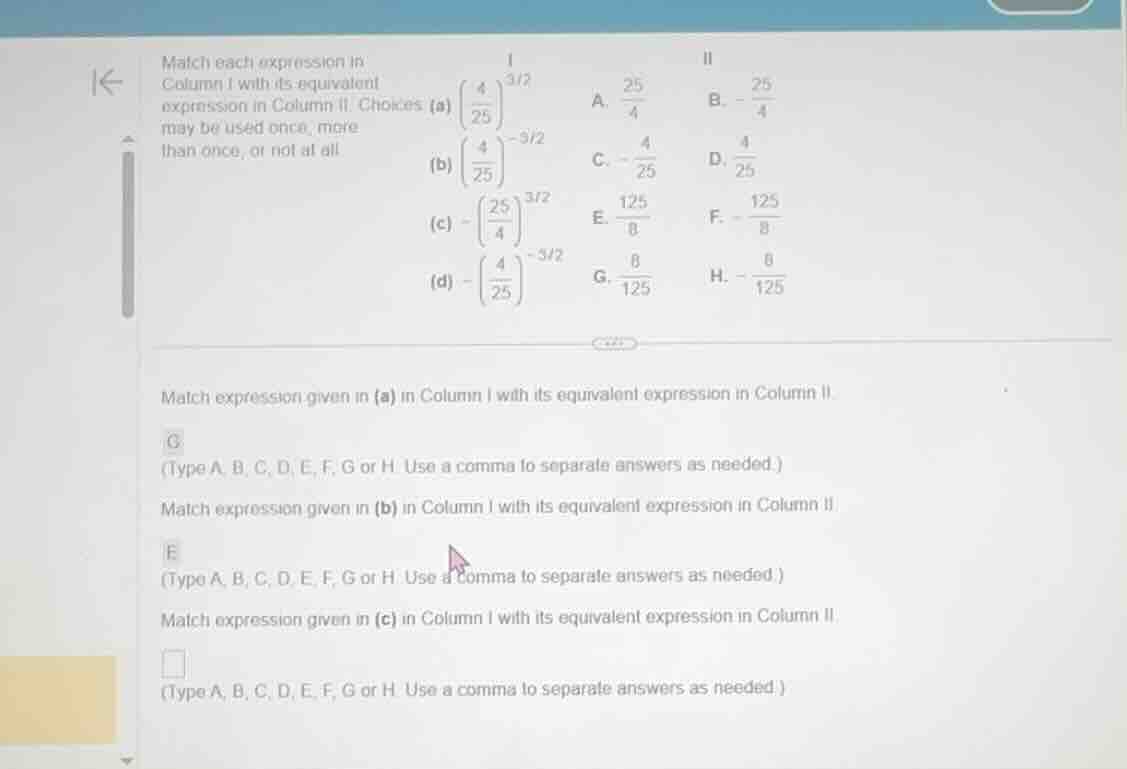
match each expression in column i with its equivalent expression in column ii. choices may be used once, more than once, or not at all.
(a) (left( \frac{4}{25}
ight)^{3/2})
a. (\frac{25}{4})
b. (-\frac{25}{4})
c. (-\frac{4}{25})
d. (\frac{4}{25})
(b) (left( \frac{4}{25}
ight)^{-3/2})
e. (\frac{125}{8})
f. (-\frac{125}{8})
(c) (-left( \frac{25}{4}
ight)^{3/2})
g. (\frac{8}{125})
h. (-\frac{8}{125})
(d) (-left( \frac{4}{25}
ight)^{-3/2})
match expression given in (a) in column i with its equivalent expression in column ii.
(type a, b, c, d, e, f, g or h. use a comma to separate answers as needed.)
match expression given in (b) in column i with its equivalent expression in column ii.
(type a, b, c, d, e, f, g or h. use a comma to separate answers as needed.)
match expression given in (c) in column i with its equivalent expression in column ii.
(type a, b, c, d, e, f, g or h. use a comma to separate answers as needed.)
match expression given in (d) in column i with its equivalent expression in column ii.
(type a, b, c, d, e, f, g or h. use a comma to separate answers as needed.)
Part (a)
Step1: Recall exponent rules
We know that \((\frac{a}{b})^{m/n}=\sqrt[n]{(\frac{a}{b})^m}=(\frac{\sqrt[n]{a}}{\sqrt[n]{b}})^m\) and \((\frac{a}{b})^{-n}=(\frac{b}{a})^n\). For \((\frac{4}{25})^{3/2}\), first, \((\frac{4}{25})^{1/2}=\frac{\sqrt{4}}{\sqrt{25}}=\frac{2}{5}\), then raise to the power of 3: \((\frac{2}{5})^3=\frac{8}{125}\)? Wait, no, wait. Wait, \((\frac{4}{25})^{3/2}=((\frac{4}{25})^{1/2})^3\). \(\sqrt{\frac{4}{25}}=\frac{2}{5}\), then \((\frac{2}{5})^3=\frac{8}{125}\)? But that's G? Wait, no, maybe I made a mistake. Wait, \((\frac{4}{25})^{3/2}=\frac{4^{3/2}}{25^{3/2}}=\frac{(2^2)^{3/2}}{(5^2)^{3/2}}=\frac{2^3}{5^3}=\frac{8}{125}\), which is G? But the options: G is \(\frac{8}{125}\), H is \(-\frac{8}{125}\). Wait, no, the expression (a) is \((\frac{4}{25})^{3/2}\), which is positive. So \(\frac{8}{125}\) is G? Wait, but let's check again. Wait, \((\frac{4}{25})^{3/2} = (\sqrt{\frac{4}{25}})^3 = (\frac{2}{5})^3 = \frac{8}{125}\), so that's G. But the initial thought was maybe I messed up. Wait, the options: G is \(\frac{8}{125}\), so (a) matches G? But the user's previous answer for (b) was E, let's check (b).
Wait, (b) is \((\frac{4}{25})^{-3/2}\). Using the negative exponent rule, \((\frac{4}{25})^{-3/2}=(\frac{25}{4})^{3/2}\). Then \((\frac{25}{4})^{3/2}=((\frac{25}{4})^{1/2})^3=(\frac{5}{2})^3=\frac{125}{8}\), which is E. So that's correct. Then (a): \((\frac{4}{25})^{3/2}=(\frac{2}{5})^3=\frac{8}{125}\), so G.
Step2: Confirm
So (a) is \((\frac{4}{25})^{3/2}=\frac{8}{125}\), which is G.
Step1: Analyze the expression
The expression is \(-(\frac{25}{4})^{3/2}\). First, compute \((\frac{25}{4})^{3/2}\). \((\frac{25}{4})^{1/2}=\frac{5}{2}\), then raise to the power of 3: \((\frac{5}{2})^3=\frac{125}{8}\). Then apply the negative sign: \(-\frac{125}{8}\), which is F.
Step2: Confirm
\((\frac{25}{4})^{3/2}=\frac{25^{3/2}}{4^{3/2}}=\frac{(5^2)^{3/2}}{(2^2)^{3/2}}=\frac{5^3}{2^3}=\frac{125}{8}\), then with the negative sign, \(-\frac{125}{8}\), which is F.

Snap & solve any problem in the app
Get step-by-step solutions on Sovi AI
Photo-based solutions with guided steps
Explore more problems and detailed explanations
G