QUESTION IMAGE
Question
match each quadratic function to its graph.
$f(x) = -3x^2 - 12x - 9 = -3(x + 3)(x + 1)$
$g(x) = 2x^2$
$h(x) = -x^2 + 2x - 1 = -(x - 1)^2$
$k(x) = x^2 + 5$
$f(x) = -3x^2 - 12x - 9$ $g(x) = 2x^2$
$h(x) = -x^2 + 2x - 1$ $k(x) = x^2 + 5$
To solve this, we analyze each quadratic function's key features (direction, vertex, roots, y - intercept) and match them to the graphs.
Analyzing \(g(x) = 2x^{2}\)
- The coefficient of \(x^{2}\) is \(2>0\), so the parabola opens upward.
- The vertex form of a parabola is \(y = a(x - h)^{2}+k\), for \(g(x)=2x^{2}\), we can write it as \(g(x)=2(x - 0)^{2}+0\). So the vertex is at \((0,0)\) and it passes through the origin \((0,0)\).
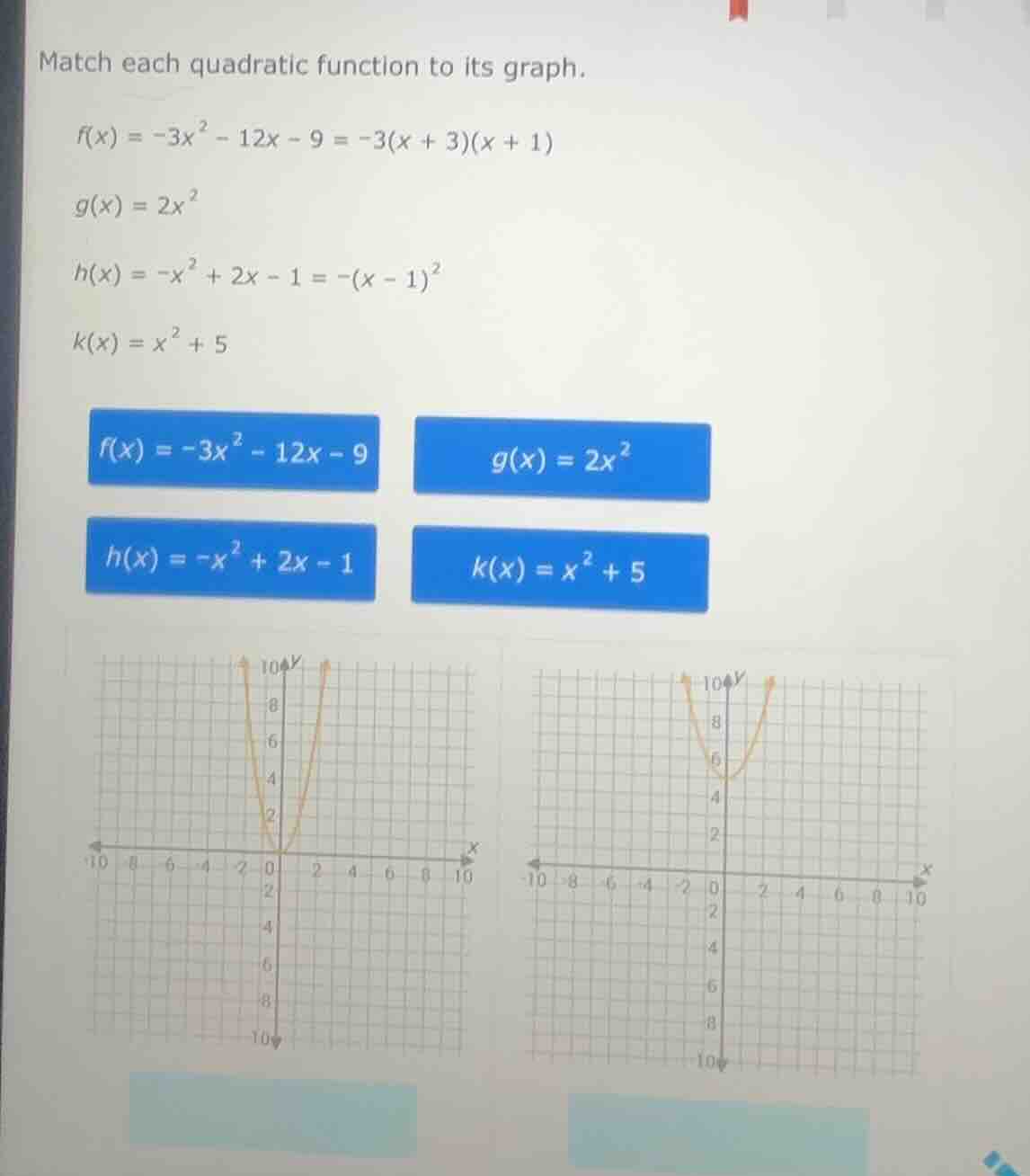
- Looking at the two graphs, the first graph (on the left) has a parabola that passes through the origin \((0,0)\) and opens upward. So \(g(x) = 2x^{2}\) matches the left - hand graph.
Analyzing \(k(x)=x^{2}+5\)
- The coefficient of \(x^{2}\) is \(1 > 0\), so the parabola opens upward.
- The vertex form is \(k(x)=(x - 0)^{2}+5\), so the vertex is at \((0,5)\).
- The second graph (on the right) has a parabola that opens upward and has a y - intercept at \(y = 5\) (since when \(x = 0\), \(y=5\)). So \(k(x)=x^{2}+5\) matches the right - hand graph.
Analyzing \(f(x)=-3x^{2}-12x - 9=-3(x + 3)(x + 1)\)
- The coefficient of \(x^{2}\) is \(-3<0\), so the parabola opens downward.
- To find the roots, we set \(f(x)=0\), then \(-3(x + 3)(x + 1)=0\). This gives \(x=-3\) or \(x=-1\). The vertex of a parabola \(y = ax^{2}+bx + c\) has its x - coordinate at \(x=-\frac{b}{2a}\). For \(f(x)=-3x^{2}-12x - 9\), \(a=-3\), \(b=-12\), so \(x =-\frac{-12}{2\times(-3)}=-2\). Substituting \(x = - 2\) into \(f(x)\): \(f(-2)=-3\times(-2)^{2}-12\times(-2)-9=-12 + 24-9 = 3\). So the vertex is at \((-2,3)\) and the parabola opens downward with roots at \(x=-3\) and \(x=-1\).
Analyzing \(h(x)=-x^{2}+2x - 1=-(x - 1)^{2}\)
- The coefficient of \(x^{2}\) is \(-1<0\), so the parabola opens downward.
- The vertex form is \(h(x)=-(x - 1)^{2}\), so the vertex is at \((1,0)\) (since when \(x = 1\), \(h(1)=0\)) and the parabola has a single root (a repeated root) at \(x = 1\) and opens downward.
Final Matching
- \(g(x)=2x^{2}\) matches the left - hand graph.
- \(k(x)=x^{2}+5\) matches the right - hand graph.
- \(f(x)=-3x^{2}-12x - 9\) (opens downward, roots at \(x=-3,x=-1\), vertex at \((-2,3)\)) and \(h(x)=-(x - 1)^{2}\) (opens downward, vertex at \((1,0)\)) would match the remaining graphs (not shown in the two given graphs in full detail but based on the analysis of the other two functions, we have already matched \(g(x)\) and \(k(x)\) correctly).
If we assume that we only need to match \(g(x)\) and \(k(x)\) from the two given graphs:
- \(g(x)=2x^{2}\) is matched to the graph with vertex at \((0,0)\) (the left - hand graph).
- \(k(x)=x^{2}+5\) is matched to the graph with vertex at \((0,5)\) (the right - hand graph).
For \(g(x)\) and \(k(x)\) matching:
- \(g(x)=2x^{2}\) → Left - hand graph.
- \(k(x)=x^{2}+5\) → Right - hand graph.
If we consider all four functions:
- \(g(x)=2x^{2}\): Left graph (passes through origin, opens up).
- \(k(x)=x^{2}+5\): Right graph (opens up, vertex at \((0,5)\)).
- \(f(x)=-3x^{2}-12x - 9\): A graph opening down with roots at \(x=-3,x=-1\) and vertex at \((-2,3)\).
- \(h(x)=-(x - 1)^{2}\): A graph opening down with vertex at \((1,0)\) (a single - root parabola opening down).

Snap & solve any problem in the app
Get step-by-step solutions on Sovi AI
Photo-based solutions with guided steps
Explore more problems and detailed explanations
To solve this, we analyze each quadratic function's key features (direction, vertex, roots, y - intercept) and match them to the graphs.
Analyzing \(g(x) = 2x^{2}\)
- The coefficient of \(x^{2}\) is \(2>0\), so the parabola opens upward.
- The vertex form of a parabola is \(y = a(x - h)^{2}+k\), for \(g(x)=2x^{2}\), we can write it as \(g(x)=2(x - 0)^{2}+0\). So the vertex is at \((0,0)\) and it passes through the origin \((0,0)\).
- Looking at the two graphs, the first graph (on the left) has a parabola that passes through the origin \((0,0)\) and opens upward. So \(g(x) = 2x^{2}\) matches the left - hand graph.
Analyzing \(k(x)=x^{2}+5\)
- The coefficient of \(x^{2}\) is \(1 > 0\), so the parabola opens upward.
- The vertex form is \(k(x)=(x - 0)^{2}+5\), so the vertex is at \((0,5)\).
- The second graph (on the right) has a parabola that opens upward and has a y - intercept at \(y = 5\) (since when \(x = 0\), \(y=5\)). So \(k(x)=x^{2}+5\) matches the right - hand graph.
Analyzing \(f(x)=-3x^{2}-12x - 9=-3(x + 3)(x + 1)\)
- The coefficient of \(x^{2}\) is \(-3<0\), so the parabola opens downward.
- To find the roots, we set \(f(x)=0\), then \(-3(x + 3)(x + 1)=0\). This gives \(x=-3\) or \(x=-1\). The vertex of a parabola \(y = ax^{2}+bx + c\) has its x - coordinate at \(x=-\frac{b}{2a}\). For \(f(x)=-3x^{2}-12x - 9\), \(a=-3\), \(b=-12\), so \(x =-\frac{-12}{2\times(-3)}=-2\). Substituting \(x = - 2\) into \(f(x)\): \(f(-2)=-3\times(-2)^{2}-12\times(-2)-9=-12 + 24-9 = 3\). So the vertex is at \((-2,3)\) and the parabola opens downward with roots at \(x=-3\) and \(x=-1\).
Analyzing \(h(x)=-x^{2}+2x - 1=-(x - 1)^{2}\)
- The coefficient of \(x^{2}\) is \(-1<0\), so the parabola opens downward.
- The vertex form is \(h(x)=-(x - 1)^{2}\), so the vertex is at \((1,0)\) (since when \(x = 1\), \(h(1)=0\)) and the parabola has a single root (a repeated root) at \(x = 1\) and opens downward.
Final Matching
- \(g(x)=2x^{2}\) matches the left - hand graph.
- \(k(x)=x^{2}+5\) matches the right - hand graph.
- \(f(x)=-3x^{2}-12x - 9\) (opens downward, roots at \(x=-3,x=-1\), vertex at \((-2,3)\)) and \(h(x)=-(x - 1)^{2}\) (opens downward, vertex at \((1,0)\)) would match the remaining graphs (not shown in the two given graphs in full detail but based on the analysis of the other two functions, we have already matched \(g(x)\) and \(k(x)\) correctly).
If we assume that we only need to match \(g(x)\) and \(k(x)\) from the two given graphs:
- \(g(x)=2x^{2}\) is matched to the graph with vertex at \((0,0)\) (the left - hand graph).
- \(k(x)=x^{2}+5\) is matched to the graph with vertex at \((0,5)\) (the right - hand graph).
For \(g(x)\) and \(k(x)\) matching:
- \(g(x)=2x^{2}\) → Left - hand graph.
- \(k(x)=x^{2}+5\) → Right - hand graph.
If we consider all four functions:
- \(g(x)=2x^{2}\): Left graph (passes through origin, opens up).
- \(k(x)=x^{2}+5\): Right graph (opens up, vertex at \((0,5)\)).
- \(f(x)=-3x^{2}-12x - 9\): A graph opening down with roots at \(x=-3,x=-1\) and vertex at \((-2,3)\).
- \(h(x)=-(x - 1)^{2}\): A graph opening down with vertex at \((1,0)\) (a single - root parabola opening down).