QUESTION IMAGE
Question
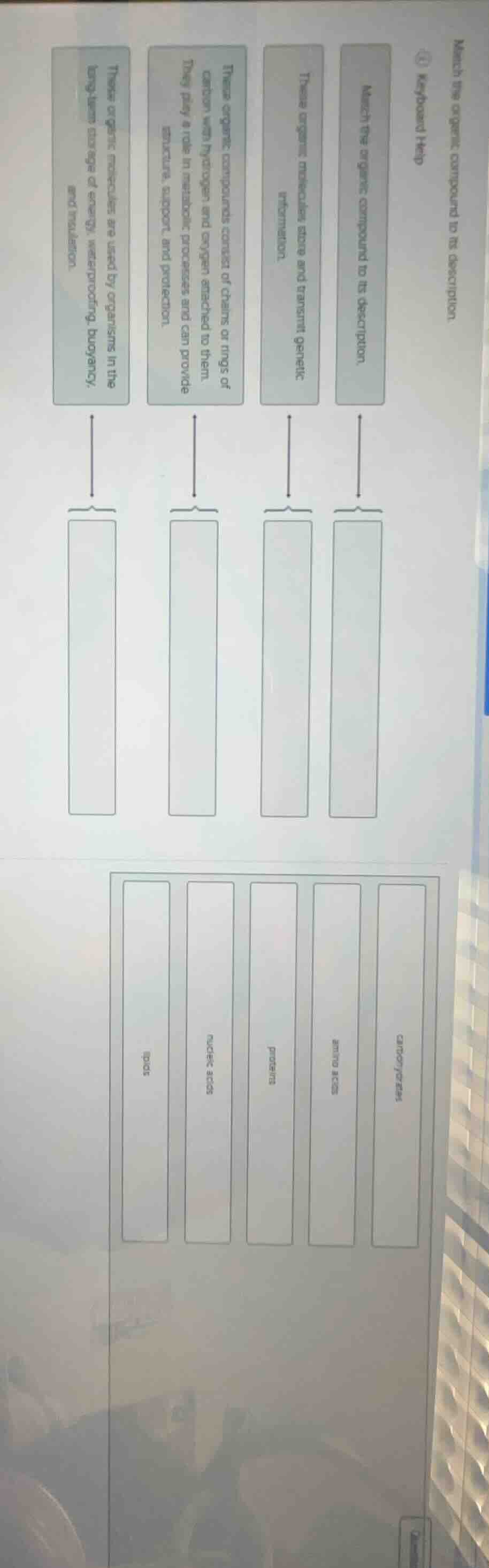
match the organic compound to its description. keyboard help match the organic compound to its description. these organic molecules store and transmit genetic information. these organic compounds consist of chains or rings of carbon with hydrogen and oxygen attached to them. they play a role in metabolic processes and can provide structure, support, and protection. these organic molecules are used by organisms in the long - term storage of energy, waterproofing, buoyancy, and insulation. carbohydrates amino acids proteins nucleic acids lipids
To solve this matching problem, we analyze the properties of each organic compound:
- Carbohydrates: These are organic compounds with carbon, hydrogen, and oxygen (in a 1:2:1 ratio, generally). They are a primary energy source and also play roles in metabolic processes (e.g., glycolysis) and can provide structure (e.g., cellulose in plants). So the description "These organic compounds consist of chains or rings of carbon with hydrogen and oxygen attached to them. They play a role in metabolic processes and can provide structure, support, and protection." matches carbohydrates.
- Nucleic Acids: Nucleic acids (DNA, RNA) store and transmit genetic information. So the description "These organic molecules store and transmit genetic information." matches nucleic acids.
- Proteins: Proteins are made of amino acids and are involved in structure, support, catalysis (enzymes), transport, etc. Wait, no—wait, the fourth description: Wait, let's re - check. Wait, the third description (the one about long - term energy, waterproofing, buoyancy) is for lipids. Wait, let's list all:
- Lipids: Used for long - term energy storage, waterproofing (e.g., waxes), buoyancy. So the description "These organic molecules are used by organisms in the long - term storage of energy, waterproofing, buoyancy, and insulation." matches lipids.
- Proteins: Made of amino acids (chains of amino acids), involved in structure, support, enzyme - catalyzed reactions (metabolism), transport, etc. Wait, the second description: "These organic compounds consist of chains or rings of carbon with hydrogen and oxygen attached to them. They play a role in metabolic processes and can provide structure, support, and protection." Wait, no—carbohydrates: carbohydrates have C, H, O. Proteins have C, H, O, N (and sometimes S). So let's correct:
- "These organic compounds consist of chains or rings of carbon with hydrogen and oxygen attached to them. They play a role in metabolic processes and can provide structure, support, and protection." → Carbohydrates (because carbohydrates have C, H, O in chains/rings, and function in energy, structure like cellulose).
- "These organic molecules store and transmit genetic information." → Nucleic Acids (DNA/RNA store and transmit genetic info).
- "These organic molecules are used by organisms in the long - term storage of energy, waterproofing, buoyancy, and insulation." → Lipids (fats, oils, waxes, etc. for long - term energy, waterproofing, buoyancy).
- The remaining description (the first one "Match the organic compound to its description" is the prompt, so the last compound is proteins? Wait, the compounds are carbohydrates, amino acids (no, amino acids are building blocks of proteins), nucleic acids, proteins, lipids. Wait, the options are carbohydrates, amino acids, nucleic acids, proteins, lipids. Wait, amino acids are the monomers of proteins. So:
- Carbohydrates: match the description about C, H, O chains/rings, metabolic role, structure.
- Nucleic Acids: match the genetic info storage.
- Lipids: match long - term energy, waterproofing.
- Proteins: Wait, maybe I made a mistake. Let's do it step by step:
- Description 1 (top left, the one with "These organic compounds consist of chains or rings of carbon with hydrogen and oxygen attached to them. They play a role in metabolic processes and can provide structure, support, and protection.") → Carbohydrates.
- Description 2 (the one with "These organic molecules store and transmit genetic information.") → Nucleic Acids.
- Des…

Snap & solve any problem in the app
Get step-by-step solutions on Sovi AI
Photo-based solutions with guided steps
Explore more problems and detailed explanations
To solve this matching problem, we analyze the properties of each organic compound:
- Carbohydrates: These are organic compounds with carbon, hydrogen, and oxygen (in a 1:2:1 ratio, generally). They are a primary energy source and also play roles in metabolic processes (e.g., glycolysis) and can provide structure (e.g., cellulose in plants). So the description "These organic compounds consist of chains or rings of carbon with hydrogen and oxygen attached to them. They play a role in metabolic processes and can provide structure, support, and protection." matches carbohydrates.
- Nucleic Acids: Nucleic acids (DNA, RNA) store and transmit genetic information. So the description "These organic molecules store and transmit genetic information." matches nucleic acids.
- Proteins: Proteins are made of amino acids and are involved in structure, support, catalysis (enzymes), transport, etc. Wait, no—wait, the fourth description: Wait, let's re - check. Wait, the third description (the one about long - term energy, waterproofing, buoyancy) is for lipids. Wait, let's list all:
- Lipids: Used for long - term energy storage, waterproofing (e.g., waxes), buoyancy. So the description "These organic molecules are used by organisms in the long - term storage of energy, waterproofing, buoyancy, and insulation." matches lipids.
- Proteins: Made of amino acids (chains of amino acids), involved in structure, support, enzyme - catalyzed reactions (metabolism), transport, etc. Wait, the second description: "These organic compounds consist of chains or rings of carbon with hydrogen and oxygen attached to them. They play a role in metabolic processes and can provide structure, support, and protection." Wait, no—carbohydrates: carbohydrates have C, H, O. Proteins have C, H, O, N (and sometimes S). So let's correct:
- "These organic compounds consist of chains or rings of carbon with hydrogen and oxygen attached to them. They play a role in metabolic processes and can provide structure, support, and protection." → Carbohydrates (because carbohydrates have C, H, O in chains/rings, and function in energy, structure like cellulose).
- "These organic molecules store and transmit genetic information." → Nucleic Acids (DNA/RNA store and transmit genetic info).
- "These organic molecules are used by organisms in the long - term storage of energy, waterproofing, buoyancy, and insulation." → Lipids (fats, oils, waxes, etc. for long - term energy, waterproofing, buoyancy).
- The remaining description (the first one "Match the organic compound to its description" is the prompt, so the last compound is proteins? Wait, the compounds are carbohydrates, amino acids (no, amino acids are building blocks of proteins), nucleic acids, proteins, lipids. Wait, the options are carbohydrates, amino acids, nucleic acids, proteins, lipids. Wait, amino acids are the monomers of proteins. So:
- Carbohydrates: match the description about C, H, O chains/rings, metabolic role, structure.
- Nucleic Acids: match the genetic info storage.
- Lipids: match long - term energy, waterproofing.
- Proteins: Wait, maybe I made a mistake. Let's do it step by step:
- Description 1 (top left, the one with "These organic compounds consist of chains or rings of carbon with hydrogen and oxygen attached to them. They play a role in metabolic processes and can provide structure, support, and protection.") → Carbohydrates.
- Description 2 (the one with "These organic molecules store and transmit genetic information.") → Nucleic Acids.
- Description 3 (the one with "These organic molecules are used by organisms in the long - term storage of energy, waterproofing, buoyancy, and insulation.") → Lipids.
- The remaining compound is Proteins, but wait, the options include amino acids? No, amino acids are the building blocks of proteins. Wait, maybe the "amino acids" is a distractor, and the correct matches are:
- "These organic compounds consist of chains or rings of carbon with hydrogen and oxygen attached to them. They play a role in metabolic processes and can provide structure, support, and protection." → Carbohydrates
- "These organic molecules store and transmit genetic information." → Nucleic Acids
- "These organic molecules are used by organisms in the long - term storage of energy, waterproofing, buoyancy, and insulation." → Lipids
- The remaining (the first "Match the organic compound to its description" is the header, so the fourth box (the one with the protein - like function) would be Proteins, but since the options are carbohydrates, amino acids, nucleic acids, proteins, lipids:
Wait, maybe the correct matches are:
- Carbohydrates - "These organic compounds consist of chains or rings of carbon with hydrogen and oxygen attached to them. They play a role in metabolic processes and can provide structure, support, and protection."
- Nucleic Acids - "These organic molecules store and transmit genetic information."
- Lipids - "These organic molecules are used by organisms in the long - term storage of energy, waterproofing, buoyancy, and insulation."
- Proteins - Wait, no, maybe the "amino acids" is a mistake. Wait, the options are carbohydrates, amino acids, nucleic acids, proteins, lipids. So:
- Carbohydrates: matches the description about C, H, O chains/rings, metabolic role, structure.
- Nucleic Acids: matches genetic info.
- Lipids: matches long - term energy, waterproofing.
- Proteins: made of amino acids, but the option is proteins. Wait, maybe the second description is for proteins? No, proteins have N. So perhaps the initial analysis had an error. Let's start over:
Organic compounds:
- Carbohydrates: C, H, O (1:2:1), energy, structure (cellulose). So the description "These organic compounds consist of chains or rings of carbon with hydrogen and oxygen attached to them. They play a role in metabolic processes and can provide structure, support, and protection." → Carbohydrates.
- Nucleic Acids: Store/transmit genetic info → "These organic molecules store and transmit genetic information." → Nucleic Acids.
- Lipids: Long - term energy, waterproofing, buoyancy → "These organic molecules are used by organisms in the long - term storage of energy, waterproofing, buoyancy, and insulation." → Lipids.
- Proteins: Made of amino acids, involved in structure, enzymes (metabolism), transport, etc. But the remaining option is proteins and amino acids. Wait, amino acids are the monomers of proteins. So maybe the "amino acids" is a mistake, and the correct matches are:
- Carbohydrates
- Nucleic Acids
- Lipids
- Proteins (but the option is proteins)
But according to the options given (carbohydrates, amino acids, nucleic acids, proteins, lipids), the matches are:
- "These organic compounds consist of chains or rings of carbon with hydrogen and oxygen attached to them. They play a role in metabolic processes and can provide structure, support, and protection." → Carbohydrates
- "These organic molecules store and transmit genetic information." → Nucleic Acids
- "These organic molecules are used by organisms in the long - term storage of energy, waterproofing, buoyancy, and insulation." → Lipids
Final Matches:
- "These organic compounds consist of chains or rings of carbon with hydrogen and oxygen attached to them. They play a role in metabolic processes and can provide structure, support, and protection." → Carbohydrates
- "These organic molecules store and transmit genetic information." → Nucleic Acids
- "These organic molecules are used by organisms in the long - term storage of energy, waterproofing, buoyancy, and insulation." → Lipids