QUESTION IMAGE
Question
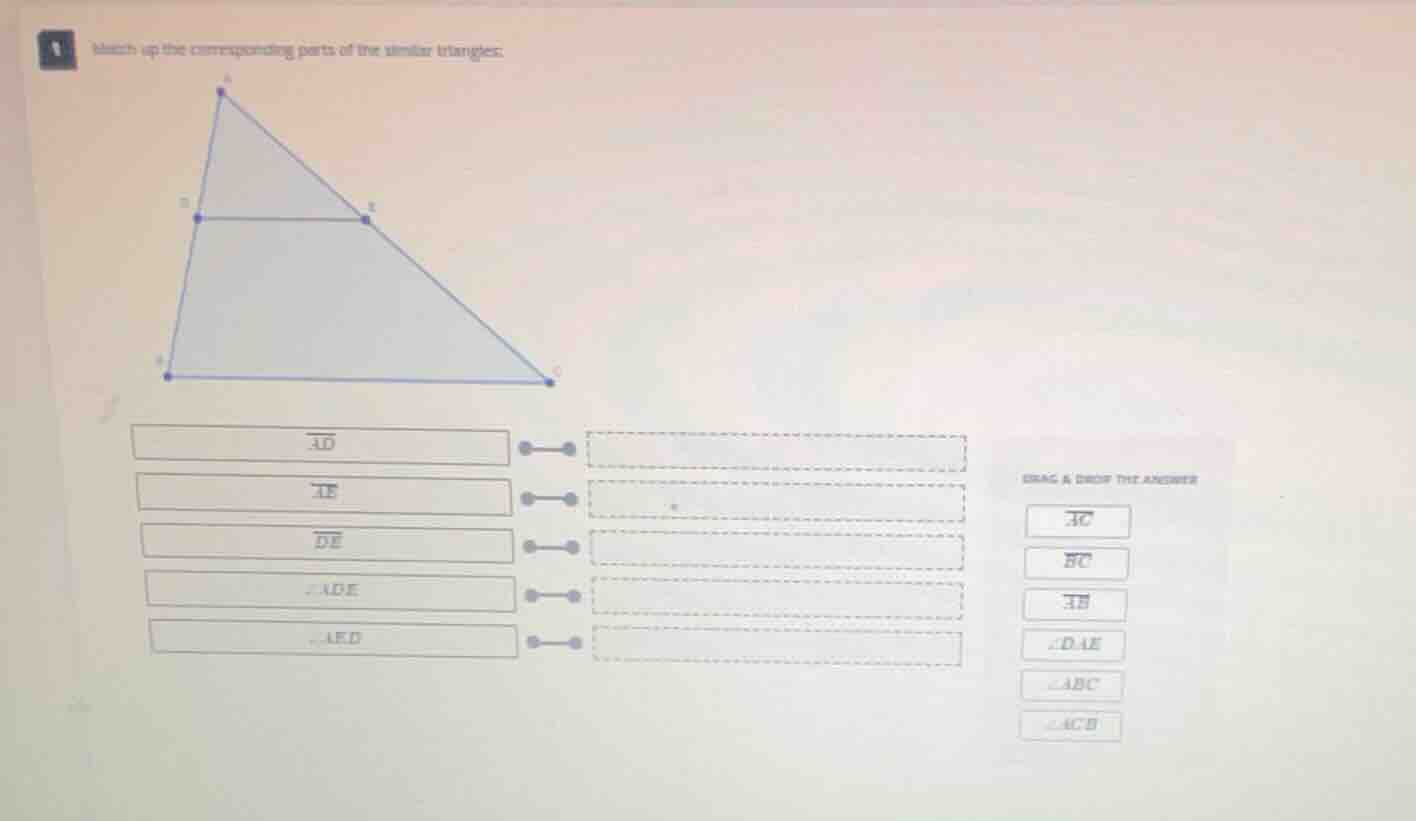
1 match up the corresponding parts of the similar triangles: drag & drop the answers overline{ac} overline{bc} overline{ab} angle dae angle abc angle acb
To match the corresponding parts of similar triangles, we use the properties of similar triangles (corresponding angles are equal, corresponding sides are proportional and in the same order). The triangles here are \(\triangle ADE\) and \(\triangle ABC\) (since \(DE \parallel BC\) by the diagram, so by the Basic Proportionality Theorem or AA similarity, they are similar).
Step 1: Match \(\overline{AD}\)
In similar triangles \(\triangle ADE \sim \triangle ABC\), the corresponding side to \(\overline{AD}\) is \(\overline{AB}\)? Wait, no, wait. Wait, the vertices: \(A\) corresponds to \(A\), \(D\) corresponds to \(B\), \(E\) corresponds to \(C\)? Wait, no, looking at the diagram, \(DE\) is parallel to \(BC\), so \(\triangle ADE \sim \triangle ABC\) by AA (angle at \(A\) is common, and \(\angle ADE = \angle ABC\) because \(DE \parallel BC\), corresponding angles). So:
- \(\overline{AD}\) corresponds to \(\overline{AB}\)? Wait, no, the options given are \(\overline{AC}\), \(\overline{BC}\), \(\overline{AB}\), \(\angle DAE\), \(\angle ABC\), \(\angle ACB\). Wait, let's re - examine:
Wait, the left side has \(\overline{AD}\), \(\overline{AE}\), \(\overline{DE}\), \(\angle ADE\), \(\angle AED\). The right side options are \(\overline{AC}\), \(\overline{BC}\), \(\overline{AB}\), \(\angle DAE\) (wait, no, \(\angle DAE\) is the same as \(\angle BAC\) since it's the common angle), \(\angle ABC\), \(\angle ACB\).
Wait, let's correct the similarity: \(\triangle ADE \sim \triangle ABC\) (order of vertices: \(A\) - \(A\), \(D\) - \(B\), \(E\) - \(C\)). So:
- Corresponding sides:
- \(\overline{AD}\) corresponds to \(\overline{AB}\)
- \(\overline{AE}\) corresponds to \(\overline{AC}\)
- \(\overline{DE}\) corresponds to \(\overline{BC}\)
- Corresponding angles:
- \(\angle ADE\) corresponds to \(\angle ABC\)
- \(\angle AED\) corresponds to \(\angle ACB\)
- \(\angle DAE\) corresponds to \(\angle BAC\) (but \(\angle DAE\) is the same as \(\angle BAC\) since it's the common angle)
Wait, but the options for sides: \(\overline{AC}\), \(\overline{BC}\), \(\overline{AB}\). For angles: \(\angle DAE\) (which is \(\angle BAC\)), \(\angle ABC\), \(\angle ACB\).
So:
- \(\overline{AD}\) should match with \(\overline{AB}\)
- \(\overline{AE}\) should match with \(\overline{AC}\)
- \(\overline{DE}\) should match with \(\overline{BC}\)
- \(\angle ADE\) should match with \(\angle ABC\)
- \(\angle AED\) should match with \(\angle ACB\)

Snap & solve any problem in the app
Get step-by-step solutions on Sovi AI
Photo-based solutions with guided steps
Explore more problems and detailed explanations
- \(\overline{AD}\) \(\longleftrightarrow\) \(\overline{AB}\)
- \(\overline{AE}\) \(\longleftrightarrow\) \(\overline{AC}\)
- \(\overline{DE}\) \(\longleftrightarrow\) \(\overline{BC}\)
- \(\angle ADE\) \(\longleftrightarrow\) \(\angle ABC\)
- \(\angle AED\) \(\longleftrightarrow\) \(\angle ACB\)
(If we follow the drag - and - drop options:
- \(\overline{AD}\) matches \(\overline{AB}\)
- \(\overline{AE}\) matches \(\overline{AC}\)
- \(\overline{DE}\) matches \(\overline{BC}\)
- \(\angle ADE\) matches \(\angle ABC\)
- \(\angle AED\) matches \(\angle ACB\))