QUESTION IMAGE
Question
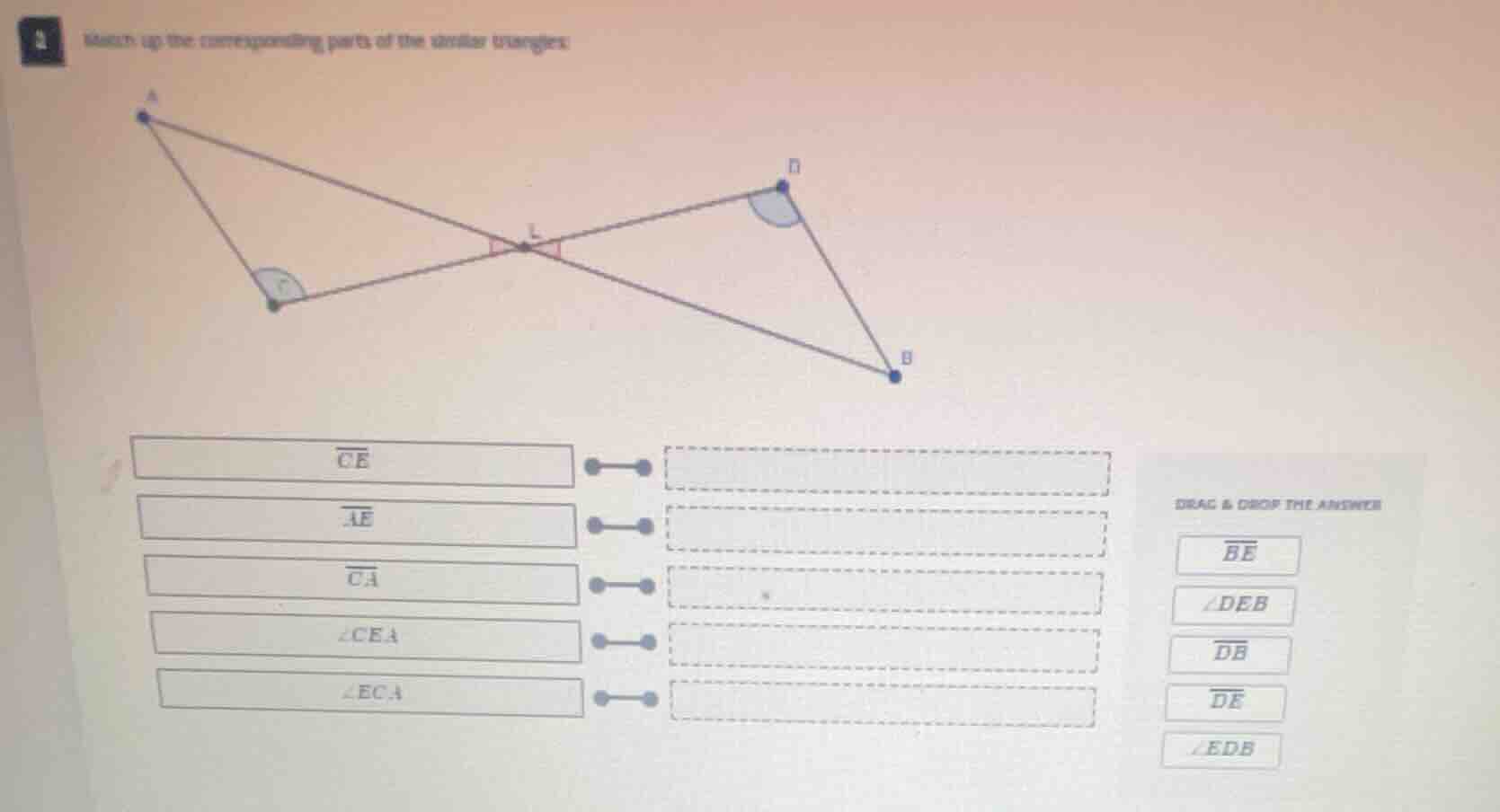
match up the corresponding parts of the similar triangles
(overline{ce})
(overline{ae})
(overline{ca})
(angle cea)
(angle eca)
drag & drop the answer
(overline{be})
(angle deb)
(overline{db})
(overline{de})
(angle edb)
To match the corresponding parts of similar triangles, we use the properties of similar triangles (corresponding sides and angles are equal or proportional). Let's analyze each part:
Step 1: Match \(\overline{CE}\)
In similar triangles, corresponding sides are in proportion. Looking at the triangles, \(\overline{CE}\) should correspond to \(\overline{DE}\) (since they are corresponding sides of the similar triangles). Wait, no, wait. Wait, let's check the labels. Wait, the triangles are \(\triangle CEA\) and \(\triangle DEB\) maybe? Wait, the right angles at \(L\) (vertical angles and right angles, so triangles are similar by AA). So:
- \(\overline{CE}\) corresponds to \(\overline{DE}\)? Wait, no, maybe \(\overline{CE}\) and \(\overline{BE}\)? Wait, no, let's re-examine. Wait, the left triangle has vertices \(C\), \(A\), \(E\) (with right angle at \(L\), so \(\angle CEA\) is a right angle? Wait, the right angles at \(L\) (the intersection point, with right angle marks). So \(\triangle CEL\) and \(\triangle DEL\)? No, maybe \(\triangle CEA\) and \(\triangle DEB\). So:
- \(\overline{CE}\) corresponds to \(\overline{DE}\)? No, wait, the options are \(\overline{BE}\), \(\angle DEB\), \(\overline{DB}\), \(\overline{DE}\), \(\angle EDB\).
Wait, let's list each left part and find the corresponding right part:
- \(\overline{CE}\): Corresponding side should be \(\overline{DE}\) (since in similar triangles, corresponding sides are proportional. If \(\triangle CEA \sim \triangle DEB\), then \(CE\) corresponds to \(DE\)).
- \(\overline{AE}\): Corresponding side should be \(\overline{BE}\) (since \(AE\) in \(\triangle CEA\) corresponds to \(BE\) in \(\triangle DEB\)).
- \(\overline{CA}\): Corresponding side should be \(\overline{DB}\) (since \(CA\) in \(\triangle CEA\) corresponds to \(DB\) in \(\triangle DEB\)).
- \(\angle CEA\): Corresponding angle should be \(\angle DEB\) (since \(\angle CEA\) and \(\angle DEB\) are corresponding angles, both right angles? Wait, the right angle marks at \(L\), so \(\angle CEA\) and \(\angle DEB\) are equal, corresponding angles).
- \(\angle ECA\): Corresponding angle should be \(\angle EDB\) (since \(\angle ECA\) and \(\angle EDB\) are corresponding angles in similar triangles).
Let's verify:
- \(\overline{CE}\) and \(\overline{DE}\): Yes, corresponding sides.
- \(\overline{AE}\) and \(\overline{BE}\): Yes, corresponding sides.
- \(\overline{CA}\) and \(\overline{DB}\): Yes, corresponding sides.
- \(\angle CEA\) and \(\angle DEB\): Yes, corresponding angles (both right angles, or equal angles).
- \(\angle ECA\) and \(\angle EDB\): Yes, corresponding angles (since triangles are similar, corresponding angles are equal).
So the matches are:
- \(\overline{CE}\) → \(\overline{DE}\)
- \(\overline{AE}\) → \(\overline{BE}\)
- \(\overline{CA}\) → \(\overline{DB}\)
- \(\angle CEA\) → \(\angle DEB\)
- \(\angle ECA\) → \(\angle EDB\)
Step 1: Match \(\overline{CE}\)
\(\overline{CE}\) corresponds to \(\overline{DE}\) (corresponding side in similar triangles).
\(\overline{CE}\) → \(\overline{DE}\)
Step 2: Match \(\overline{AE}\)
\(\overline{AE}\) corresponds to \(\overline{BE}\) (corresponding side in similar triangles).
\(\overline{AE}\) → \(\overline{BE}\)
Step 3: Match \(\overline{CA}\)
\(\overline{CA}\) corresponds to \(\overline{DB}\) (corresponding side in similar triangles).
\(\overline{CA}\) → \(\overline{DB}\)
Step 4: Match \(\angle CEA\)
\(\angle CEA\) corresponds to \(\angle DEB\) (corresponding angle in similar triangles).
\(\angle CEA\) → \(\angle DEB\)
Step 5: Ma…

Snap & solve any problem in the app
Get step-by-step solutions on Sovi AI
Photo-based solutions with guided steps
Explore more problems and detailed explanations
- \(\overline{CE}\) : \(\overline{DE}\)
- \(\overline{AE}\) : \(\overline{BE}\)
- \(\overline{CA}\) : \(\overline{DB}\)
- \(\angle CEA\) : \(\angle DEB\)
- \(\angle ECA\) : \(\angle EDB\)