QUESTION IMAGE
Question
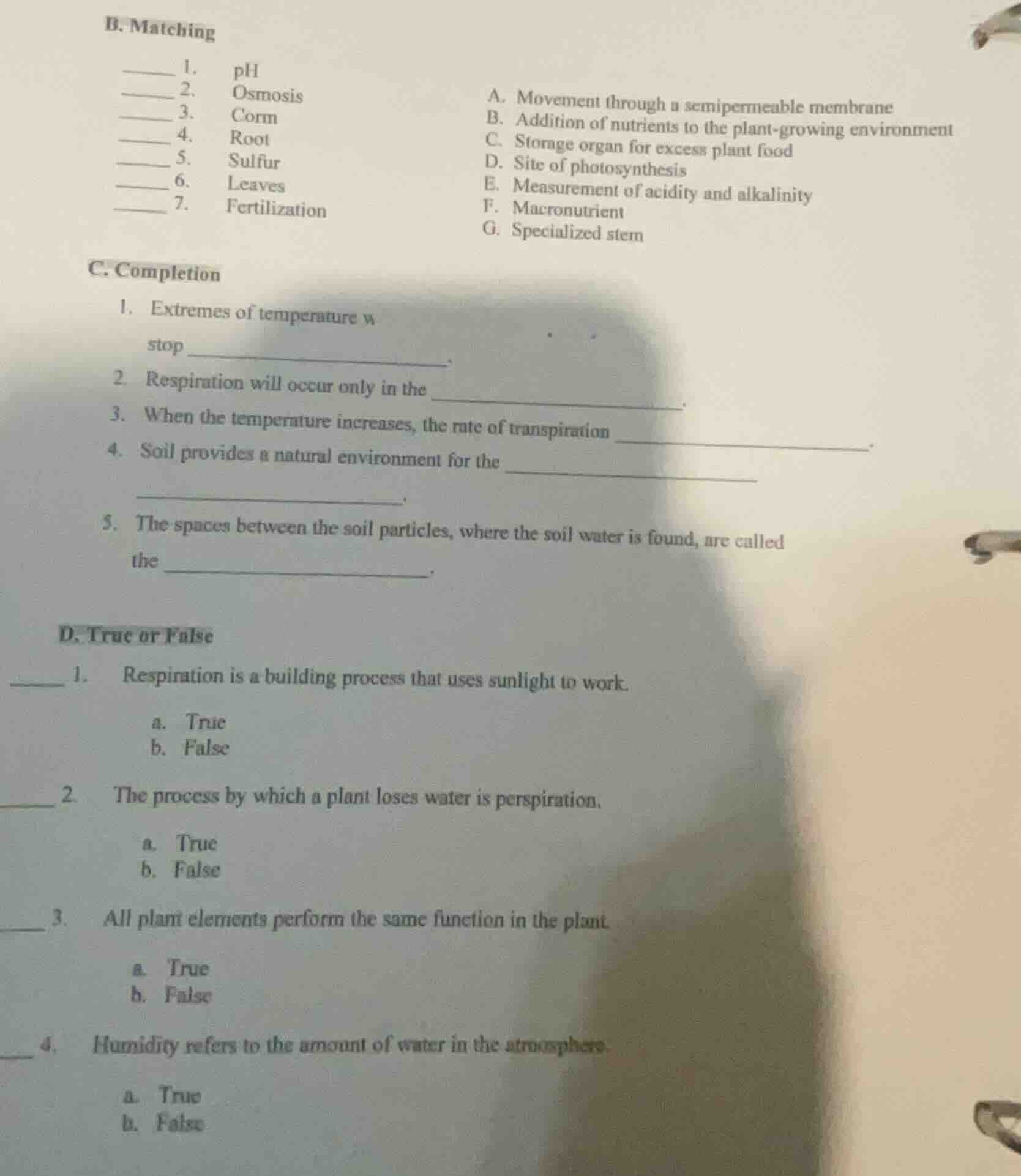
b. matching
______ 1. ph
______ 2. osmosis
______ 3. corn
______ 4. root
______ 5. sulfur
______ 6. leaves
______ 7. fertilization
a. movement through a semipermeable membrane
b. addition of nutrients to the plant - growing environment
c. storage organ for excess plant food
d. site of photosynthesis
e. measurement of acidity and alkalinity
f. macronutrient
g. specialized stem
c. completion
- extremes of temperature will stop ________.
- respiration will occur only in the ________.
- when the temperature increases, the rate of transpiration ________.
- soil provides a natural environment for the ________.
- the spaces between the soil particles, where the soil water is found, are called the ________.
d. true or false
______ 1. respiration is a building process that uses sunlight to work.
a. true
b. false
______ 2. the process by which a plant loses water is perspiration.
a. true
b. false
______ 3. all plant elements perform the same function in the plant.
a. true
b. false
______ 4. humidity refers to the amount of water in the atmosphere.
a. true
b. false
B. Matching
- pH - E (Measurement of acidity and alkalinity)
- Osmosis - A (Movement through a semipermeable membrane)
- Corn - G (Specialized stem)
- Root - C (Storage organ for excess plant food)
- Sulfur - F (Macronutrient)
- Leaves - D (Site of photosynthesis)
- Fertilization - B (Addition of nutrients to the plant - growing environment)
C. Completion
- Extremes of temperature will stop photosynthesis/respiration (biological processes in plants are affected by extreme temp).
- Respiration will occur only in the presence of oxygen (or living cells) (respiration is a cellular process, aerobic respiration needs O₂).
- When the temperature increases, the rate of transpiration increases (higher temp increases evaporation from leaves).
- Soil provides a natural environment for the growth of plant roots (or plant growth) (soil supports plant root systems).
- The spaces between the soil particles, where the soil water is found, are called the pore spaces (definition of soil pore spaces).
D. True or False
- Respiration is a building process that uses sunlight to work. - b. False (Respiration is a breakdown process, photosynthesis uses sunlight).
- The process by which a plant loses water is perspiration. - b. False (Plant water loss is transpiration, perspiration is in animals).
- All plant elements perform the same function in the plant. - b. False (Different plant parts/elements have different functions).
- Humidity refers to the amount of water in the atmosphere. - a. True (Definition of humidity).

Snap & solve any problem in the app
Get step-by-step solutions on Sovi AI
Photo-based solutions with guided steps
Explore more problems and detailed explanations
B. Matching
- pH - E (Measurement of acidity and alkalinity)
- Osmosis - A (Movement through a semipermeable membrane)
- Corn - G (Specialized stem)
- Root - C (Storage organ for excess plant food)
- Sulfur - F (Macronutrient)
- Leaves - D (Site of photosynthesis)
- Fertilization - B (Addition of nutrients to the plant - growing environment)
C. Completion
- Extremes of temperature will stop photosynthesis/respiration (biological processes in plants are affected by extreme temp).
- Respiration will occur only in the presence of oxygen (or living cells) (respiration is a cellular process, aerobic respiration needs O₂).
- When the temperature increases, the rate of transpiration increases (higher temp increases evaporation from leaves).
- Soil provides a natural environment for the growth of plant roots (or plant growth) (soil supports plant root systems).
- The spaces between the soil particles, where the soil water is found, are called the pore spaces (definition of soil pore spaces).
D. True or False
- Respiration is a building process that uses sunlight to work. - b. False (Respiration is a breakdown process, photosynthesis uses sunlight).
- The process by which a plant loses water is perspiration. - b. False (Plant water loss is transpiration, perspiration is in animals).
- All plant elements perform the same function in the plant. - b. False (Different plant parts/elements have different functions).
- Humidity refers to the amount of water in the atmosphere. - a. True (Definition of humidity).