QUESTION IMAGE
Question
math: graphing a budget equation
part ii: practice problems
complete the following practice problems by showing your work in the space provided. then, write your final solution in the answer boxes.
note: remember to use appropriate scales for your x and y axes. you can try to:
- adjust the units on each axis and create your own intervals so that the data fits within the graph. (ex: each unit represents 2)
- use a separate graph paper
teacher tip: pre - label intervals for the x and y axes if your students need support for graphing
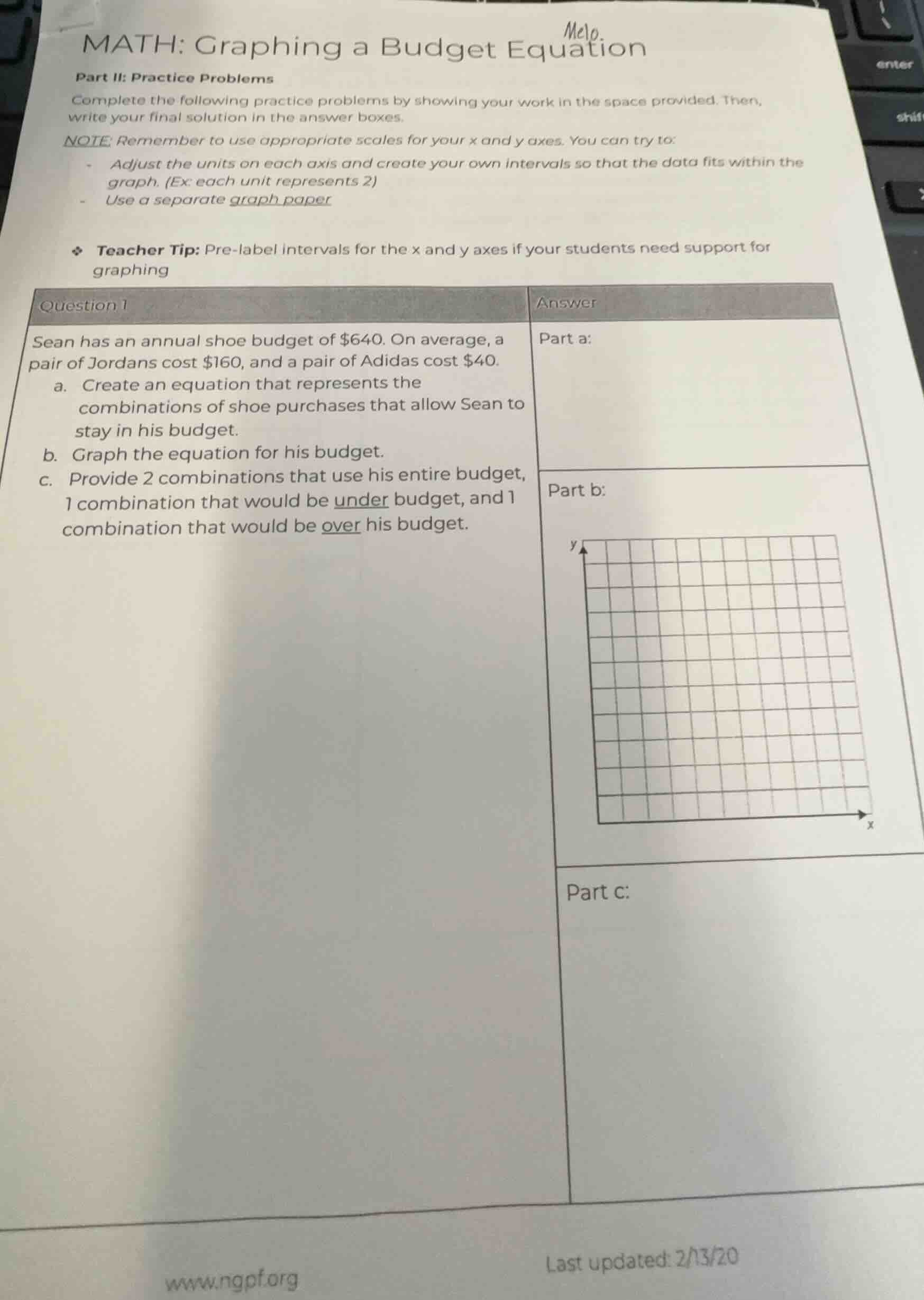
question 1
sean has an annual shoe budget of $640. on average, a pair of jordans cost $160, and a pair of adidas cost $40.
a. create an equation that represents the combinations of shoe purchases that allow sean to stay in his budget.
b. graph the equation for his budget.
c. provide 2 combinations that use his entire budget, 1 combination that would be under budget, and 1 combination that would be over his budget.
answer
part a:
part b:
graph with x and y axes
part c:
Step1: Define variables for shoes
Let $x$ = number of Jordans, $y$ = number of Adidas.
Step2: Set up budget equation
Total cost = cost of Jordans + cost of Adidas, equal to budget.
$$160x + 40y = 640$$
Simplify by dividing by 40:
$$4x + y = 16$$
Or rearrange for graphing:
$$y = -4x + 16$$
Step3: Find intercepts for graph
x-intercept (y=0):
$$4x = 16 \implies x=4$$
Point: $(4, 0)$
y-intercept (x=0):
$$y = 16$$
Point: $(0, 16)$
Step4: Identify budget combinations
Full budget: Use intercepts or solve for pairs.
Under budget: Total cost < $640.
Over budget: Total cost > $640.

Snap & solve any problem in the app
Get step-by-step solutions on Sovi AI
Photo-based solutions with guided steps
Explore more problems and detailed explanations
Part a:
$\boldsymbol{160x + 40y = 640}$ (or simplified $\boldsymbol{4x + y = 16}$)
Part b:
To graph:
- Label the x-axis "Number of Jordans" and y-axis "Number of Adidas".
- Plot the x-intercept $(4, 0)$ and y-intercept $(0, 16)$.
- Draw a straight line connecting the two points (this line represents all combinations that use the full budget).
Part c:
- Full budget combinations: (4, 0) [4 Jordans, 0 Adidas], (0, 16) [0 Jordans, 16 Adidas]
- Under budget combination: (1, 10) [1 Jordan, 10 Adidas; total cost = $160 + 400 = \$560 < \$640$]
- Over budget combination: (5, 0) [5 Jordans, 0 Adidas; total cost = $800 > \$640$]