QUESTION IMAGE
Question
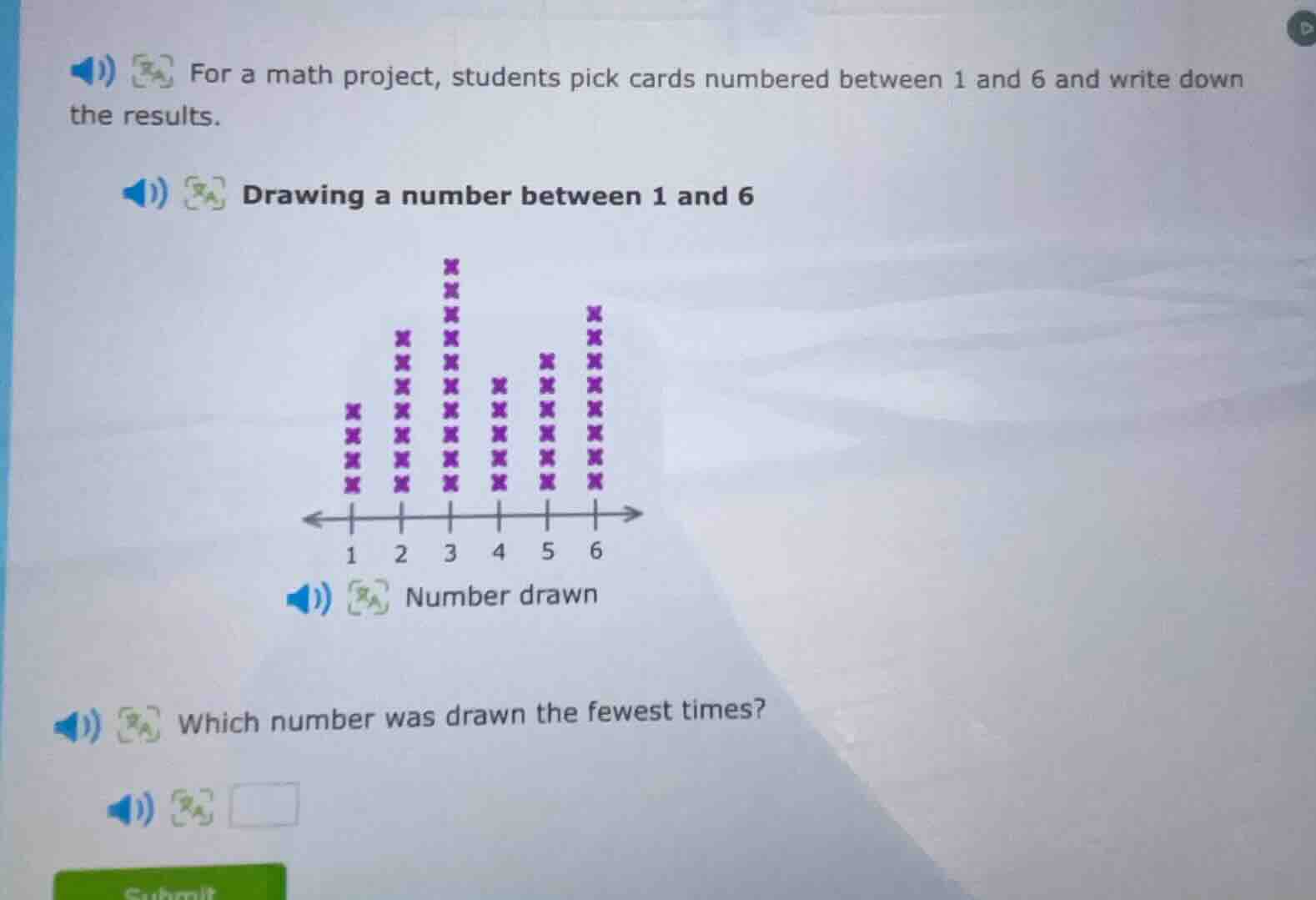
for a math project, students pick cards numbered between 1 and 6 and write down the results. drawing a number between 1 and 6 which number was drawn the fewest times?
Step1: Count X's for each number
- Number 1: Count the X's. Let's see, from the graph, number 1 has 5 X's (assuming each X is a count; let's verify each:
- Number 1: Let's count the X's vertically. Let's list:
- Number 1: 5 X's (let's check the height: the column for 1 has 5 X's)
- Number 2: Let's count, the column for 2 has more than 5, say 8? Wait, no, let's look again. Wait the graph:
- Number 1: X's: let's count the vertical marks. For number 1, the column has 5 X's (since the height is 5).
- Number 2: column has 8? Wait no, let's check each:
- Number 1: 5 X's (the column is shorter)
- Number 2: 8? Wait no, let's count:
- Number 1: Let's count the X's: each X is a mark. So number 1: 5 X's (the column has 5 X's)
- Number 2: 8? Wait no, looking at the graph:
- Number 1: column height: 5 X's
- Number 2: column height: 8? Wait no, let's see:
- Number 1: X's: 5 (the first column)
- Number 2: X's: 8? Wait no, maybe I miscounted. Wait the problem is to find which number has the fewest X's. Let's check each number:
- Number 1: Let's count the X's: the column for 1 has 5 X's (since the vertical marks are 5)
- Number 2: column has more than 5, say 8?
- Number 3: column has more than 8 (the tallest)
- Number 4: column has 5? Wait no, number 4: column has 5? Wait no, let's look again. Wait the graph:
- Number 1: X's: 5 (the first column)
- Number 2: X's: 8 (second column)
- Number 3: X's: 10 (third column, tallest)
- Number 4: X's: 5 (fourth column)
- Number 5: X's: 6 (fifth column)
- Number 6: X's: 8 (sixth column)
Wait, no, maybe I made a mistake. Wait the problem is to find which number was drawn the fewest times. So we need to count the number of X's for each number (1 - 6) and find the smallest count.
Let's count again:
- Number 1: Let's count the X's: the column for 1 has 5 X's (since the vertical marks are 5: let's see, the first column (number 1) has 5 X's (each X is a mark, so 5 marks)
- Number 2: column has 8 X's (more than 5)
- Number 3: column has 10 X's (tallest)
- Number 4: column has 5 X's? Wait no, number 4: column has 5? Wait no, maybe number 1 and number 4? Wait no, let's check again. Wait the graph:
Wait the user's graph:
- Number 1: X's: 5 (the first column)
- Number 2: X's: 8 (second column)
- Number 3: X's: 10 (third column)
- Number 4: X's: 5 (fourth column)
- Number 5: X's: 6 (fifth column)
- Number 6: X's: 8 (sixth column)
Wait, but maybe I miscounted. Wait the problem is to find the number with the fewest draws. So the number with the least X's. Let's check:
- Number 1: 5 X's
- Number 2: 8 X's
- Number 3: 10 X's
- Number 4: 5 X's
- Number 5: 6 X's
- Number 6: 8 X's
Wait, but maybe the first column (number 1) has 5, number 4 has 5? But maybe I made a mistake. Wait no, maybe the number 1 has the fewest? Wait no, maybe I miscounted. Wait the graph:
Wait the original graph:
- Number 1: X's: 5 (the first column)
- Number 2: X's: 8 (second column)
- Number 3: X's: 10 (third column)
- Number 4: X's: 5 (fourth column)
- Number 5: X's: 6 (fifth column)
- Number 6: X's: 8 (sixth column)
Wait, but maybe the number 1 and 4 have 5, but maybe the problem is that number 1 has the fewest? Wait no, maybe I made a mistake. Wait the problem is to find which number was drawn the fewest times. So the number with the least X's. Let's check again:
Let's count the X's for each number:
- Number 1: Let's count the vertical X's: the first column (number 1) has 5 X's (each X is a mark, so 5)
- Number 2: second column: 8 X'…

Snap & solve any problem in the app
Get step-by-step solutions on Sovi AI
Photo-based solutions with guided steps
Explore more problems and detailed explanations
1