QUESTION IMAGE
Question
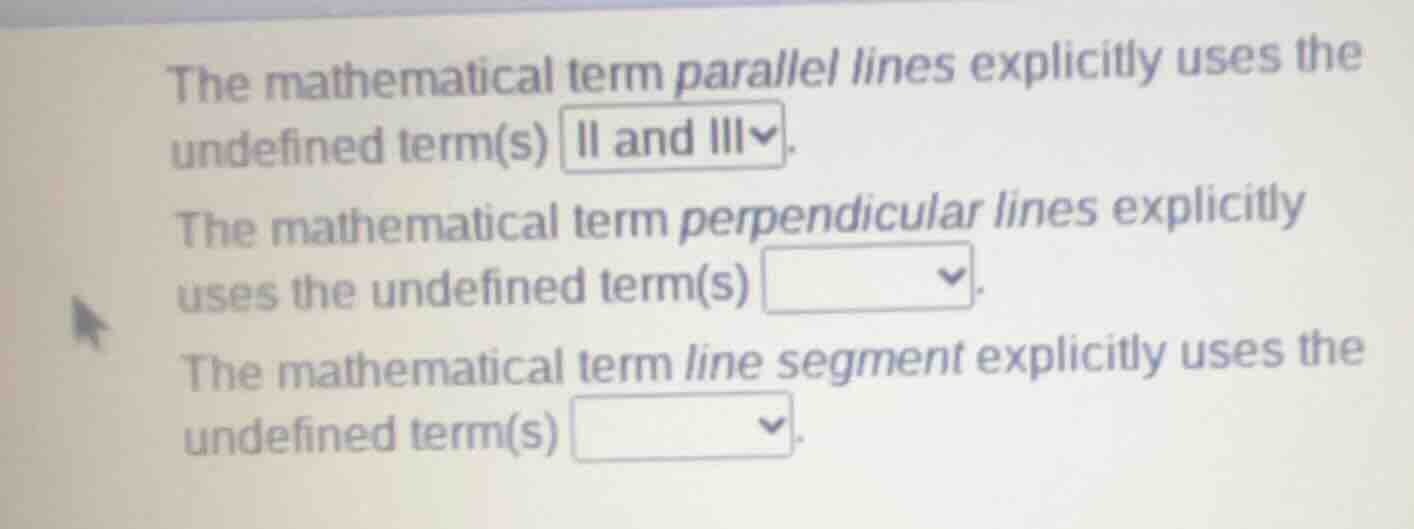
the mathematical term parallel lines explicitly uses the undefined term(s) ii and iii. the mathematical term perpendicular lines explicitly uses the undefined term(s) . the mathematical term line segment explicitly uses the undefined term(s) .
To solve this, we recall the undefined terms in geometry: point, line, and plane.
For "perpendicular lines":
Perpendicular lines are defined as two lines that intersect at a right angle (90 degrees). The definition relies on the undefined term "line" (since we need lines to be perpendicular) and "point" (where they intersect). But typically, the key undefined term here is "line" (and implicitly "point" for intersection), but more precisely, the undefined terms used are "line" (since perpendicularity is a relationship between lines) and "point" (where they meet). However, in standard geometry, the undefined terms for perpendicular lines are "line" (and "point" for intersection). But often, the primary undefined term here is "line" (and "point" as the intersection point). But let's think again: undefined terms are point, line, plane. Perpendicular lines: we need lines (undefined term) and the concept of intersection (which uses point, an undefined term). But the main undefined terms here are "line" and "point"? Wait, no—let's check. The definition of perpendicular lines: two lines that intersect at a right angle. So the undefined terms are "line" (since lines are undefined) and "point" (since intersection is a point, which is undefined). But maybe the options (even though not shown) would have "line" and "point" or similar. Wait, maybe the dropdown has options like I (point), II (line), III (plane). Let's assume:
For perpendicular lines: we need lines (II) and the point of intersection (I). So the undefined terms are I (point) and II (line).
For line segment: a line segment is part of a line between two points. So the undefined terms are "line" (II) and "point" (I), because a line segment is defined by two points (I) on a line (II).
But since the original problem's first part had "II and III" (maybe II is line, III is plane? No, plane is another undefined term. Wait, maybe the undefined terms are: I: point, II: line, III: plane.
So:
- Parallel lines: two lines (II) that never meet, so they use II (line) and maybe III (plane, but no—parallel lines are in a plane, but the undefined terms for parallel lines are line (II) and plane (III)? No, parallel lines are lines (II) in a plane (III) that don't intersect. So first part: II and III (line and plane).
Then, perpendicular lines: two lines (II) that intersect at a point (I), so they use I (point) and II (line).
Line segment: part of a line (II) between two points (I), so uses I (point) and II (line).
Assuming the dropdown options are I (point), II (line), III (plane):
- Perpendicular lines: uses I (point) and II (line) (since they intersect at a point, and are lines).
- Line segment: uses I (point) and II (line) (since it's between two points on a line).
But let's confirm:
Undefined terms in geometry: point (I), line (II), plane (III).
- Perpendicular lines: lines (II) intersecting at a point (I) at 90 degrees. So undefined terms: I (point) and II (line).
- Line segment: a line segment is a part of a line (II) with two endpoints (points, I). So undefined terms: I (point) and II (line).
So:
- Perpendicular lines: undefined terms are I and II (point and line).
- Line segment: undefined terms are I and II (point and line).
But since the first problem had "II and III" (maybe for parallel lines, which are in a plane, so line (II) and plane (III)), then:
- Perpendicular lines: intersecting lines (so line (II)) and point (I) of intersection. So I and II.
- Line segment: line (II) and two points (I), so I and II.
So the answers would be:
- Perpendicular lines: I and II (…

Snap & solve any problem in the app
Get step-by-step solutions on Sovi AI
Photo-based solutions with guided steps
Explore more problems and detailed explanations
To solve this, we recall the undefined terms in geometry: point, line, and plane.
For "perpendicular lines":
Perpendicular lines are defined as two lines that intersect at a right angle (90 degrees). The definition relies on the undefined term "line" (since we need lines to be perpendicular) and "point" (where they intersect). But typically, the key undefined term here is "line" (and implicitly "point" for intersection), but more precisely, the undefined terms used are "line" (since perpendicularity is a relationship between lines) and "point" (where they meet). However, in standard geometry, the undefined terms for perpendicular lines are "line" (and "point" for intersection). But often, the primary undefined term here is "line" (and "point" as the intersection point). But let's think again: undefined terms are point, line, plane. Perpendicular lines: we need lines (undefined term) and the concept of intersection (which uses point, an undefined term). But the main undefined terms here are "line" and "point"? Wait, no—let's check. The definition of perpendicular lines: two lines that intersect at a right angle. So the undefined terms are "line" (since lines are undefined) and "point" (since intersection is a point, which is undefined). But maybe the options (even though not shown) would have "line" and "point" or similar. Wait, maybe the dropdown has options like I (point), II (line), III (plane). Let's assume:
For perpendicular lines: we need lines (II) and the point of intersection (I). So the undefined terms are I (point) and II (line).
For line segment: a line segment is part of a line between two points. So the undefined terms are "line" (II) and "point" (I), because a line segment is defined by two points (I) on a line (II).
But since the original problem's first part had "II and III" (maybe II is line, III is plane? No, plane is another undefined term. Wait, maybe the undefined terms are: I: point, II: line, III: plane.
So:
- Parallel lines: two lines (II) that never meet, so they use II (line) and maybe III (plane, but no—parallel lines are in a plane, but the undefined terms for parallel lines are line (II) and plane (III)? No, parallel lines are lines (II) in a plane (III) that don't intersect. So first part: II and III (line and plane).
Then, perpendicular lines: two lines (II) that intersect at a point (I), so they use I (point) and II (line).
Line segment: part of a line (II) between two points (I), so uses I (point) and II (line).
Assuming the dropdown options are I (point), II (line), III (plane):
- Perpendicular lines: uses I (point) and II (line) (since they intersect at a point, and are lines).
- Line segment: uses I (point) and II (line) (since it's between two points on a line).
But let's confirm:
Undefined terms in geometry: point (I), line (II), plane (III).
- Perpendicular lines: lines (II) intersecting at a point (I) at 90 degrees. So undefined terms: I (point) and II (line).
- Line segment: a line segment is a part of a line (II) with two endpoints (points, I). So undefined terms: I (point) and II (line).
So:
- Perpendicular lines: undefined terms are I and II (point and line).
- Line segment: undefined terms are I and II (point and line).
But since the first problem had "II and III" (maybe for parallel lines, which are in a plane, so line (II) and plane (III)), then:
- Perpendicular lines: intersecting lines (so line (II)) and point (I) of intersection. So I and II.
- Line segment: line (II) and two points (I), so I and II.
So the answers would be:
- Perpendicular lines: I and II (point and line)
- Line segment: I and II (point and line)
But since the original problem's first dropdown was "II and III" (maybe II is line, III is plane), then:
Wait, maybe the first part: parallel lines are lines (II) in a plane (III) that don't intersect, so II (line) and III (plane). Then:
- Perpendicular lines: lines (II) that intersect at a point (I), so I (point) and II (line).
- Line segment: part of a line (II) between two points (I), so I (point) and II (line).
So, assuming the dropdown options are I (point), II (line), III (plane):
- Perpendicular lines: I and II
- Line segment: I and II
But since the user's problem shows dropdowns, but we can infer:
For "perpendicular lines", the undefined terms are "point" (I) and "line" (II), so I and II.
For "line segment", the undefined terms are "point" (I) and "line" (II), so I and II.
But let's check standard definitions:
- Undefined terms in geometry: point, line, plane.
- Perpendicular lines: Two lines (line is undefined) that intersect at a point (point is undefined) and form a right angle. So undefined terms: point (I) and line (II).
- Line segment: A part of a line (line is undefined) that is bounded by two distinct points (point is undefined). So undefined terms: point (I) and line (II).
Thus, the answers are:
- Perpendicular lines: I and II (or whatever the dropdown labels are, but assuming I=point, II=line, III=plane, then I and II)
- Line segment: I and II
But since the first part had "II and III" (maybe II=line, III=plane), then:
- Perpendicular lines: I and II (point and line)
- Line segment: I and II (point and line)
So, to answer:
For "perpendicular lines", the undefined terms are I (point) and II (line) (or whatever the labels are, but likely I and II).
For "line segment", the undefined terms are I (point) and II (line).
But since the original problem's first dropdown was "II and III", let's assume the dropdown options are:
I: point
II: line
III: plane
Then:
- Parallel lines: II (line) and III (plane) (since parallel lines are in a plane)
- Perpendicular lines: I (point) and II (line) (intersecting lines at a point)
- Line segment: I (point) and II (line) (part of a line between two points)
Thus, the answers are:
- Perpendicular lines: I and II
- Line segment: I and II
(Note: If the dropdown options are different, adjust accordingly, but this is the logical breakdown.)