QUESTION IMAGE
Question
mathematical thinking and reasoning
demonstrate understanding by representing
problems in multiple ways
mathematicians who demonstrate understanding by representing problems in
multiple ways represent solutions to problems in multiple ways using objects,
drawings, tables, graphs, and equations.
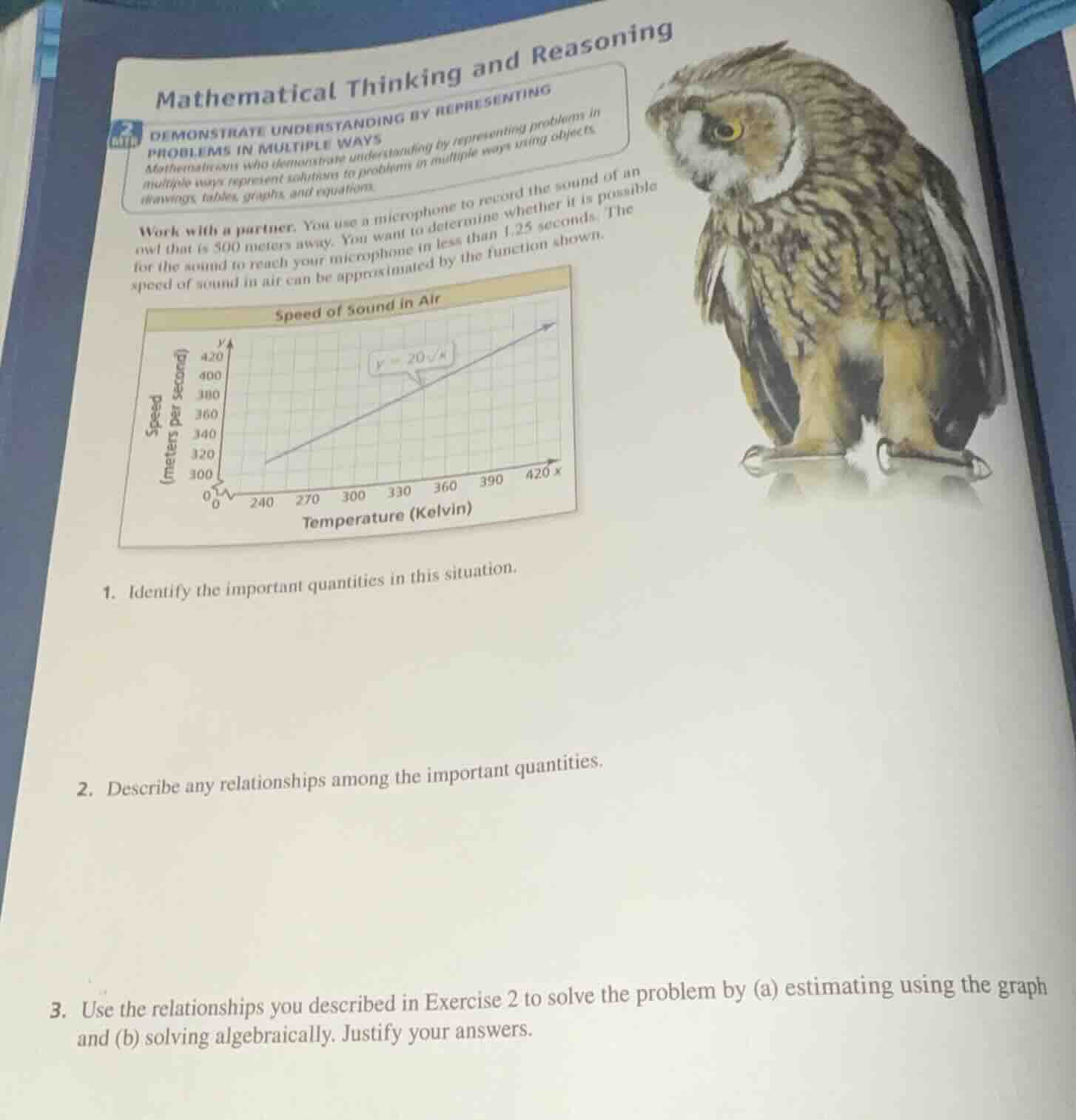
work with a partner. you use a microphone to record the sound of an
owl that is 500 meters away. you want to determine whether it is possible
for the sound to reach your microphone in less than 1.25 seconds. the
speed of sound in air can be approximated by the function shown.
- identify the important quantities in this situation.
- describe any relationships among the important quantities.
- use the relationships you described in exercise 2 to solve the problem by (a) estimating using the graph
and (b) solving algebraically. justify your answers.
Step1: Identify key quantities
The important quantities are:
- Distance to the owl: $d = 500$ meters
- Maximum allowed time: $t = 1.25$ seconds
- Temperature (Kelvin): $x$
- Speed of sound (m/s): $y$, defined by $y=20\sqrt{x}$
- Travel time of sound: $t = \frac{d}{y}$
Step2: Describe quantity relationships
- Speed of sound $y$ depends on temperature $x$: $y=20\sqrt{x}$
- Sound travel time $t$ is $\frac{\text{distance}}{\text{speed}}$: $t=\frac{500}{y}$
- Substitute $y$ to link $t$ and $x$: $t=\frac{500}{20\sqrt{x}}=\frac{25}{\sqrt{x}}$
---
Part 3a: Estimate using the graph
Step3: Find required minimum speed
Calculate the speed needed for $t<1.25$:
$y > \frac{500}{1.25} = 400$ m/s
Step4: Estimate temperature from graph
On the graph, find $y=400$ on the vertical axis, trace to the line $y=20\sqrt{x}$, then read the corresponding $x$-value. This gives $x \approx 400$ Kelvin. So when temperature is above ~400 K, sound speed exceeds 400 m/s, and travel time is less than 1.25 seconds.
---
Part 3b: Solve algebraically
Step5: Set up inequality for time
We need $t < 1.25$, substitute $t=\frac{25}{\sqrt{x}}$:
$\frac{25}{\sqrt{x}} < 1.25$
Step6: Isolate the square root term
Multiply both sides by $\sqrt{x}$ (positive, so inequality direction stays):
$25 < 1.25\sqrt{x}$
Divide both sides by 1.25:
$\frac{25}{1.25} < \sqrt{x}$
$20 < \sqrt{x}$
Step7: Solve for x
Square both sides (both sides positive, inequality direction stays):
$20^2 < x$
$400 < x$

Snap & solve any problem in the app
Get step-by-step solutions on Sovi AI
Photo-based solutions with guided steps
Explore more problems and detailed explanations
- Important quantities: Distance to owl (500 m), maximum allowed sound travel time (1.25 s), air temperature (Kelvin, $x$), speed of sound (m/s, $y$), actual sound travel time.
- Relationships:
- Speed of sound is a function of temperature: $y=20\sqrt{x}$
- Sound travel time equals distance divided by speed: $t=\frac{500}{y}$
- Substituting gives time as a function of temperature: $t=\frac{25}{\sqrt{x}}$
- (a) Estimation: The graph shows that a speed of 400 m/s (needed for $t=1.25$s) corresponds to a temperature of ~400 Kelvin. So if the air temperature is above 400 Kelvin, the sound will reach the microphone in less than 1.25 seconds.
(b) Algebraic solution: The inequality $\frac{25}{\sqrt{x}} < 1.25$ simplifies to $x > 400$. When the air temperature is greater than 400 Kelvin, the sound from the owl will reach the microphone in less than 1.25 seconds.