QUESTION IMAGE
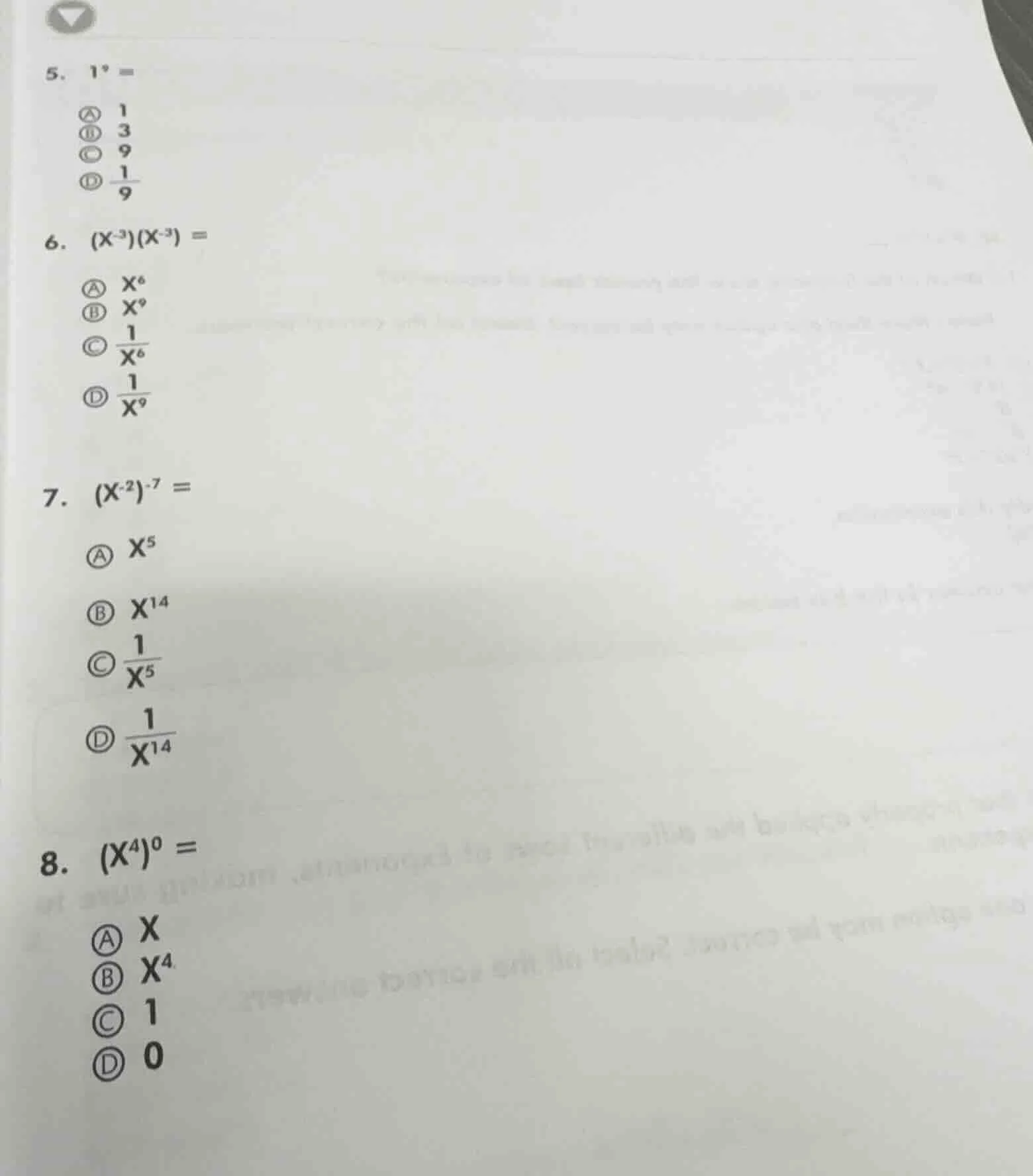
Question
- $1^9 = $
a 1
b 3
c 9
d $\frac{1}{9}$
- $(x^{-3})(x^{-3}) = $
a $x^6$
b $x^9$
c $\frac{1}{x^6}$
d $\frac{1}{x^9}$
- $(x^{-2})^{-7} = $
a $x^5$
b $x^{14}$
c $\frac{1}{x^5}$
d $\frac{1}{x^{14}}$
- $(x^4)^0 = $
a $x$
b $x^4$
c 1
d 0
Question 5
Step1: Recall the rule of exponent \(a^n\) when \(a = 1\).
Any non - zero number to the power of \(0\) is \(1\), and \(1\) to any power \(n\) is \(1\) (because \(1\times1\times\cdots\times1\) (\(n\) times) is \(1\)). Here, we have \(1^{9}\), and by the rule \(1^n=1\) for any real number \(n\), so \(1^{9} = 1\).
Step1: Recall the product rule of exponents.
The product rule of exponents states that for any non - zero real number \(a\) and integers \(m\) and \(n\), \(a^{m}\times a^{n}=a^{m + n}\). Here, \(a = x\), \(m=-3\) and \(n = - 3\). So \((x^{-3})(x^{-3})=x^{-3+( - 3)}\).
Step2: Simplify the exponent.
\(-3+( - 3)=-6\), so we have \(x^{-6}\).
Step3: Recall the negative exponent rule.
The negative exponent rule states that \(a^{-n}=\frac{1}{a^{n}}\) for \(a
eq0\) and integer \(n\). So \(x^{-6}=\frac{1}{x^{6}}\).
Step1: Recall the power of a power rule of exponents.
The power of a power rule states that for any non - zero real number \(a\) and integers \(m\) and \(n\), \((a^{m})^{n}=a^{m\times n}\). Here, \(a = x\), \(m=-2\) and \(n=-7\). So \((x^{-2})^{-7}=x^{(-2)\times(-7)}\).
Step2: Simplify the exponent.
\((-2)\times(-7) = 14\), so \((x^{-2})^{-7}=x^{14}\).

Snap & solve any problem in the app
Get step-by-step solutions on Sovi AI
Photo-based solutions with guided steps
Explore more problems and detailed explanations
A. 1