QUESTION IMAGE
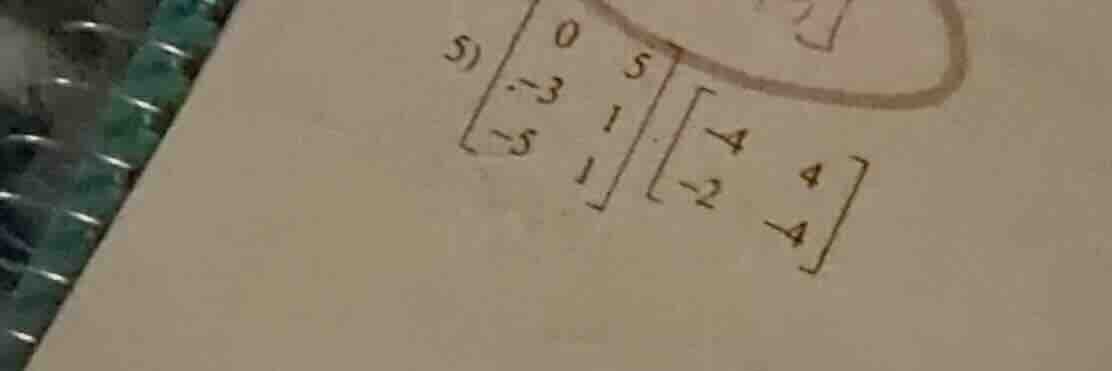
Question
- \\(\
\
\\)
To multiply two matrices, we use the rule for matrix multiplication: if we have a matrix \( A \) of size \( m \times n \) and a matrix \( B \) of size \( n \times p \), the resulting matrix \( C = A \times B \) will be of size \( m \times p \), and each element \( c_{ij} \) is calculated as the dot product of the \( i \)-th row of \( A \) and the \( j \)-th column of \( B \), i.e., \( c_{ij}=\sum_{k = 1}^{n}a_{ik}b_{kj} \)
Let \( A=
\) (a \( 3\times2 \) matrix) and \( B=
\) (a \( 2\times2 \) matrix). The product \( A\times B \) will be a \( 3\times2 \) matrix.
Step 1: Calculate the first row of the product matrix
The first row of \( A \) is \( [0,5] \)
- For the first element of the first row (\( i = 1,j=1 \)):
\( c_{11}=0\times(-4)+5\times(-2)=0 - 10=- 10 \)
- For the second element of the first row (\( i = 1,j = 2 \)):
\( c_{12}=0\times4+5\times(-4)=0-20 = - 20 \)
Step 2: Calculate the second row of the product matrix
The second row of \( A \) is \( [-3,1] \)
- For the first element of the second row (\( i=2,j = 1 \)):
\( c_{21}=(-3)\times(-4)+1\times(-2)=12 - 2=10 \)
- For the second element of the second row (\( i = 2,j=2 \)):
\( c_{22}=(-3)\times4+1\times(-4)=-12-4=-16 \)
Step 3: Calculate the third row of the product matrix
The third row of \( A \) is \( [-5,1] \)
- For the first element of the third row (\( i = 3,j=1 \)):
\( c_{31}=(-5)\times(-4)+1\times(-2)=20 - 2 = 18 \)
- For the second element of the third row (\( i=3,j = 2 \)):
\( c_{32}=(-5)\times4+1\times(-4)=-20-4=-24 \)

Snap & solve any problem in the app
Get step-by-step solutions on Sovi AI
Photo-based solutions with guided steps
Explore more problems and detailed explanations
The product of the two matrices is \(
\)