QUESTION IMAGE
Question
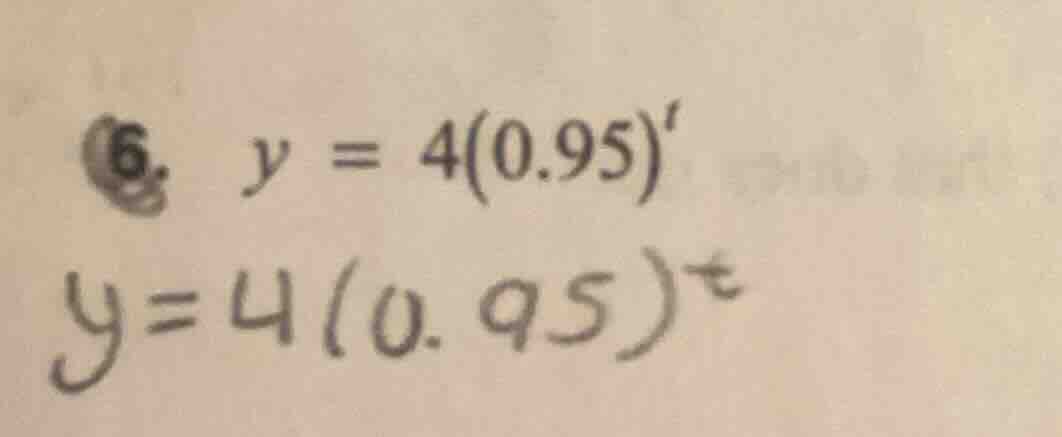
- y = 4(0.95)^t
The function \( y = 4(0.95)^t \) is an exponential function. If we want to analyze its properties, such as determining if it's a growth or decay function, or finding specific values for a given \( t \), we can follow these steps.
Step 1: Identify the type of exponential function
The general form of an exponential function is \( y = ab^t \), where \( a \) is the initial value and \( b \) is the base. In this function, \( a = 4 \) and \( b = 0.95 \). Since \( 0 < b < 1 \) ( \( 0.95 \) is between 0 and 1), this is an exponential decay function.
Step 2: Calculate the decay rate
The decay rate \( r \) can be found using the formula \( b = 1 - r \). So, \( 0.95 = 1 - r \), which gives \( r = 1 - 0.95 = 0.05 \) or \( 5\% \). This means the quantity \( y \) is decreasing by \( 5\% \) each time \( t \) increases by 1.
Step 3: Find specific values (example: \( t = 0 \), \( t = 1 \), \( t = 2 \))
- When \( t = 0 \): \( y = 4(0.95)^0 = 4(1) = 4 \) (any non - zero number to the power of 0 is 1).
- When \( t = 1 \): \( y = 4(0.95)^1 = 4\times0.95 = 3.8 \).
- When \( t = 2 \): \( y = 4(0.95)^2 = 4\times0.9025 = 3.61 \).

Snap & solve any problem in the app
Get step-by-step solutions on Sovi AI
Photo-based solutions with guided steps
Explore more problems and detailed explanations
The function \( y = 4(0.95)^t \) is an exponential decay function with an initial value of 4 and a decay rate of \( 5\% \) per unit increase in \( t \). For specific values: at \( t = 0 \), \( y = 4 \); at \( t = 1 \), \( y = 3.8 \); at \( t = 2 \), \( y = 3.61 \) (and so on for other values of \( t \)).