QUESTION IMAGE
Question
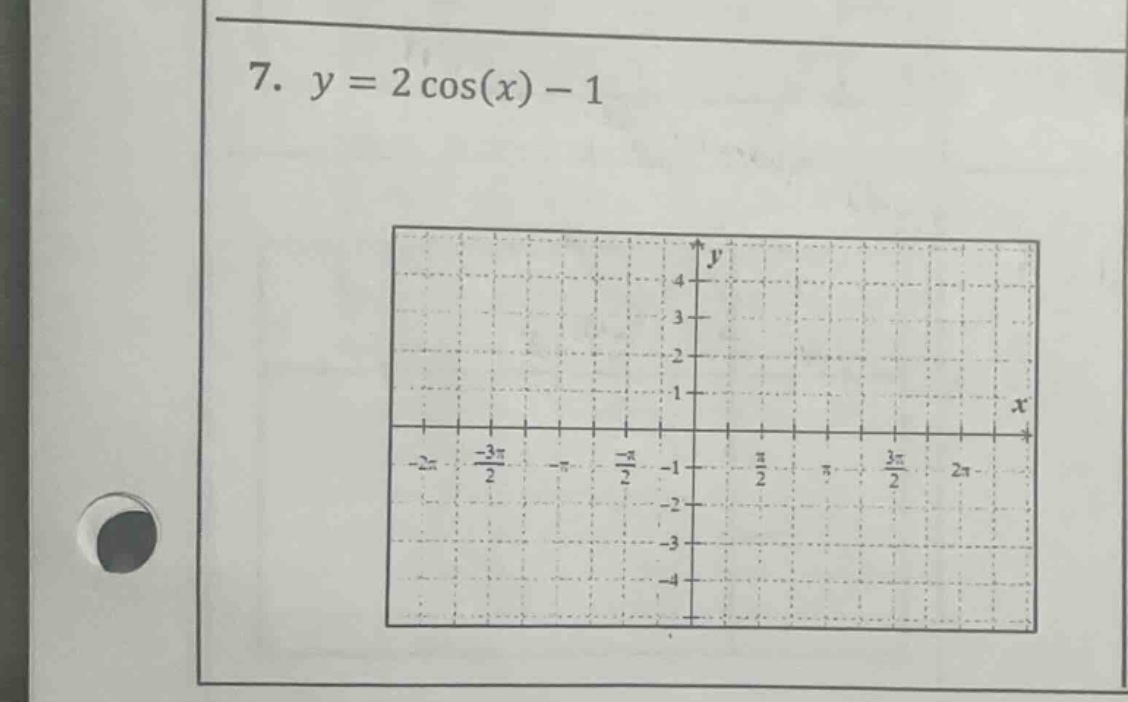
- $y = 2cos(x) - 1$
Assuming the problem is to graph \( y = 2\cos(x)-1 \), here's the step - by - step process:
Step 1: Recall the parent function
The parent function is \( y=\cos(x) \), which has an amplitude of 1, a period of \( 2\pi \), a vertical shift of 0, and a horizontal shift of 0. Its key points on one period (\([0, 2\pi]\)) are: \((0, 1)\), \((\frac{\pi}{2}, 0)\), \((\pi, - 1)\), \((\frac{3\pi}{2}, 0)\), \((2\pi, 1)\).
Step 2: Apply the vertical stretch
For the function \( y = 2\cos(x)-1 \), we first apply the vertical stretch by a factor of 2 to \( y=\cos(x) \). The amplitude of the new function (before vertical shift) becomes \( 2\times1 = 2 \). So the key points after the vertical stretch (but before vertical shift) are: \((0, 2\times1)=(0, 2)\), \((\frac{\pi}{2}, 2\times0)=(0, 0)\), \((\pi, 2\times(- 1))=(\pi, - 2)\), \((\frac{3\pi}{2}, 2\times0)=(\frac{3\pi}{2}, 0)\), \((2\pi, 2\times1)=(2\pi, 2)\).
Step 3: Apply the vertical shift
Now we apply the vertical shift of - 1 (downward shift by 1 unit) to the points obtained from the vertical stretch.
- For the point \((0, 2)\): After shifting down by 1, we get \((0, 2 - 1)=(0, 1)\).
- For the point \((\frac{\pi}{2}, 0)\): After shifting down by 1, we get \((\frac{\pi}{2}, 0 - 1)=(\frac{\pi}{2}, - 1)\).
- For the point \((\pi, - 2)\): After shifting down by 1, we get \((\pi, - 2-1)=(\pi, - 3)\).
- For the point \((\frac{3\pi}{2}, 0)\): After shifting down by 1, we get \((\frac{3\pi}{2}, 0 - 1)=(\frac{3\pi}{2}, - 1)\).
- For the point \((2\pi, 2)\): After shifting down by 1, we get \((2\pi, 2 - 1)=(2\pi, 1)\).
Step 4: Plot the key points and draw the graph
Plot the key points \((0, 1)\), \((\frac{\pi}{2}, - 1)\), \((\pi, - 3)\), \((\frac{3\pi}{2}, - 1)\), \((2\pi, 1)\) on the given coordinate plane. Then, since the period is still \( 2\pi \) (because there is no horizontal stretch or compression), we can also plot points for the interval \([- 2\pi,0]\) by using the periodicity of the cosine function. For example, for \( x=-2\pi \), since \( \cos(-2\pi)=\cos(2\pi) = 1 \), then \( y=2\cos(-2\pi)-1=2\times1 - 1 = 1 \), so the point is \((-2\pi, 1)\). For \( x =-\frac{3\pi}{2}\), \( \cos(-\frac{3\pi}{2})=\cos(\frac{3\pi}{2}) = 0 \), so \( y=2\times0-1=-1 \), and the point is \((-\frac{3\pi}{2}, - 1)\). For \( x=-\pi \), \( \cos(-\pi)=\cos(\pi)=-1 \), so \( y=2\times(-1)-1=-3 \), and the point is \((-\pi, - 3)\). For \( x =-\frac{\pi}{2}\), \( \cos(-\frac{\pi}{2})=\cos(\frac{\pi}{2}) = 0 \), so \( y=2\times0 - 1=-1 \), and the point is \((-\frac{\pi}{2}, - 1)\). After plotting all these key points, we draw a smooth curve connecting them to get the graph of \( y = 2\cos(x)-1 \).
If the problem was to find properties like amplitude, period, vertical shift:
- Amplitude: The amplitude of \( y = A\cos(Bx - C)+D \) is \(|A|\). Here \( A = 2 \), so the amplitude is \( 2 \).
- Period: The period of \( y = A\cos(Bx - C)+D \) is \( \frac{2\pi}{|B|} \). Here \( B = 1 \), so the period is \( \frac{2\pi}{1}=2\pi \).
- Vertical shift: The vertical shift is \( D=-1 \), which means the graph is shifted down by 1 unit.

Snap & solve any problem in the app
Get step-by-step solutions on Sovi AI
Photo-based solutions with guided steps
Explore more problems and detailed explanations
If graphing, the graph is a cosine - shaped curve with amplitude 2, period \( 2\pi \), shifted down by 1 unit. Key points on \([-2\pi, 2\pi]\) are \((-2\pi, 1)\), \((-\frac{3\pi}{2}, - 1)\), \((-\pi, - 3)\), \((-\frac{\pi}{2}, - 1)\), \((0, 1)\), \((\frac{\pi}{2}, - 1)\), \((\pi, - 3)\), \((\frac{3\pi}{2}, - 1)\), \((2\pi, 1)\) connected by a smooth curve. If finding properties: Amplitude = 2, Period = \( 2\pi \), Vertical Shift = - 1 (down 1 unit).