QUESTION IMAGE
Question
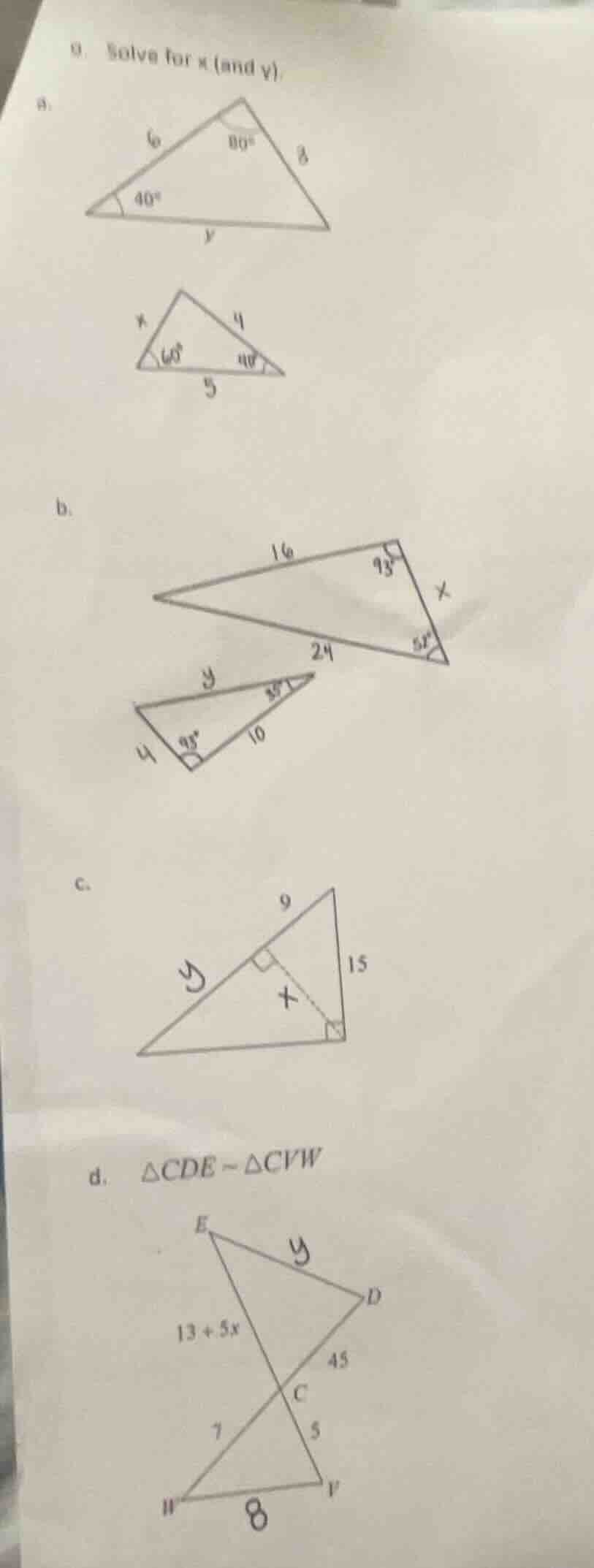
- solve for x (and y).
a.
b.
c.
d. $\triangle cde \sim \triangle cvw$
Part a
Step 1: Check Triangle Similarity (AA Criterion)
First triangle angles: \(40^\circ\), \(80^\circ\), so third angle \(180 - 40 - 80 = 60^\circ\).
Second triangle angles: \(60^\circ\), \(40^\circ\), so third angle \(180 - 60 - 40 = 80^\circ\).
Triangles are similar by AA (two angles equal).
Step 2: Set Up Proportions for \(y\) and \(x\)
For the first triangle (sides 6, 8, \(y\)) and second (sides \(x\), 4, 5):
- Corresponding sides: \(6\) (first) ↔ \(x\) (second), \(8\) ↔ \(4\), \(y\) ↔ \(5\).
- Proportion for \(y\): \(\frac{y}{5}=\frac{6}{x}=\frac{8}{4}\).
- Simplify \(\frac{8}{4}=2\), so \(\frac{y}{5}=2\) → \(y = 10\); \(\frac{6}{x}=2\) → \(x = 3\).
Part b
Step 1: Check Triangle Similarity (AA Criterion)
Both triangles have a \(95^\circ\) angle and a \(5x^\circ\) (and \(5x^\circ\)) angle. So similar by AA.
Step 2: Set Up Proportions
Sides: \(16\) ↔ \(y\), \(24\) ↔ \(10\), \(x\) ↔ \(4\). Wait, correct correspondence: larger triangle sides \(16\), \(24\), \(x\); smaller: \(y\), \(10\), \(4\).
Proportion: \(\frac{16}{y}=\frac{24}{10}=\frac{x}{4}\).
- Simplify \(\frac{24}{10}=\frac{12}{5}\).
- For \(y\): \(\frac{16}{y}=\frac{12}{5}\) → \(12y = 80\) → \(y=\frac{20}{3}\approx6.67\).
- For \(x\): \(\frac{x}{4}=\frac{12}{5}\) → \(x=\frac{48}{5}=9.6\). Also, angles: \(5x + 95 + \text{third angle}=180\), but since similar, angles match. Wait, angle sum: \(95 + 5x + \text{third}=180\), and in smaller triangle, \(95 + 5x + \text{third}=180\). So \(5x\) can be found, but since similar, focus on sides. Wait, maybe I mixed correspondence. Let’s recheck: larger triangle sides 16, 24, \(x\); smaller: 4, 10, \(y\). So \(\frac{16}{y}=\frac{24}{10}=\frac{x}{4}\). Wait, \(\frac{24}{10}=\frac{12}{5}\), so \(x=\frac{4\times12}{5}=\frac{48}{5}=9.6\), \(y=\frac{16\times5}{12}=\frac{20}{3}\approx6.67\).
Part c
Step 1: Right Triangle Altitude Theorem
In a right triangle, the altitude to the hypotenuse relates segments:
- Let the large triangle have hypotenuse \(y\), altitude \(x\), segments 9 and (let’s say) \(z\), and leg 15.
- The theorem: \(x^2 = 9 \times z\), \(15^2 = 9 \times y\) (since \(y = 9 + z\)).
Step 2: Solve for \(y\) and \(x\)
- \(15^2 = 9y\) → \(225 = 9y\) → \(y = 25\).
- Then \(z = y - 9 = 16\).
- \(x^2 = 9 \times 16 = 144\) → \(x = 12\).
Part d
Step 1: Use Similar Triangles (AA, Vertical Angles)
\(\triangle CDE \sim \triangle CVW\) (given), so \(\angle DCE = \angle WCV\) (vertical angles), and \(\angle CDE = \angle CVW\), \(\angle CED = \angle CWV\) (AA).
Step 2: Set Up Proportions
Corresponding sides: \(CE = 13 + 5x\), \(CW = 7\); \(CD = 45\), \(CV = 5\); \(DE = y\), \(VW = 8\).
Proportion: \(\frac{CE}{CW}=\frac{CD}{CV}=\frac{DE}{VW}\).
- \(\frac{13 + 5x}{7}=\frac{45}{5}\).
- Simplify \(\frac{45}{5}=9\), so \(13 + 5x = 63\) → \(5x = 50\) → \(x = 10\).
- For \(y\): \(\frac{y}{8}=\frac{45}{5}=9\) → \(y = 72\).
Final Answers
a. \(x = 3\), \(y = 10\)
b. \(x = 9.6\) (or \(\frac{48}{5}\)), \(y = \frac{20}{3}\) (or \(6.67\))
c. \(x = 12\), \(y = 25\)
d. \(x = 10\), \(y = 72\)

Snap & solve any problem in the app
Get step-by-step solutions on Sovi AI
Photo-based solutions with guided steps
Explore more problems and detailed explanations
Part a
Step 1: Check Triangle Similarity (AA Criterion)
First triangle angles: \(40^\circ\), \(80^\circ\), so third angle \(180 - 40 - 80 = 60^\circ\).
Second triangle angles: \(60^\circ\), \(40^\circ\), so third angle \(180 - 60 - 40 = 80^\circ\).
Triangles are similar by AA (two angles equal).
Step 2: Set Up Proportions for \(y\) and \(x\)
For the first triangle (sides 6, 8, \(y\)) and second (sides \(x\), 4, 5):
- Corresponding sides: \(6\) (first) ↔ \(x\) (second), \(8\) ↔ \(4\), \(y\) ↔ \(5\).
- Proportion for \(y\): \(\frac{y}{5}=\frac{6}{x}=\frac{8}{4}\).
- Simplify \(\frac{8}{4}=2\), so \(\frac{y}{5}=2\) → \(y = 10\); \(\frac{6}{x}=2\) → \(x = 3\).
Part b
Step 1: Check Triangle Similarity (AA Criterion)
Both triangles have a \(95^\circ\) angle and a \(5x^\circ\) (and \(5x^\circ\)) angle. So similar by AA.
Step 2: Set Up Proportions
Sides: \(16\) ↔ \(y\), \(24\) ↔ \(10\), \(x\) ↔ \(4\). Wait, correct correspondence: larger triangle sides \(16\), \(24\), \(x\); smaller: \(y\), \(10\), \(4\).
Proportion: \(\frac{16}{y}=\frac{24}{10}=\frac{x}{4}\).
- Simplify \(\frac{24}{10}=\frac{12}{5}\).
- For \(y\): \(\frac{16}{y}=\frac{12}{5}\) → \(12y = 80\) → \(y=\frac{20}{3}\approx6.67\).
- For \(x\): \(\frac{x}{4}=\frac{12}{5}\) → \(x=\frac{48}{5}=9.6\). Also, angles: \(5x + 95 + \text{third angle}=180\), but since similar, angles match. Wait, angle sum: \(95 + 5x + \text{third}=180\), and in smaller triangle, \(95 + 5x + \text{third}=180\). So \(5x\) can be found, but since similar, focus on sides. Wait, maybe I mixed correspondence. Let’s recheck: larger triangle sides 16, 24, \(x\); smaller: 4, 10, \(y\). So \(\frac{16}{y}=\frac{24}{10}=\frac{x}{4}\). Wait, \(\frac{24}{10}=\frac{12}{5}\), so \(x=\frac{4\times12}{5}=\frac{48}{5}=9.6\), \(y=\frac{16\times5}{12}=\frac{20}{3}\approx6.67\).
Part c
Step 1: Right Triangle Altitude Theorem
In a right triangle, the altitude to the hypotenuse relates segments:
- Let the large triangle have hypotenuse \(y\), altitude \(x\), segments 9 and (let’s say) \(z\), and leg 15.
- The theorem: \(x^2 = 9 \times z\), \(15^2 = 9 \times y\) (since \(y = 9 + z\)).
Step 2: Solve for \(y\) and \(x\)
- \(15^2 = 9y\) → \(225 = 9y\) → \(y = 25\).
- Then \(z = y - 9 = 16\).
- \(x^2 = 9 \times 16 = 144\) → \(x = 12\).
Part d
Step 1: Use Similar Triangles (AA, Vertical Angles)
\(\triangle CDE \sim \triangle CVW\) (given), so \(\angle DCE = \angle WCV\) (vertical angles), and \(\angle CDE = \angle CVW\), \(\angle CED = \angle CWV\) (AA).
Step 2: Set Up Proportions
Corresponding sides: \(CE = 13 + 5x\), \(CW = 7\); \(CD = 45\), \(CV = 5\); \(DE = y\), \(VW = 8\).
Proportion: \(\frac{CE}{CW}=\frac{CD}{CV}=\frac{DE}{VW}\).
- \(\frac{13 + 5x}{7}=\frac{45}{5}\).
- Simplify \(\frac{45}{5}=9\), so \(13 + 5x = 63\) → \(5x = 50\) → \(x = 10\).
- For \(y\): \(\frac{y}{8}=\frac{45}{5}=9\) → \(y = 72\).
Final Answers
a. \(x = 3\), \(y = 10\)
b. \(x = 9.6\) (or \(\frac{48}{5}\)), \(y = \frac{20}{3}\) (or \(6.67\))
c. \(x = 12\), \(y = 25\)
d. \(x = 10\), \(y = 72\)