QUESTION IMAGE
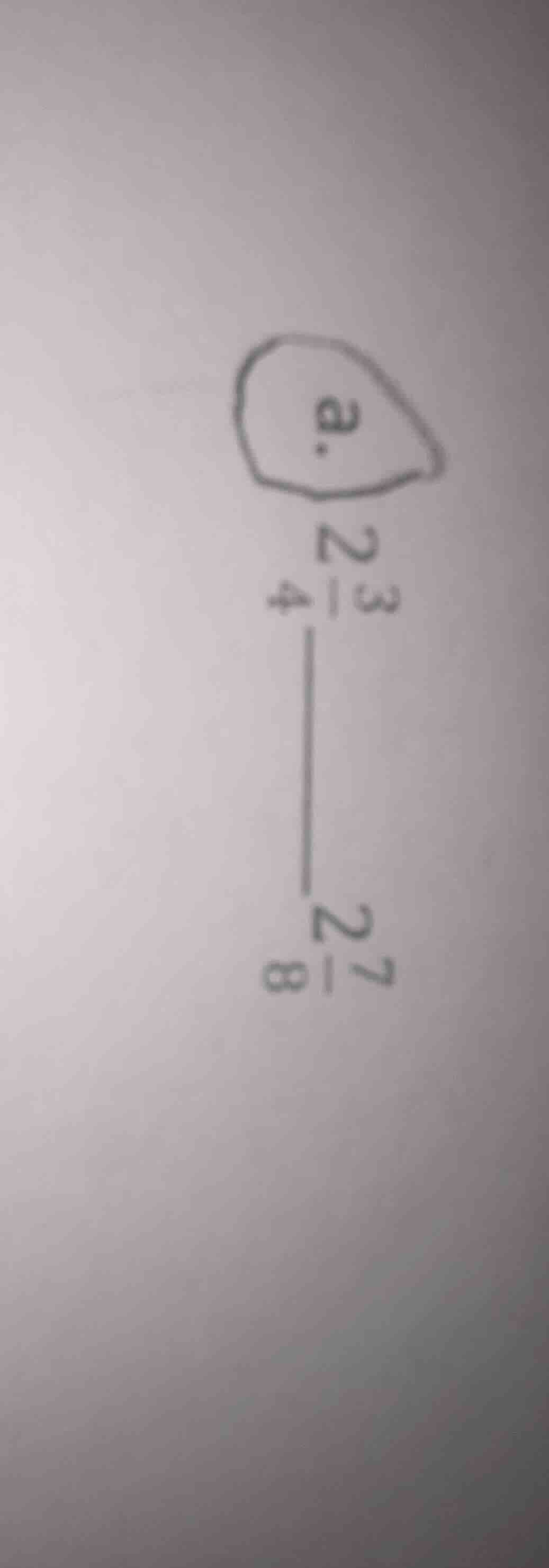
Question
a. \\(2\frac{3}{4} - 2\frac{7}{8}\\)
Step1: Convert mixed numbers to improper fractions
First, convert \(2\frac{3}{4}\) to an improper fraction. The formula for converting a mixed number \(a\frac{b}{c}\) to an improper fraction is \(\frac{a\times c + b}{c}\). So for \(2\frac{3}{4}\), we have \(a = 2\), \(b = 3\), \(c = 4\). Then \(2\frac{3}{4}=\frac{2\times4 + 3}{4}=\frac{8 + 3}{4}=\frac{11}{4}\).
Next, convert \(2\frac{7}{8}\) to an improper fraction. Using the same formula, with \(a = 2\), \(b = 7\), \(c = 8\), we get \(2\frac{7}{8}=\frac{2\times8+7}{8}=\frac{16 + 7}{8}=\frac{23}{8}\).
Step2: Find a common denominator
The denominators are 4 and 8. The least common denominator (LCD) of 4 and 8 is 8. So we need to convert \(\frac{11}{4}\) to a fraction with denominator 8. To do this, multiply the numerator and denominator by 2: \(\frac{11}{4}=\frac{11\times2}{4\times2}=\frac{22}{8}\).
Step3: Subtract the fractions
Now we have \(\frac{22}{8}-\frac{23}{8}\). When subtracting fractions with the same denominator, we subtract the numerators: \(\frac{22 - 23}{8}=\frac{-1}{8}\). Wait, that can't be right. Wait, maybe the operation is subtraction or addition? Wait, the original problem has a line between \(2\frac{3}{4}\) and \(2\frac{7}{8}\), maybe it's subtraction? Wait, no, maybe I misread. Wait, \(2\frac{3}{4}\) and \(2\frac{7}{8}\), let's check the calculation again. Wait, \(2\frac{3}{4}=2.75\) and \(2\frac{7}{8}=2.875\). So \(2.75 - 2.875=-0.125=-\frac{1}{8}\), or if it's addition, \(2.75 + 2.875 = 5.625=\frac{45}{8}=5\frac{5}{8}\). Wait, maybe the problem is subtraction? Wait, the user's image shows \(2\frac{3}{4}\) and \(2\frac{7}{8}\) with a line, maybe it's subtraction. Wait, but let's confirm the steps again.
Wait, maybe I made a mistake in the sign. Wait, if the problem is \(2\frac{3}{4}-2\frac{7}{8}\), then:
Convert to improper fractions:
\(2\frac{3}{4}=\frac{11}{4}\), \(2\frac{7}{8}=\frac{23}{8}\)
Common denominator 8: \(\frac{11}{4}=\frac{22}{8}\)
Subtract: \(\frac{22}{8}-\frac{23}{8}=-\frac{1}{8}\)
But that's negative. Alternatively, maybe it's \(2\frac{7}{8}-2\frac{3}{4}\):
\(\frac{23}{8}-\frac{22}{8}=\frac{1}{8}\)
Ah, maybe the operation is subtraction of the smaller from the larger. Let's check the mixed numbers: \(2\frac{7}{8}\) is larger than \(2\frac{3}{4}\) because \(\frac{7}{8}=0.875\) and \(\frac{3}{4}=0.75\), so \(2.875>2.75\). So \(2\frac{7}{8}-2\frac{3}{4}=\frac{23}{8}-\frac{22}{8}=\frac{1}{8}\).
Wait, maybe the original problem is subtraction, but I had the order wrong. Let's re - examine the image. The image has \(2\frac{3}{4}\) above the line and \(2\frac{7}{8}\) below, maybe it's \(2\frac{3}{4}-2\frac{7}{8}\) or \(2\frac{7}{8}-2\frac{3}{4}\). Let's assume it's \(2\frac{7}{8}-2\frac{3}{4}\):
Step1: Convert to improper fractions
\(2\frac{3}{4}=\frac{2\times4 + 3}{4}=\frac{11}{4}\), \(2\frac{7}{8}=\frac{2\times8+7}{8}=\frac{23}{8}\)
Step2: Find common denominator
LCD of 4 and 8 is 8. Convert \(\frac{11}{4}\) to eighths: \(\frac{11\times2}{4\times2}=\frac{22}{8}\)
Step3: Subtract
\(\frac{23}{8}-\frac{22}{8}=\frac{1}{8}\)

Snap & solve any problem in the app
Get step-by-step solutions on Sovi AI
Photo-based solutions with guided steps
Explore more problems and detailed explanations
\(\frac{1}{8}\) (assuming the operation is \(2\frac{7}{8}-2\frac{3}{4}\))