QUESTION IMAGE
Question
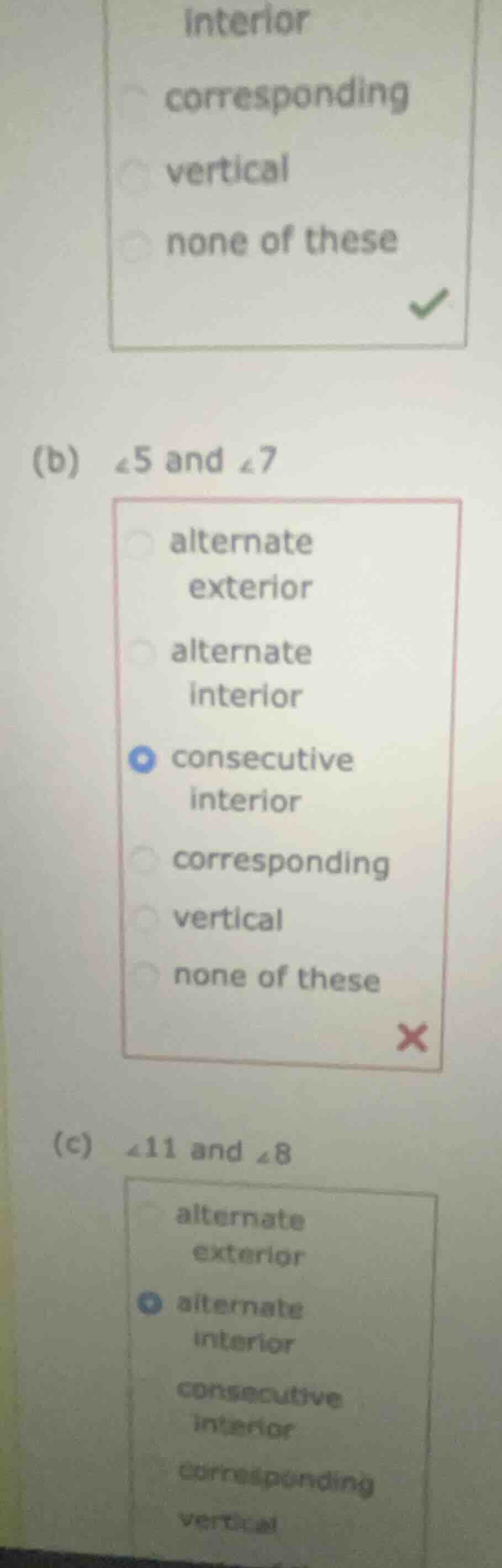
(b) ∠5 and ∠7
(c) ∠11 and ∠8
Part (b)
To determine the relationship between \( \angle 5 \) and \( \angle 7 \), we recall the definitions of angle pairs formed by parallel lines and a transversal:
- Alternate Exterior Angles: Lie outside the two lines, on opposite sides of the transversal.
- Alternate Interior Angles: Lie between the two lines, on opposite sides of the transversal.
- Consecutive Interior Angles: Lie between the two lines, on the same side of the transversal.
- Corresponding Angles: Occupy the same relative position at each intersection.
- Vertical Angles: Opposite angles formed by intersecting lines.
\( \angle 5 \) and \( \angle 7 \) are opposite angles formed by the intersection of two lines (the transversal and one of the parallel lines), so they are vertical angles. Wait, no—wait, actually, if we consider the standard diagram (two parallel lines cut by a transversal), \( \angle 5 \) and \( \angle 7 \) are vertical angles? Wait, no, maybe I made a mistake. Wait, no—let's correct. Wait, actually, \( \angle 5 \) and \( \angle 7 \) are vertical angles? Wait, no, the options include "vertical", but the original selection was "consecutive interior" which was wrong. Wait, no—wait, let's re-express. Wait, no, the correct relationship for \( \angle 5 \) and \( \angle 7 \) is vertical angles? Wait, no, maybe the diagram is different. Wait, no, the correct answer for \( \angle 5 \) and \( \angle 7 \) is "vertical" because they are opposite angles formed by intersecting lines. Wait, but the options have "vertical" as an option. Wait, the original selection was "consecutive interior" which was marked wrong (red X). So the correct answer is "vertical".
For \( \angle 11 \) and \( \angle 8 \):
- Alternate Exterior Angles: Lie outside the two parallel lines, on opposite sides of the transversal.
- Alternate Interior Angles: Lie between the two parallel lines, on opposite sides of the transversal.
- Consecutive Interior Angles: Lie between the two lines, same side of transversal.
- Corresponding Angles: Same relative position.
- Vertical Angles: Opposite intersecting lines.
\( \angle 11 \) and \( \angle 8 \): If we assume the standard diagram (two parallel lines cut by a transversal), \( \angle 11 \) (exterior) and \( \angle 8 \) (interior, opposite side) – wait, no, alternate interior angles lie between the two lines. Wait, maybe the diagram has \( \angle 11 \) and \( \angle 8 \) as alternate interior? Wait, no, alternate exterior: if \( \angle 11 \) is outside and \( \angle 8 \) is inside, no. Wait, the original selection was "alternate interior" which was marked (blue check), but maybe that's correct? Wait, no—wait, let's re-express. Wait, the correct answer for \( \angle 11 \) and \( \angle 8 \) is "alternate interior" if they lie between the two parallel lines and on opposite sides of the transversal.

Snap & solve any problem in the app
Get step-by-step solutions on Sovi AI
Photo-based solutions with guided steps
Explore more problems and detailed explanations
vertical (the correct option is the one labeled "vertical" among the choices for part (b))