QUESTION IMAGE
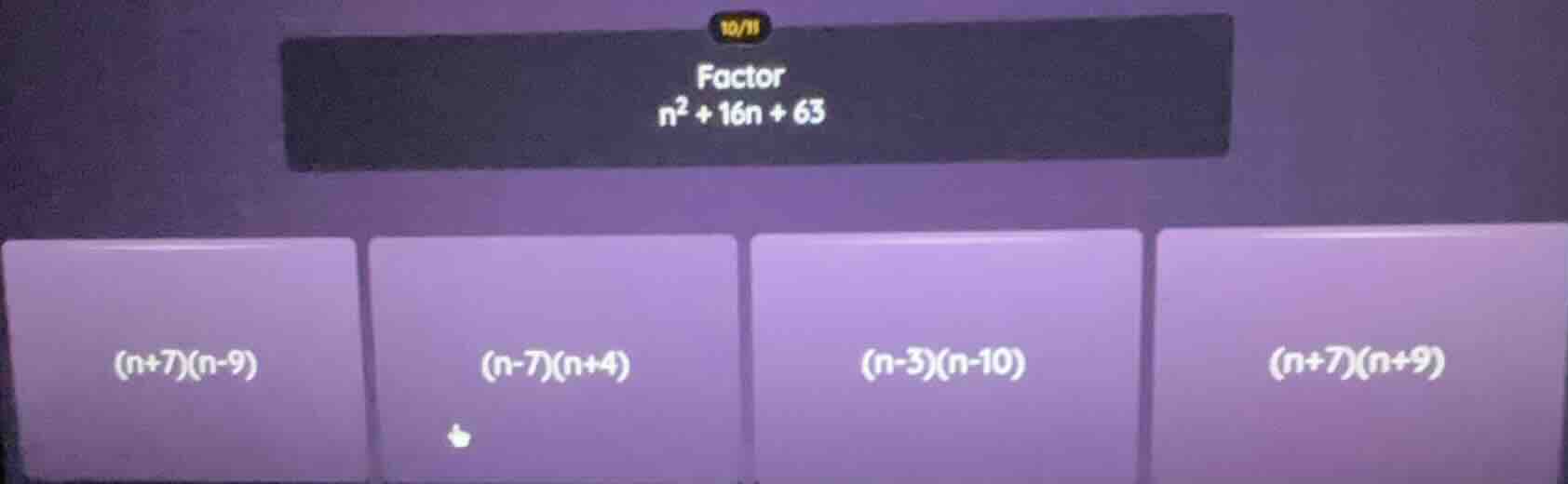
Question
factor
$n^2 + 16n + 63$
$(n+7)(n-9)$
$(n-7)(n+4)$
$(n-3)(n-10)$
$(n+7)(n+9)$
Step1: Recall factoring trinomials
To factor \(n^2 + 16n + 63\), we need two numbers that multiply to \(63\) and add up to \(16\).
Step2: Find the two numbers
The factors of \(63\) are: \(1\) & \(63\), \(3\) & \(21\), \(7\) & \(9\). Among these, \(7\) and \(9\) add up to \(16\) (\(7 + 9 = 16\)) and multiply to \(63\) (\(7\times9 = 63\)).
Step3: Write the factored form
Using the two numbers \(7\) and \(9\), the quadratic \(n^2 + 16n + 63\) factors as \((n + 7)(n + 9)\) because when we expand \((n + 7)(n + 9)\) using the distributive property (FOIL method), we get \(n^2+9n + 7n+63=n^2 + 16n + 63\), which matches the original expression.
Let's check the other options:
- For \((n + 7)(n - 9)\): Expanding gives \(n^2-9n + 7n-63=n^2 - 2n - 63\), which is not the original expression.
- For \((n - 7)(n + 4)\): Expanding gives \(n^2+4n - 7n-28=n^2 - 3n - 28\), which is not the original expression.
- For \((n - 3)(n - 10)\): Expanding gives \(n^2-10n - 3n+30=n^2 - 13n + 30\), which is not the original expression.

Snap & solve any problem in the app
Get step-by-step solutions on Sovi AI
Photo-based solutions with guided steps
Explore more problems and detailed explanations
D. \((n + 7)(n + 9)\) (assuming the options are labeled A, B, C, D in order as given: A. \((n+7)(n-9)\), B. \((n-7)(n+4)\), C. \((n-3)(n-10)\), D. \((n+7)(n+9)\))