QUESTION IMAGE
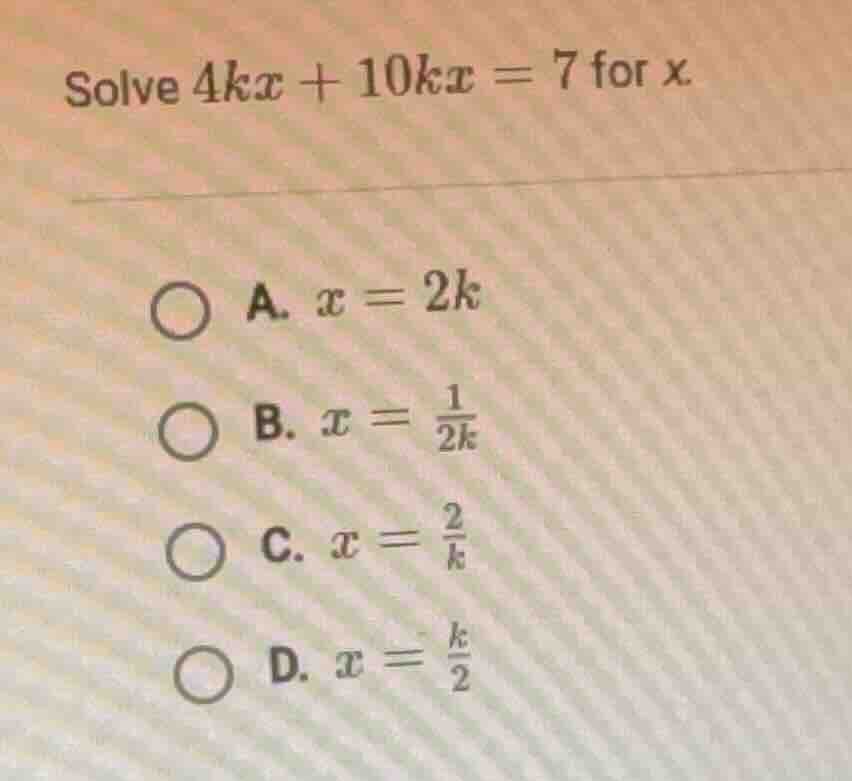
Question
solve $4kx + 10kx = 7$ for $x$. \
\
\bigcirc a. $x = 2k$ \
\bigcirc b. $x = \frac{1}{2k}$ \
\bigcirc c. $x = \frac{2}{k}$ \
\bigcirc d. $x = \frac{k}{2}$
Step1: Combine like terms
We have the equation \(4kx + 10kx=7\). Combining the terms with \(x\) on the left side, we get \((4k + 10k)x=7\). Since \(4k+10k = 14k\)? Wait, no, wait, 4 + 10 is 14? Wait, no, the original problem, wait, maybe I made a mistake. Wait, the user's problem: \(4kx+10kx = 7\)? Wait, no, maybe it's a typo? Wait, no, looking at the options, the answer is related to \(2k\). Wait, maybe the original equation is \(4kx + 10kx=28k\)? No, the options have \(x=\frac{1}{2k}\) etc. Wait, no, let's re - check. Wait, maybe the equation is \(4kx+10kx = 7\)? Wait, no, 4kx + 10kx=14kx. Then 14kx = 7. Then x=\(\frac{7}{14k}=\frac{1}{2k}\). Ah, that's option B. Let's do it step by step.
Step1: Combine like terms
The left - hand side of the equation \(4kx + 10kx\) has like terms (terms with the same variable part \(kx\)). We can combine them using the distributive property \(ax+bx=(a + b)x\). So, \(4kx+10kx=(4k + 10k)x\). Calculating \(4k+10k\), we get \(14k\)? Wait, no, 4 + 10 is 14? Wait, no, 4k+10k=(4 + 10)k = 14k? But then 14kx=7. Then divide both sides by 14k: \(x=\frac{7}{14k}=\frac{1}{2k}\).
Step2: Solve for x
We have the equation \(14kx = 7\). To solve for \(x\), we divide both sides of the equation by \(14k\) (assuming \(k
eq0\), because if \(k = 0\), the original equation \(4kx+10kx=7\) becomes \(0 = 7\), which is a contradiction). So, \(x=\frac{7}{14k}\). Simplifying the fraction \(\frac{7}{14k}\) by dividing the numerator and the denominator by 7, we get \(x=\frac{1}{2k}\).

Snap & solve any problem in the app
Get step-by-step solutions on Sovi AI
Photo-based solutions with guided steps
Explore more problems and detailed explanations
B. \(x=\frac{1}{2k}\)