QUESTION IMAGE
Question
the mayflower compact of 1620
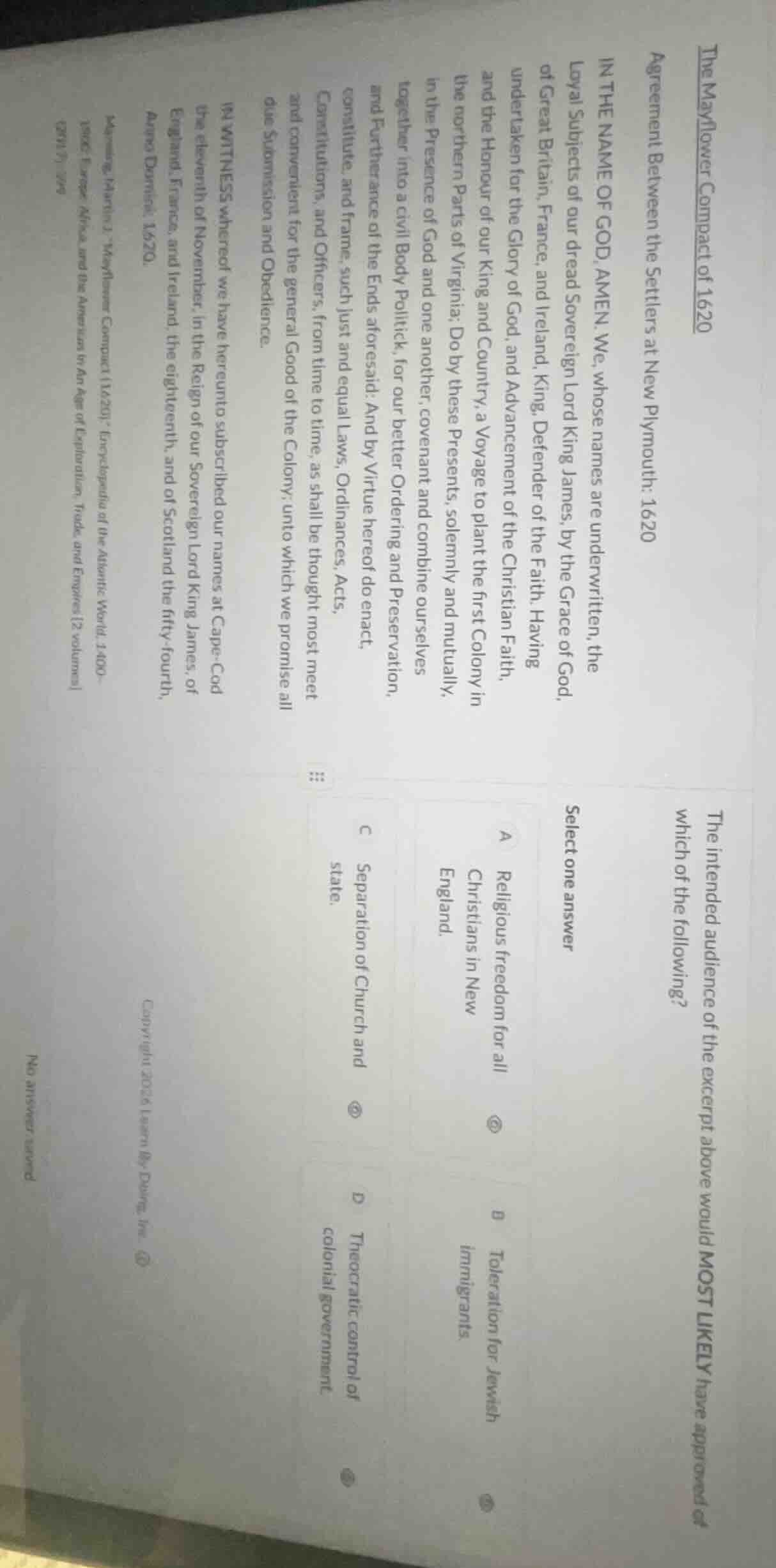
agreement between the settlers at new plymouth: 1620
in the name of god, amen. we, whose names are underwritten, the loyal subjects of our dread sovereign lord king james, by the grace of god, of great britain, france, and ireland, king, defender of the faith, having undertaken for the glory of god, and advancement of the christian faith, and the honour of our king and country, a voyage to plant the first colony in the northern parts of virginia; do by these presents, solemnly and mutually, in the presence of god and one another, covenant and combine ourselves together into a civil body politick, for our better ordering and preservation, and furtherance of the ends aforesaid: and by virtue hereof do enact, constitute, and frame, such just and equal laws, ordinances, acts, constitutions, and officers, from time to time, as shall be thought most meet and convenient for the general good of the colony; unto which we promise all due submission and obedience.
(4) witness whereof we have hereunto subscribed our names at cape cod the eleventh of november, in the reign of our sovereign lord king james, of england, france, and ireland, the eighteenth, and of scotland the fifty - fourth, anno domini, 1620.
source: martin j. - mayflower compact (1620), encyclopedia of the atlantic world, 1400 - 1800: europe, africa, and the americas in an age of exploration, trade, and empires 2 volumes
(2017): 289
the intended audience of the excerpt above would most likely have approved of which of the following?
select one answer
a religious freedom for all christians in new england.
b toleration for jewish immigrants.
c separation of church and state.
d theocratic control of colonial government.
The Mayflower Compact was created by Pilgrims (English Protestants) seeking to establish a civil body politic for their colony, with a focus on the "Glory of God" and Christian faith. Option A (Religious freedom for all Christians in New England) aligns with their intent to govern under Christian principles for their community. Option B is incorrect as it focuses on Jewish immigrants (not the Pilgrims’ focus). Option C (Separation of Church and state) is opposite, as the Compact blends religious and civil governance. Option D (Theocratic control) is inaccurate; it was a civil body politic with religious motivation, not theocratic rule.

Snap & solve any problem in the app
Get step-by-step solutions on Sovi AI
Photo-based solutions with guided steps
Explore more problems and detailed explanations
A. Religious freedom for all Christians in New England