QUESTION IMAGE
Question
mcv4u
problem set #1a: limits
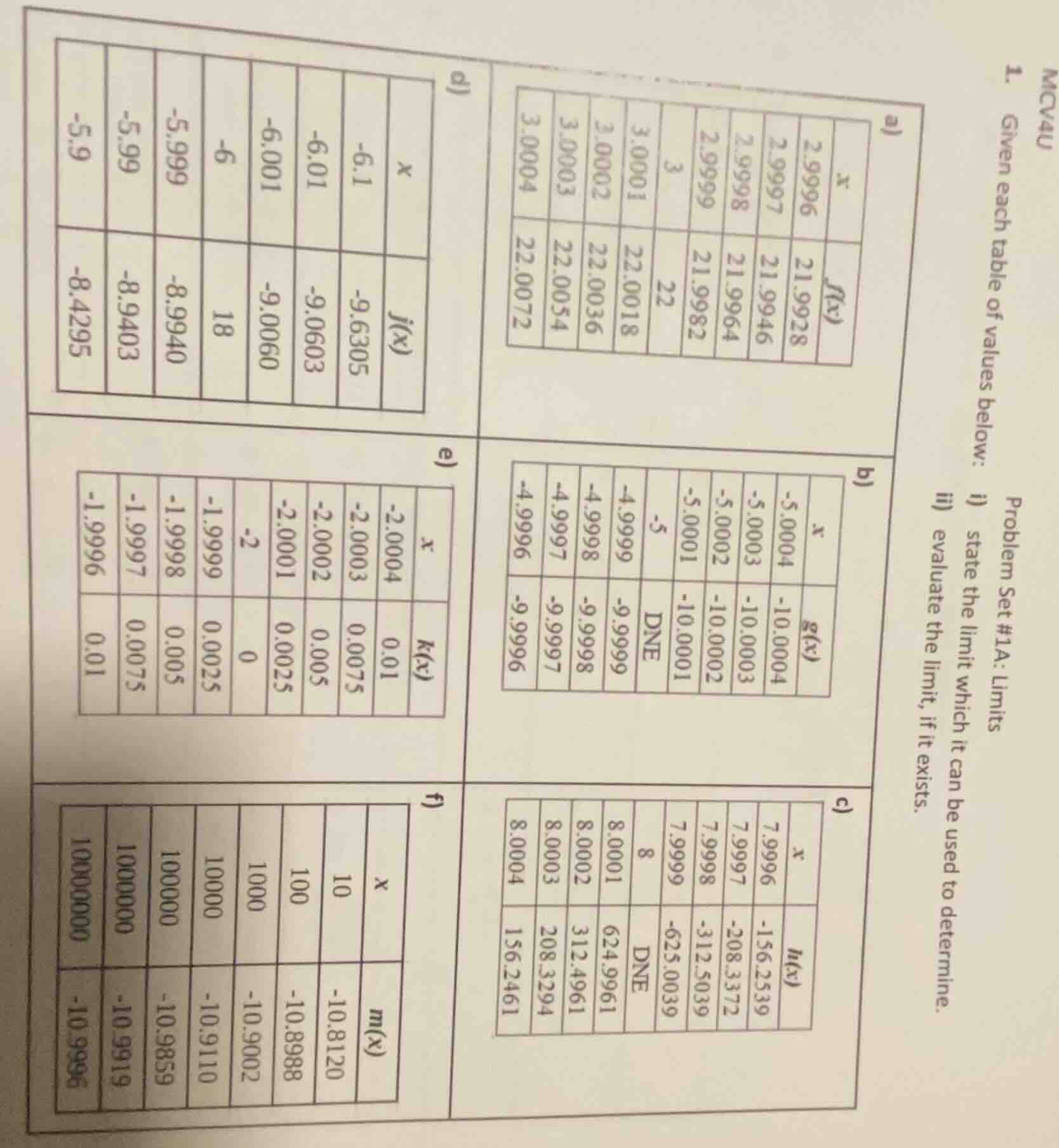
- given each table of values below:
i) state the limit which it can be used to determine.
ii) evaluate the limit, if it exists.
a)
| $x$ | $f(x)$ |
|---|---|
| 2.9997 | 21.9946 |
| 2.9998 | 21.9964 |
| 2.9999 | 21.9982 |
| 3 | 22 |
| 3.0001 | 22.0018 |
| 3.0002 | 22.0036 |
| 3.0003 | 22.0054 |
| 3.0004 | 22.0072 |
b)
| $x$ | $g(x)$ |
|---|---|
| -5.0003 | -10.0003 |
| -5.0002 | -10.0002 |
| -5.0001 | -10.0001 |
| -5 | dne |
| -4.9999 | -9.9999 |
| -4.9998 | -9.9998 |
| -4.9997 | -9.9997 |
| -4.9996 | -9.9996 |
c)
| $x$ | $h(x)$ |
|---|---|
| 7.9997 | -208.3372 |
| 7.9998 | -312.5039 |
| 7.9999 | -625.0039 |
| 8 | dne |
| 8.0001 | 624.9961 |
| 8.0002 | 312.4961 |
| 8.0003 | 208.3294 |
| 8.0004 | 156.2461 |
d)
| $x$ | $j(x)$ |
|---|---|
| -6.01 | -9.0603 |
| -6.001 | -9.0060 |
| -6 | 18 |
| -5.999 | -8.9940 |
| -5.99 | -8.9403 |
| -5.9 | -8.4295 |
e)
| $x$ | $k(x)$ |
|---|---|
| -2.0003 | 0.0075 |
| -2.0002 | 0.005 |
| -2.0001 | 0.0025 |
| -2 | 0 |
| -1.9999 | 0.0025 |
| -1.9998 | 0.005 |
| -1.9997 | 0.0075 |
| -1.9996 | 0.01 |
f)
| $x$ | $m(x)$ |
|---|---|
| 100 | -10.8988 |
| 1000 | -10.9002 |
| 10000 | -10.9110 |
| 100000 | -10.9859 |
| 1000000 | -10.9919 |
| 10000000 | -10.9996 |
Part a)
Step1: Analyze left limit as $x\to3$
As $x$ approaches 3 from values less than 3, $f(x)$ approaches 22.
Step2: Analyze right limit as $x\to3$
As $x$ approaches 3 from values greater than 3, $f(x)$ approaches 22.
Step3: State the limit
Left and right limits match, so the limit exists.
Part b)
Step1: Analyze left limit as $x\to-5$
As $x$ approaches -5 from values less than -5, $g(x)$ approaches -10.
Step2: Analyze right limit as $x\to-5$
As $x$ approaches -5 from values greater than -5, $g(x)$ approaches -10.
Step3: State the limit
Left and right limits match, so the limit exists.
Part c)
Step1: Analyze left limit as $x\to8$
As $x$ approaches 8 from values less than 8, $h(x)$ approaches $-\infty$ (values grow negatively without bound).
Step2: Analyze right limit as $x\to8$
As $x$ approaches 8 from values greater than 8, $h(x)$ approaches $+\infty$ (values grow positively without bound).
Step3: State the limit
Left and right limits do not match, so the limit does not exist.
Part d)
Step1: Analyze left limit as $x\to-6$
As $x$ approaches -6 from values less than -6, $j(x)$ approaches 18.
Step2: Analyze right limit as $x\to-6$
As $x$ approaches -6 from values greater than -6, $j(x)$ approaches 18.
Step3: State the limit
Left and right limits match, so the limit exists.
Part e)
Step1: Analyze left limit as $x\to-2$
As $x$ approaches -2 from values less than -2, $k(x)$ approaches 0.
Step2: Analyze right limit as $x\to-2$
As $x$ approaches -2 from values greater than -2, $k(x)$ approaches 0.
Step3: State the limit
Left and right limits match, so the limit exists.
Part f)
Step1: Analyze limit as $x\to+\infty$
As $x$ increases without bound, $m(x)$ approaches -11.
Step2: State the limit
Values approach a consistent finite number, so the limit exists.

Snap & solve any problem in the app
Get step-by-step solutions on Sovi AI
Photo-based solutions with guided steps
Explore more problems and detailed explanations
a) $\lim_{x \to 3} f(x) = 22$
b) $\lim_{x \to -5} g(x) = -10$
c) $\lim_{x \to 8} h(x)$ does not exist (DNE)
d) $\lim_{x \to -6} j(x) = 18$
e) $\lim_{x \to -2} k(x) = 0$
f) $\lim_{x \to +\infty} m(x) = -11$
Limit Type Justification (for part i):
a) Two-sided limit (approaching 3 from both sides)
b) Two-sided limit (approaching -5 from both sides)
c) Two-sided limit (approaching 8 from both sides, DNE)
d) Two-sided limit (approaching -6 from both sides)
e) Two-sided limit (approaching -2 from both sides)
f) Limit at positive infinity (x grows without bound)