QUESTION IMAGE
Question
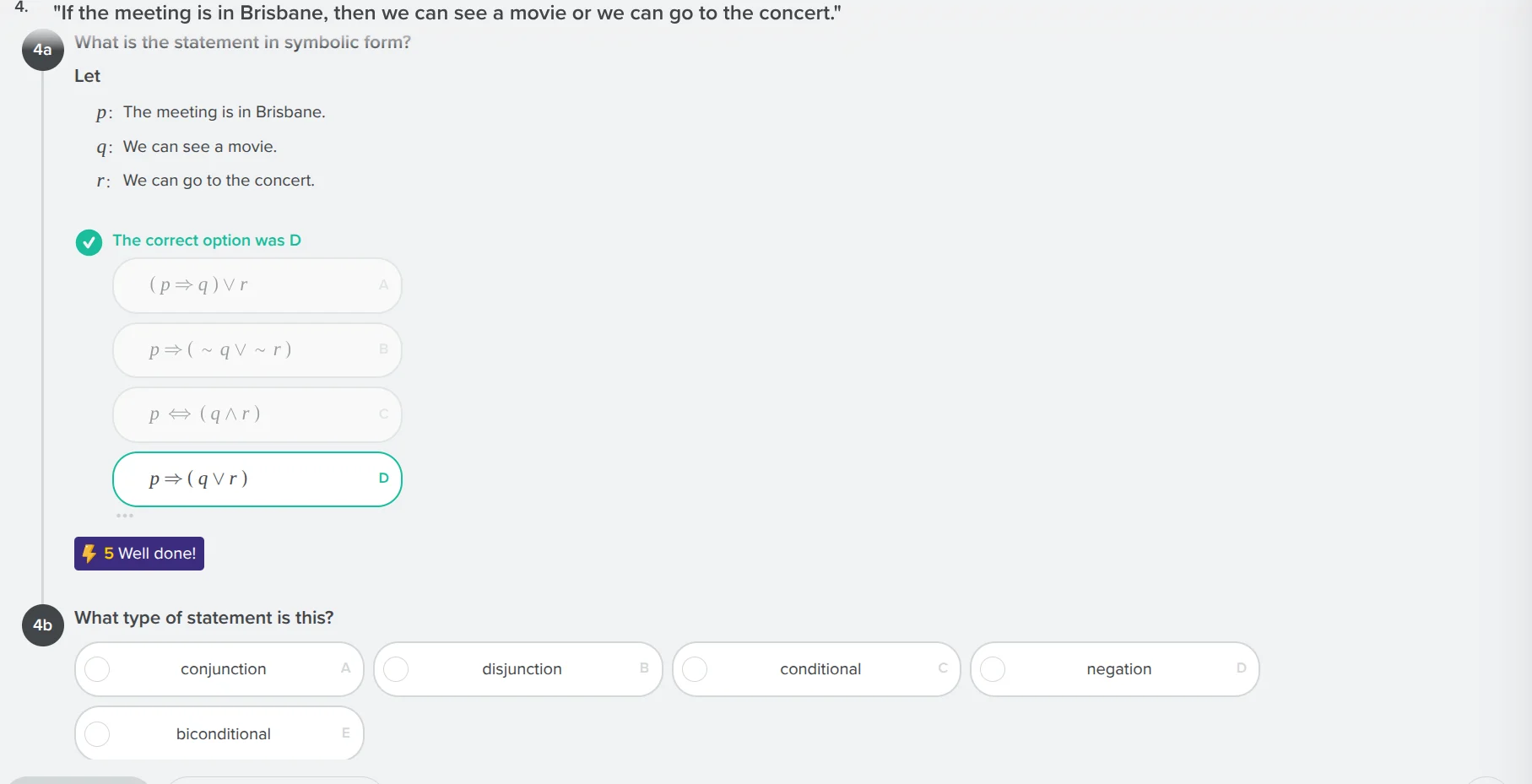
- \if the meeting is in brisbane, then we can see a movie or we can go to the concert.\ 4a what is the statement in symbolic form? let p: the meeting is in brisbane. q: we can see a movie. r: we can go to the concert. the correct option was d a ((p rightarrow q) vee r) b (p rightarrow (sim q vee sim r)) c (p leftrightarrow (q wedge r)) d (p rightarrow (q vee r)) 5 well done! 4b what type of statement is this? a conjunction b disjunction c conditional d negation e biconditional
Response
4b
Brief Explanations
A conditional statement has the form "If \( p \), then \( q \)" (symbolized as \( p \Rightarrow q \)). The given statement is "If the meeting is in Brisbane (\( p \)), then we can see a movie or go to the concert (\( q \vee r \))", which matches the conditional structure \( p \Rightarrow (q \vee r) \). Conjunction is \( \wedge \) (and), disjunction is \( \vee \) (or) but not in an "if - then" structure, negation is \( \sim \) (not), and biconditional is \( \Leftrightarrow \) (if and only if), so it's a conditional.

Snap & solve any problem in the app
Get step-by-step solutions on Sovi AI
Photo-based solutions with guided steps
Explore more problems and detailed explanations
C. conditional