QUESTION IMAGE
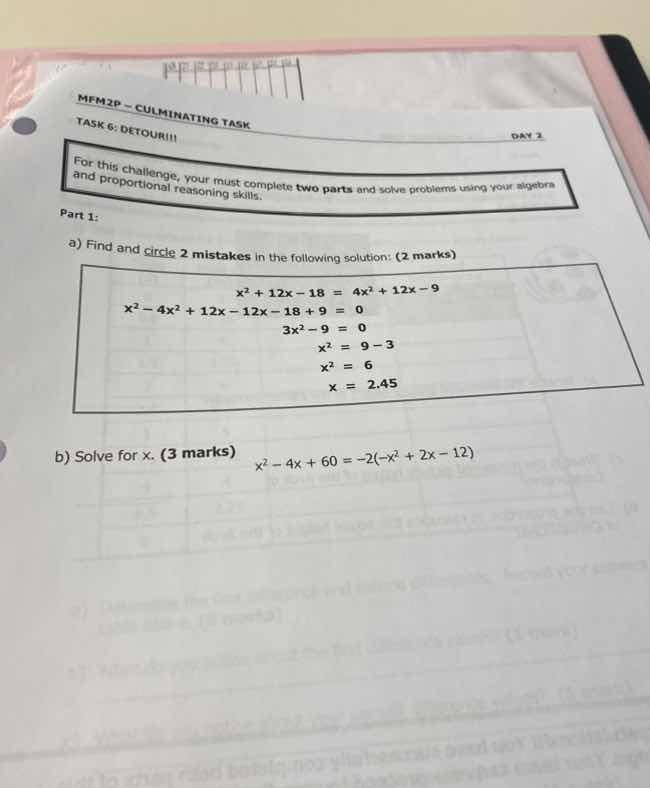
Question
mfm2p - culminating task
task 6: detour!!!
day 3
for this challenge, your must complete two parts and solve problems using your algebra and proportional reasoning skills.
part 1:
a) find and circle 2 mistakes in the following solution: (2 marks)
$x^2 + 12x - 18 = 4x^2 + 12x - 9$
$x^2 - 4x^2 + 12x - 12x - 18 + 9 = 0$
$3x^2 - 9 = 0$
$x^2 = 9 - 3$
$x^2 = 6$
$x = 2.45$
b) solve for x. (3 marks)
$x^2 - 4x + 60 = -2(-x^2 + 2x - 12)$
Part a)
Step1: Identify first sign error
When moving $4x^2 + 12x - 9$ to the left side, the correct first step is:
$x^2 + 12x - 18 - 4x^2 - 12x + 9 = 0$
The original solution incorrectly kept $+4x^2$ and $+12x$ instead of flipping their signs.
Step2: Identify second arithmetic error
Combine like terms correctly:
$(1-4)x^2 + (12-12)x + (-18+9) = 0$
$-3x^2 - 9 = 0$
The original solution incorrectly calculated $1-4=3$ (should be $-3$) and $-18+9=0$ (should be $-9$), leading to wrong subsequent steps.
Part b)
Step1: Expand right-hand side
Distribute the $-2$ to each term inside the parentheses:
$x^2 - 4x + 60 = -2x^2 + 4x + 24$
Step2: Bring all terms to left side
Add $2x^2$, subtract $4x$, subtract $24$ from both sides to set equation to 0:
$x^2 + 2x^2 - 4x - 4x + 60 - 24 = 0$
Step3: Combine like terms
Simplify the left-hand side:
$3x^2 - 8x + 36 = 0$
Step4: Calculate discriminant
Use discriminant formula $\Delta = b^2 - 4ac$ for $ax^2+bx+c=0$:
$\Delta = (-8)^2 - 4(3)(36) = 64 - 432 = -368$
Since $\Delta < 0$, there are no real solutions for $x$.

Snap & solve any problem in the app
Get step-by-step solutions on Sovi AI
Photo-based solutions with guided steps
Explore more problems and detailed explanations
Part a)
- First mistake: Incorrect sign handling when rearranging terms (should be $x^2 + 12x - 18 - 4x^2 - 12x + 9 = 0$, not $x^2 - 4x^2 + 12x - 12x - 18 + 9 = 0$ with the wrong implied sign transfer of the original right-hand side).
- Second mistake: Incorrect combination of constants and leading coefficient (should be $-3x^2 - 9 = 0$, not $3x^2 - 9 = 0$).
Part b)
There are no real solutions for $x$ (the discriminant is negative, so only complex solutions exist: $x = \frac{4 \pm 2i\sqrt{23}}{3}$).