QUESTION IMAGE
Question
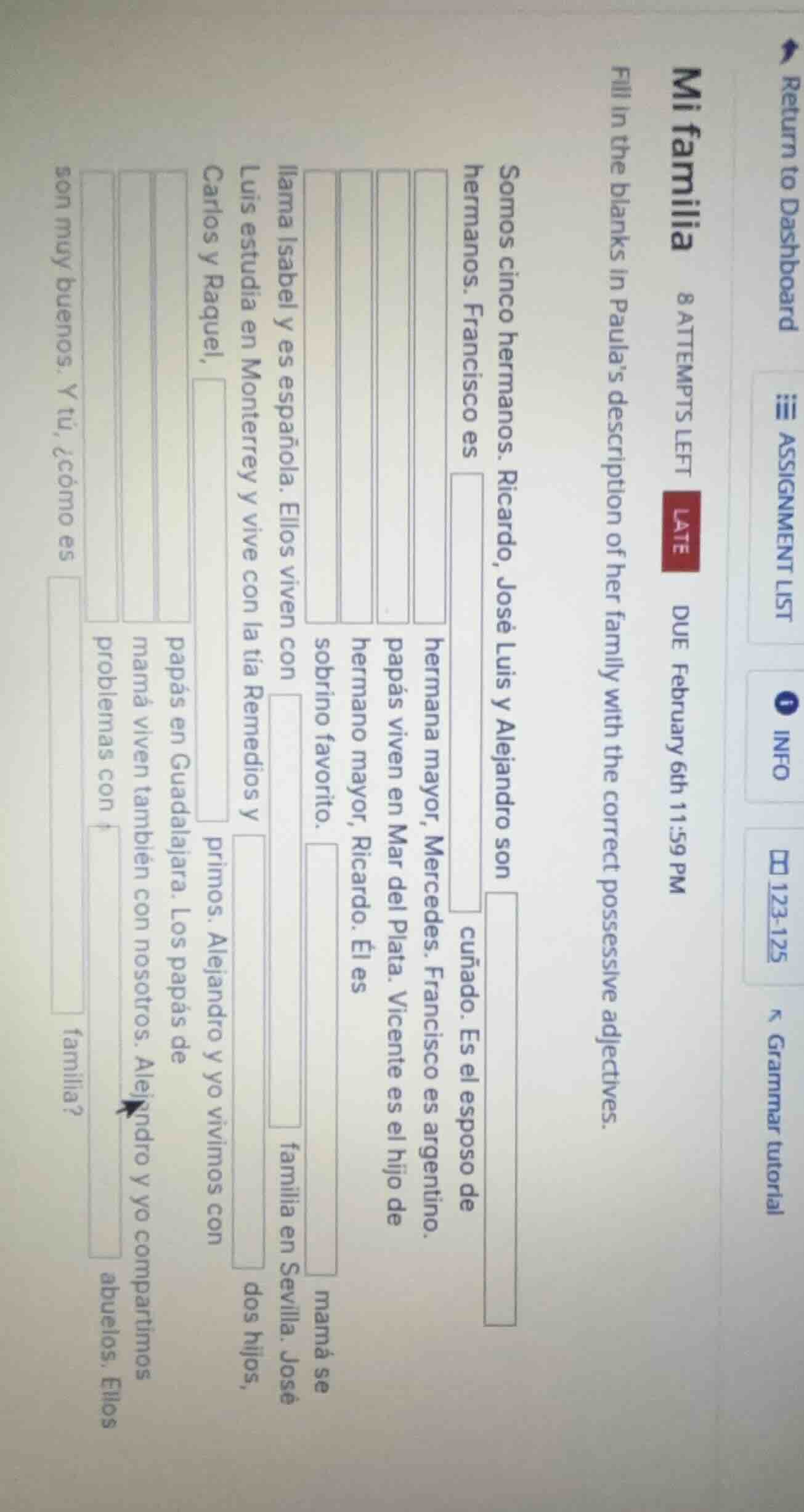
mi familia fill in the blanks in paulas description of her family with the correct possessive adjectives. somos cinco hermanos. ricardo, josé luis y alejandro son hermanos. francisco es cuñado. es el esposo de hermana mayor, mercedes. francisco es argentino. papás viven en mar del plata. vicente es el hijo de hermano mayor, ricardo. él es sobrino favorito. llama isabel y es española. ellos viven con familia en sevilla. josé luis estudia en monterrey y vive con la tía remedios y primos. alejandro y yo vivimos con papás en guadalajara. los papás de mamá viven también con nosotros. alejandro y yo compartimos problemas con abuelos. ellos son muy buenos. y tú, ¿cómo es familia?
To solve this fill - in - the - blank exercise about Paula's family using possessive adjectives in Spanish, we analyze each blank based on the context of family relationships:
1. First blank (after "Francisco es")
The context says "Somos cinco hermanos. Ricardo, José Luis y Alejandro son hermanos. Francisco es ____ cuñado. Es el esposo de ____ hermana mayor, Mercedes." Since Francisco is the brother - in - law (cuñado) and Mercedes is the sister, we need to show the relationship. The correct possessive adjective here is "mi" (my) because from Paula's perspective, Francisco is her brother - in - law. So we fill in "mi".
2. Second blank (before "hermana mayor")
As Mercedes is Paula's sister, the possessive adjective "mi" is used again. So we fill in "mi".
3. Third blank (after "Vicente es el hijo de")
The text says "papás viven en Mar del Plata. Vicente es el hijo de ______". Since Vicente's parents (papás) live in Mar del Plata, and from Paula's perspective, these are her parents, we use "mis" (my, plural) because "papás" is plural. So we fill in "mis".
4. Fourth blank (after "Él es ______ sobrino favorito")
Vicente is the nephew, and from Paula's perspective, he is her favorite nephew. So we use "mi" (my). So we fill in "mi".
5. Fifth blank (after "Ellos viven con ______ familia en Sevilla")
The text is about Isabel (who is Spanish) and her family. The subject here is "Ellos" (they, Isabel and her family), but from Paula's description, we can assume it's "su" (their, but in the context of Isabel's family, "su" is appropriate as "their" in Spanish for "su familia" meaning "their family"). So we fill in "su".
6. Sixth blank (after "José Luis estudia en Monterrey y vive con la tía Remedios y ______ primos")
José Luis lives with Aunt Remedios and his cousins. The possessive adjective for "his" (from José Luis' perspective, but in the context of Paula's description) is "sus" (his, plural) because "primos" is plural. So we fill in "sus".
7. Seventh blank (after "Alejandro y yo vivimos con ______ abuelos")
Alejandro and Paula live with their grandparents. The possessive adjective for "our" is "nuestros" (our, plural) because "abuelos" is plural. So we fill in "nuestros".
8. Eighth blank (after "Alejandro y yo compartimos ____ problemas con ____ abuelos")
Alejandro and Paula share their problems with their grandparents. For the first blank, the possessive adjective for "our" (problems) is "nuestros" (our, plural as "problemas" is plural). For the second blank, for "our" (grandparents), we use "nuestros" again. So we fill in "nuestros" for the first and "nuestros" for the second.
9. Ninth blank (after "Y tú, ¿cómo es ______ familia?")
This is a question asking about the other person's family, so we use "tu" (your). So we fill in "tu".
The filled - in text would be:
Somos cinco hermanos. Ricardo, José Luis y Alejandro son hermanos. Francisco es mi cuñado. Es el esposo de mi hermana mayor, Mercedes. Francisco es argentino. Mis papás viven en Mar del Plata. Vicente es el hijo de mis papás. Él es mi sobrino favorito.
Llama Isabel y es española. Ellos viven con su familia en Sevilla. José Luis estudia en Monterrey y vive con la tía Remedios y sus primos. Carlos y Raquel, sus primos. Alejandro y yo vivimos con nuestros abuelos. Los papás de mamá viven también con nosotros. Alejandro y yo compartimos nuestros problemas con nuestros abuelos. Ellos son muy buenos. Y tú, ¿cómo es tu familia?

Snap & solve any problem in the app
Get step-by-step solutions on Sovi AI
Photo-based solutions with guided steps
Explore more problems and detailed explanations
To solve this fill - in - the - blank exercise about Paula's family using possessive adjectives in Spanish, we analyze each blank based on the context of family relationships:
1. First blank (after "Francisco es")
The context says "Somos cinco hermanos. Ricardo, José Luis y Alejandro son hermanos. Francisco es ____ cuñado. Es el esposo de ____ hermana mayor, Mercedes." Since Francisco is the brother - in - law (cuñado) and Mercedes is the sister, we need to show the relationship. The correct possessive adjective here is "mi" (my) because from Paula's perspective, Francisco is her brother - in - law. So we fill in "mi".
2. Second blank (before "hermana mayor")
As Mercedes is Paula's sister, the possessive adjective "mi" is used again. So we fill in "mi".
3. Third blank (after "Vicente es el hijo de")
The text says "papás viven en Mar del Plata. Vicente es el hijo de ______". Since Vicente's parents (papás) live in Mar del Plata, and from Paula's perspective, these are her parents, we use "mis" (my, plural) because "papás" is plural. So we fill in "mis".
4. Fourth blank (after "Él es ______ sobrino favorito")
Vicente is the nephew, and from Paula's perspective, he is her favorite nephew. So we use "mi" (my). So we fill in "mi".
5. Fifth blank (after "Ellos viven con ______ familia en Sevilla")
The text is about Isabel (who is Spanish) and her family. The subject here is "Ellos" (they, Isabel and her family), but from Paula's description, we can assume it's "su" (their, but in the context of Isabel's family, "su" is appropriate as "their" in Spanish for "su familia" meaning "their family"). So we fill in "su".
6. Sixth blank (after "José Luis estudia en Monterrey y vive con la tía Remedios y ______ primos")
José Luis lives with Aunt Remedios and his cousins. The possessive adjective for "his" (from José Luis' perspective, but in the context of Paula's description) is "sus" (his, plural) because "primos" is plural. So we fill in "sus".
7. Seventh blank (after "Alejandro y yo vivimos con ______ abuelos")
Alejandro and Paula live with their grandparents. The possessive adjective for "our" is "nuestros" (our, plural) because "abuelos" is plural. So we fill in "nuestros".
8. Eighth blank (after "Alejandro y yo compartimos ____ problemas con ____ abuelos")
Alejandro and Paula share their problems with their grandparents. For the first blank, the possessive adjective for "our" (problems) is "nuestros" (our, plural as "problemas" is plural). For the second blank, for "our" (grandparents), we use "nuestros" again. So we fill in "nuestros" for the first and "nuestros" for the second.
9. Ninth blank (after "Y tú, ¿cómo es ______ familia?")
This is a question asking about the other person's family, so we use "tu" (your). So we fill in "tu".
The filled - in text would be:
Somos cinco hermanos. Ricardo, José Luis y Alejandro son hermanos. Francisco es mi cuñado. Es el esposo de mi hermana mayor, Mercedes. Francisco es argentino. Mis papás viven en Mar del Plata. Vicente es el hijo de mis papás. Él es mi sobrino favorito.
Llama Isabel y es española. Ellos viven con su familia en Sevilla. José Luis estudia en Monterrey y vive con la tía Remedios y sus primos. Carlos y Raquel, sus primos. Alejandro y yo vivimos con nuestros abuelos. Los papás de mamá viven también con nosotros. Alejandro y yo compartimos nuestros problemas con nuestros abuelos. Ellos son muy buenos. Y tú, ¿cómo es tu familia?