QUESTION IMAGE
Question
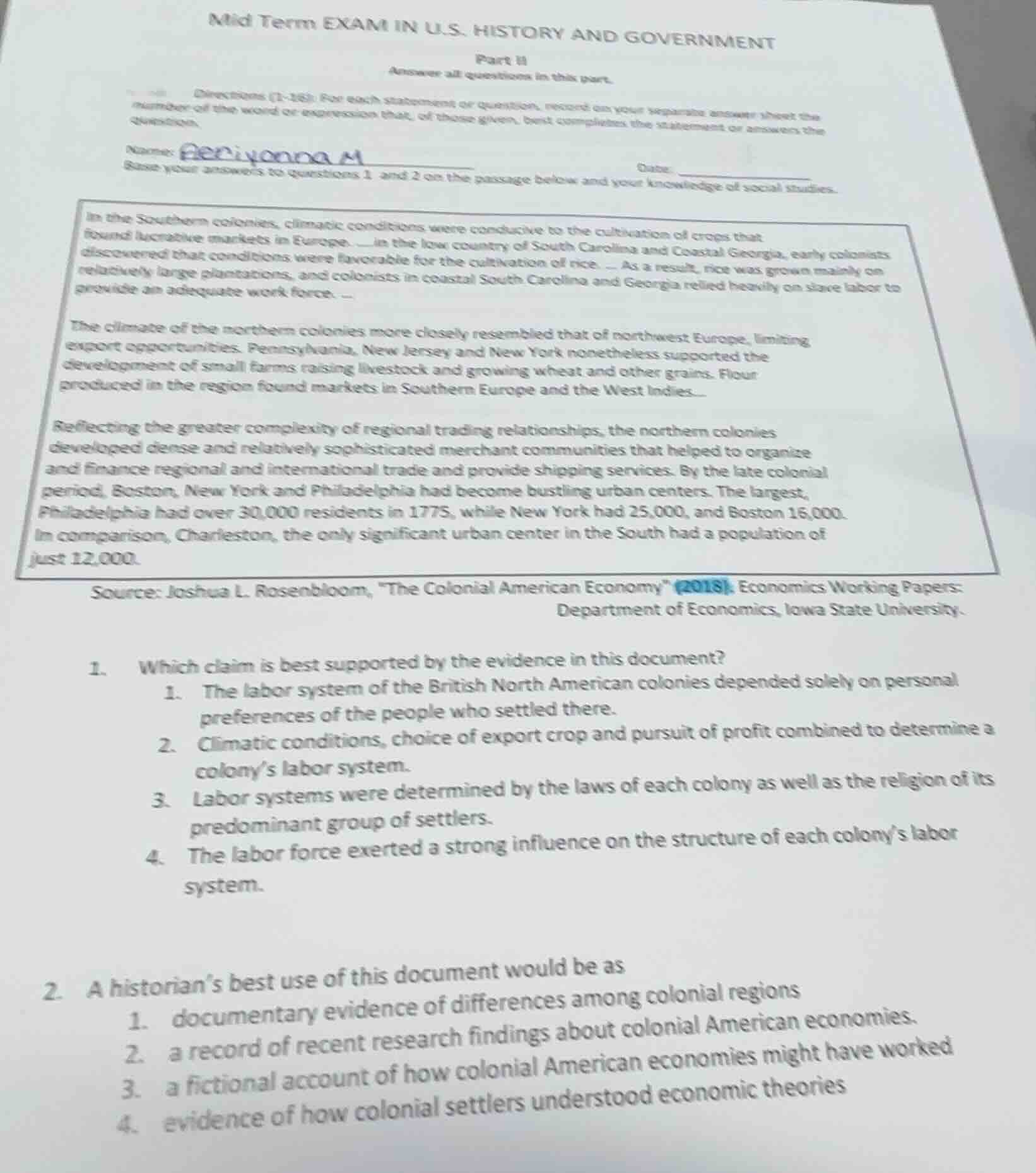
mid term exam in u.s. history and government
part ii
answer all questions in this part.
directions (1-18): for each statement or question, record on your separate answer sheet the number of the word or expression that, of those given, best completes the statement or answers the question.
name: beriyonna m
date:
base your answers to questions 1 and 2 on the passage below and your knowledge of social studies.
in the southern colonies, climatic conditions were conducive to the cultivation of crops that found lucrative markets in europe. ... in the low country of south carolina and coastal georgia, early colonists discovered that conditions were favorable for the cultivation of rice. ... as a result, rice was grown mainly on relatively large plantations, and colonists in coastal south carolina and georgia relied heavily on slave labor to provide an adequate work force. ...
the climate of the northern colonies more closely resembled that of northwest europe, limiting export opportunities. pennsylvania, new jersey and new york nonetheless supported the development of small farms raising livestock and growing wheat and other grains. flour produced in the region found markets in southern europe and the west indies. ...
reflecting the greater complexity of regional trading relationships, the northern colonies developed dense and relatively sophisticated merchant communities that helped to organize and finance regional and international trade and provide shipping services. by the late colonial period, boston, new york and philadelphia had become bustling urban centers. the largest, philadelphia had over 30,000 residents in 1775, while new york had 25,000, and boston 16,000. in comparison, charleston, the only significant urban center in the south had a population of just 12,000.
source: joshua l. rosenbloom, \the colonial american economy\ (2018). economics working papers: department of economics, iowa state university.
- which claim is best supported by the evidence in this document?
- the labor system of the british north american colonies depended solely on personal preferences of the people who settled there.
- climatic conditions, choice of export crop and pursuit of profit combined to determine a colony’s labor system.
- labor systems were determined by the laws of each colony as well as the religion of its predominant group of settlers.
- the labor force exerted a strong influence on the structure of each colony’s labor system.
- a historian’s best use of this document would be as
- documentary evidence of differences among colonial regions
- a record of recent research findings about colonial american economies.
- a fictional account of how colonial american economies might have worked
- evidence of how colonial settlers understood economic theories
- For question 1: The passage links Southern colonies' climate to rice cultivation, which required slave labor for profit; Northern colonies' climate led to small farms without heavy slave reliance. This shows climate, export crops, and profit shaped labor systems, matching option 2. Other options are unsupported: the passage does not mention personal preferences, laws/religion, or labor force influencing labor systems.
- For question 2: The document is an academic working paper comparing Northern and Southern colonial economies, labor systems, and urbanization. It provides direct documentary evidence of regional colonial differences, making option 1 correct. It is not fictional, not just a record of recent research findings (it presents historical evidence), and does not show settlers' understanding of economic theories.

Snap & solve any problem in the app
Get step-by-step solutions on Sovi AI
Photo-based solutions with guided steps
Explore more problems and detailed explanations
- 2. Climatic conditions, choice of export crop and pursuit of profit combined to determine a colony’s labor system.
- 1. documentary evidence of differences among colonial regions