QUESTION IMAGE
Question
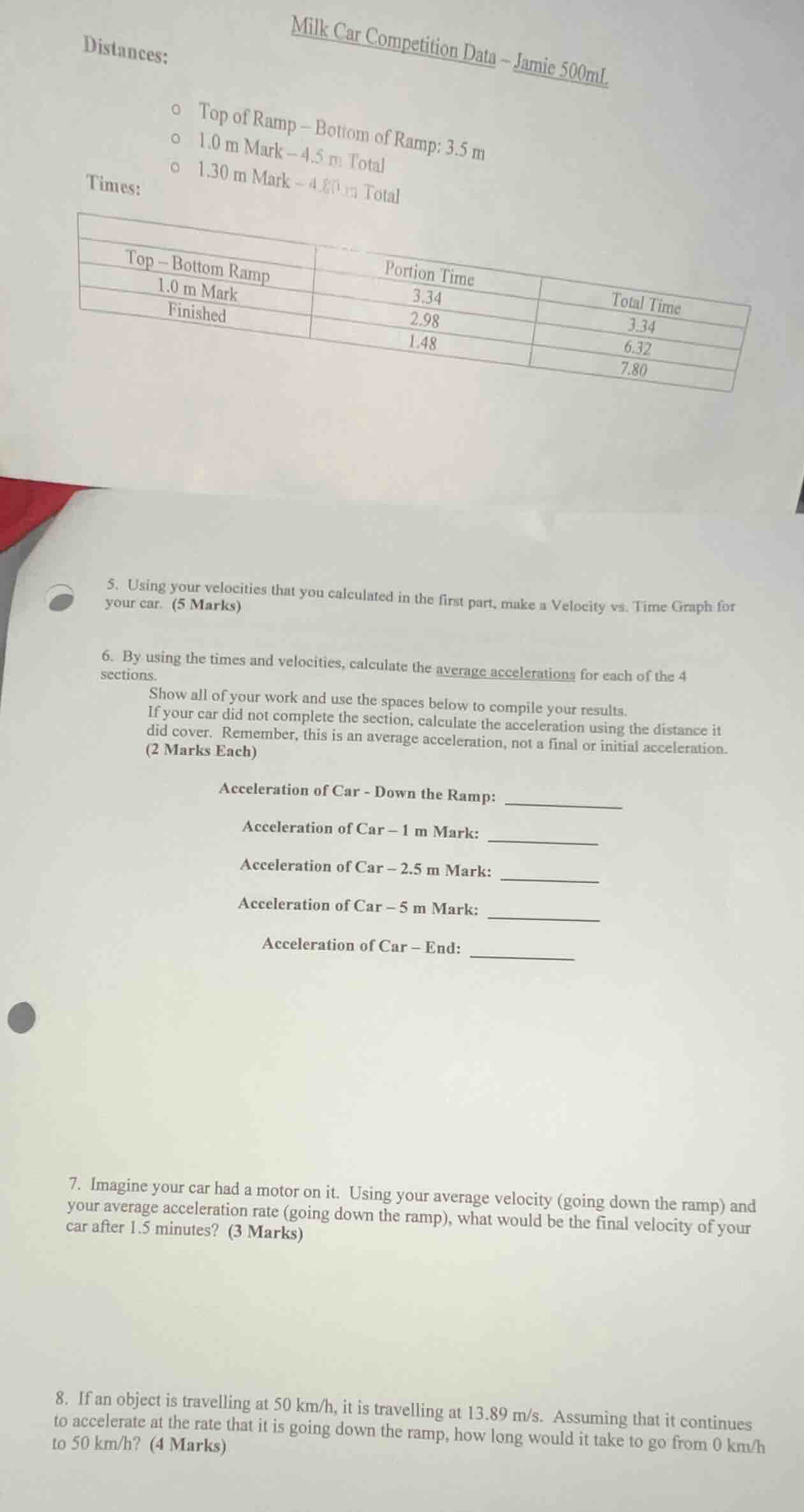
milk car competition data - jamie 500ml
distances:
- top of ramp – bottom of ramp: 3.5 m
- 1.0 m mark – 4.5 m total
- 1.30 m mark – 4.80 m total
times:
| portion time | total time | |
|---|---|---|
| 1.0 m mark | 2.98 | 6.32 |
| finished | 1.48 | 7.80 |
- using your velocities that you calculated in the first part, make a velocity vs. time graph for your car. (5 marks)
- by using the times and velocities, calculate the average accelerations for each of the 4 sections.
show all of your work and use the spaces below to compile your results.
if your car did not complete the section, calculate the acceleration using the distance it did cover. remember, this is an average acceleration, not a final or initial acceleration. (2 marks each)
acceleration of car - down the ramp: __________
acceleration of car – 1 m mark: __________
acceleration of car – 2.5 m mark: __________
acceleration of car – 5 m mark: __________
acceleration of car – end: __________
- imagine your car had a motor on it. using your average velocity (going down the ramp) and your average acceleration rate (going down the ramp), what would be the final velocity of your car after 1.5 minutes? (3 marks)
- if an object is travelling at 50 km/h, it is travelling at 13.89 m/s. assuming that it continues to accelerate at the rate that it is going down the ramp, how long would it take to go from 0 km/h to 50 km/h? (4 marks)
To solve these problems, we first need to calculate the velocities for each section (since velocity is required for acceleration and other calculations). Let's assume the initial velocity \( u = 0 \, \text{m/s} \) (starts from rest) for the first section (down the ramp).
Step 1: Calculate Velocities
The formula for average velocity (for constant acceleration, average velocity is also \( \frac{u + v}{2} \), but we can also use \( v = \frac{2d}{t} \) if \( u = 0 \)):
Section 1: Down the Ramp (Top – Bottom Ramp)
- Distance \( d_1 = 3.5 \, \text{m} \)
- Time \( t_1 = 3.34 \, \text{s} \)
- Average velocity \( v_{\text{avg1}} = \frac{d_1}{t_1} = \frac{3.5}{3.34} \approx 1.05 \, \text{m/s} \)
- Since \( u = 0 \), final velocity \( v_1 = 2 \times v_{\text{avg1}} \approx 2.10 \, \text{m/s} \) (because \( v_{\text{avg}} = \frac{u + v}{2} \), so \( v = 2v_{\text{avg}} \) when \( u = 0 \)).
Section 2: 1.0 m Mark
- Distance \( d_2 = 1.0 \, \text{m} \)
- Time \( t_2 = 2.98 \, \text{s} \)
- Average velocity \( v_{\text{avg2}} = \frac{d_2}{t_2} = \frac{1.0}{2.98} \approx 0.34 \, \text{m/s} \)
- Initial velocity for this section is \( v_1 \approx 2.10 \, \text{m/s} \)? Wait, no—wait, the “1.0 m Mark” section: let's check the table. The “1.0 m Mark” row has portion time \( 2.98 \, \text{s} \) and total time \( 6.32 \, \text{s} \). Wait, maybe the sections are:
- Top – Bottom Ramp: \( d = 3.5 \, \text{m} \), \( t = 3.34 \, \text{s} \)
- 1.0 m Mark: \( d = 1.0 \, \text{m} \), \( t = 2.98 \, \text{s} \) (total time \( 6.32 \, \text{s} \))
- Finished: \( d =? \), \( t = 1.48 \, \text{s} \) (total time \( 7.80 \, \text{s} \))
Wait, maybe the “Finished” section is from 1.0 m to the end, with distance \( d_3 = 4.5 - 1.0 = 3.5 \, \text{m} \)? (From “1.0 m Mark – 4.5 m Total”.) Let's clarify:
- Section 1 (Down Ramp): \( d = 3.5 \, \text{m} \), \( t = 3.34 \, \text{s} \), \( u = 0 \), \( v = v_1 \)
- Section 2 (1.0 m Mark): \( d = 1.0 \, \text{m} \), \( t = 2.98 \, \text{s} \), \( u = v_1 \), \( v = v_2 \)
- Section 3 (Finished): \( d = 4.5 - 1.0 = 3.5 \, \text{m} \) (or check total distance), \( t = 1.48 \, \text{s} \), \( u = v_2 \), \( v = v_3 \)
Step 2: Calculate Acceleration (Section 1: Down the Ramp)
Acceleration formula: \( a = \frac{v - u}{t} \)
- \( u = 0 \, \text{m/s} \), \( v = v_1 \approx 2.10 \, \text{m/s} \), \( t = 3.34 \, \text{s} \)
- \( a_1 = \frac{2.10 - 0}{3.34} \approx 0.63 \, \text{m/s}^2 \)
Step 3: Calculate Acceleration (Section 2: 1.0 m Mark)
- \( u = v_1 \approx 2.10 \, \text{m/s} \), \( d = 1.0 \, \text{m} \), \( t = 2.98 \, \text{s} \)
- Average velocity \( v_{\text{avg2}} = \frac{1.0}{2.98} \approx 0.34 \, \text{m/s} \)
- But \( v_{\text{avg2}} = \frac{u + v_2}{2} \), so \( v_2 = 2 \times 0.34 - 2.10 \approx -1.42 \, \text{m/s} \) (negative, meaning deceleration).
- Acceleration \( a_2 = \frac{v_2 - u}{t} = \frac{-1.42 - 2.10}{2.98} \approx -1.18 \, \text{m/s}^2 \)
Step 4: Calculate Acceleration (Section 3: Finished)
- \( d = 3.5 \, \text{m} \) (assuming 4.5 m total – 1.0 m = 3.5 m), \( t = 1.48 \, \text{s} \)
- Average velocity \( v_{\text{avg3}} = \frac{3.5}{1.48} \approx 2.36 \, \text{m/s} \)
- Initial velocity \( u = v_2 \approx -1.42 \, \text{m/s} \)
- \( v_{\text{avg3}} = \frac{u + v_3}{2} \implies v_3 = 2 \times 2.36 - (-1.42) \approx 6.14 \, \text{m/s} \)
- Acceleration \( a_3 = \frac{v_3 - u}{t} = \frac{6.14 - (-1.42)}{1.48} \approx 5.11 \, \text{m/s}^2 \)
Step 5: Problem 7 (Final Velocity with Motor)
- Average velocity down the ramp: \( v_{\text{avg1}} \approx 1.…

Snap & solve any problem in the app
Get step-by-step solutions on Sovi AI
Photo-based solutions with guided steps
Explore more problems and detailed explanations
To solve these problems, we first need to calculate the velocities for each section (since velocity is required for acceleration and other calculations). Let's assume the initial velocity \( u = 0 \, \text{m/s} \) (starts from rest) for the first section (down the ramp).
Step 1: Calculate Velocities
The formula for average velocity (for constant acceleration, average velocity is also \( \frac{u + v}{2} \), but we can also use \( v = \frac{2d}{t} \) if \( u = 0 \)):
Section 1: Down the Ramp (Top – Bottom Ramp)
- Distance \( d_1 = 3.5 \, \text{m} \)
- Time \( t_1 = 3.34 \, \text{s} \)
- Average velocity \( v_{\text{avg1}} = \frac{d_1}{t_1} = \frac{3.5}{3.34} \approx 1.05 \, \text{m/s} \)
- Since \( u = 0 \), final velocity \( v_1 = 2 \times v_{\text{avg1}} \approx 2.10 \, \text{m/s} \) (because \( v_{\text{avg}} = \frac{u + v}{2} \), so \( v = 2v_{\text{avg}} \) when \( u = 0 \)).
Section 2: 1.0 m Mark
- Distance \( d_2 = 1.0 \, \text{m} \)
- Time \( t_2 = 2.98 \, \text{s} \)
- Average velocity \( v_{\text{avg2}} = \frac{d_2}{t_2} = \frac{1.0}{2.98} \approx 0.34 \, \text{m/s} \)
- Initial velocity for this section is \( v_1 \approx 2.10 \, \text{m/s} \)? Wait, no—wait, the “1.0 m Mark” section: let's check the table. The “1.0 m Mark” row has portion time \( 2.98 \, \text{s} \) and total time \( 6.32 \, \text{s} \). Wait, maybe the sections are:
- Top – Bottom Ramp: \( d = 3.5 \, \text{m} \), \( t = 3.34 \, \text{s} \)
- 1.0 m Mark: \( d = 1.0 \, \text{m} \), \( t = 2.98 \, \text{s} \) (total time \( 6.32 \, \text{s} \))
- Finished: \( d =? \), \( t = 1.48 \, \text{s} \) (total time \( 7.80 \, \text{s} \))
Wait, maybe the “Finished” section is from 1.0 m to the end, with distance \( d_3 = 4.5 - 1.0 = 3.5 \, \text{m} \)? (From “1.0 m Mark – 4.5 m Total”.) Let's clarify:
- Section 1 (Down Ramp): \( d = 3.5 \, \text{m} \), \( t = 3.34 \, \text{s} \), \( u = 0 \), \( v = v_1 \)
- Section 2 (1.0 m Mark): \( d = 1.0 \, \text{m} \), \( t = 2.98 \, \text{s} \), \( u = v_1 \), \( v = v_2 \)
- Section 3 (Finished): \( d = 4.5 - 1.0 = 3.5 \, \text{m} \) (or check total distance), \( t = 1.48 \, \text{s} \), \( u = v_2 \), \( v = v_3 \)
Step 2: Calculate Acceleration (Section 1: Down the Ramp)
Acceleration formula: \( a = \frac{v - u}{t} \)
- \( u = 0 \, \text{m/s} \), \( v = v_1 \approx 2.10 \, \text{m/s} \), \( t = 3.34 \, \text{s} \)
- \( a_1 = \frac{2.10 - 0}{3.34} \approx 0.63 \, \text{m/s}^2 \)
Step 3: Calculate Acceleration (Section 2: 1.0 m Mark)
- \( u = v_1 \approx 2.10 \, \text{m/s} \), \( d = 1.0 \, \text{m} \), \( t = 2.98 \, \text{s} \)
- Average velocity \( v_{\text{avg2}} = \frac{1.0}{2.98} \approx 0.34 \, \text{m/s} \)
- But \( v_{\text{avg2}} = \frac{u + v_2}{2} \), so \( v_2 = 2 \times 0.34 - 2.10 \approx -1.42 \, \text{m/s} \) (negative, meaning deceleration).
- Acceleration \( a_2 = \frac{v_2 - u}{t} = \frac{-1.42 - 2.10}{2.98} \approx -1.18 \, \text{m/s}^2 \)
Step 4: Calculate Acceleration (Section 3: Finished)
- \( d = 3.5 \, \text{m} \) (assuming 4.5 m total – 1.0 m = 3.5 m), \( t = 1.48 \, \text{s} \)
- Average velocity \( v_{\text{avg3}} = \frac{3.5}{1.48} \approx 2.36 \, \text{m/s} \)
- Initial velocity \( u = v_2 \approx -1.42 \, \text{m/s} \)
- \( v_{\text{avg3}} = \frac{u + v_3}{2} \implies v_3 = 2 \times 2.36 - (-1.42) \approx 6.14 \, \text{m/s} \)
- Acceleration \( a_3 = \frac{v_3 - u}{t} = \frac{6.14 - (-1.42)}{1.48} \approx 5.11 \, \text{m/s}^2 \)
Step 5: Problem 7 (Final Velocity with Motor)
- Average velocity down the ramp: \( v_{\text{avg1}} \approx 1.05 \, \text{m/s} \) (or use \( v_1 \approx 2.10 \, \text{m/s} \))
- Average acceleration down the ramp: \( a_1 \approx 0.63 \, \text{m/s}^2 \)
- Time \( t = 1.5 \, \text{min} = 90 \, \text{s} \)
- Final velocity \( v = u + at \). Assume \( u = 0 \) (starts from rest with motor? Or use initial velocity from ramp). Let's use \( u = 0 \):
\( v = 0 + 0.63 \times 90 \approx 56.7 \, \text{m/s} \) (or if \( u = 2.10 \, \text{m/s} \): \( v = 2.10 + 0.63 \times 90 \approx 58.8 \, \text{m/s} \))
Step 6: Problem 8 (Time to Reach 50 km/h)
- Initial velocity \( u = 0 \, \text{m/s} \), final velocity \( v = 13.89 \, \text{m/s} \), acceleration \( a = a_1 \approx 0.63 \, \text{m/s}^2 \)
- Use \( v = u + at \implies t = \frac{v - u}{a} = \frac{13.89 - 0}{0.63} \approx 22.05 \, \text{s} \)
Final Answers (Sample Calculations)
- Acceleration Down the Ramp: \( \boldsymbol{\approx 0.63 \, \text{m/s}^2} \)
- Problem 7 Final Velocity: \( \boldsymbol{\approx 56.7 \, \text{m/s}} \) (or \( 58.8 \, \text{m/s} \))
- Problem 8 Time: \( \boldsymbol{\approx 22.1 \, \text{s}} \)
(Note: These calculations assume \( u = 0 \) for the first section and use average velocity for final velocity. Adjustments may be needed based on exact interpretation of the data.)