QUESTION IMAGE
Question
mitosis stations student response sheet name: annah
station 1: what are chromosomes?
summarize the function of each term in the table below.
read this station’s card and complete the activities below.
| term | function / description |
|---|---|
| 2. chromatin | |
| 3. dna | contains genetic information |
| 4. sister chromatids | |
| 5. chromosome | |
| 6. centromere |
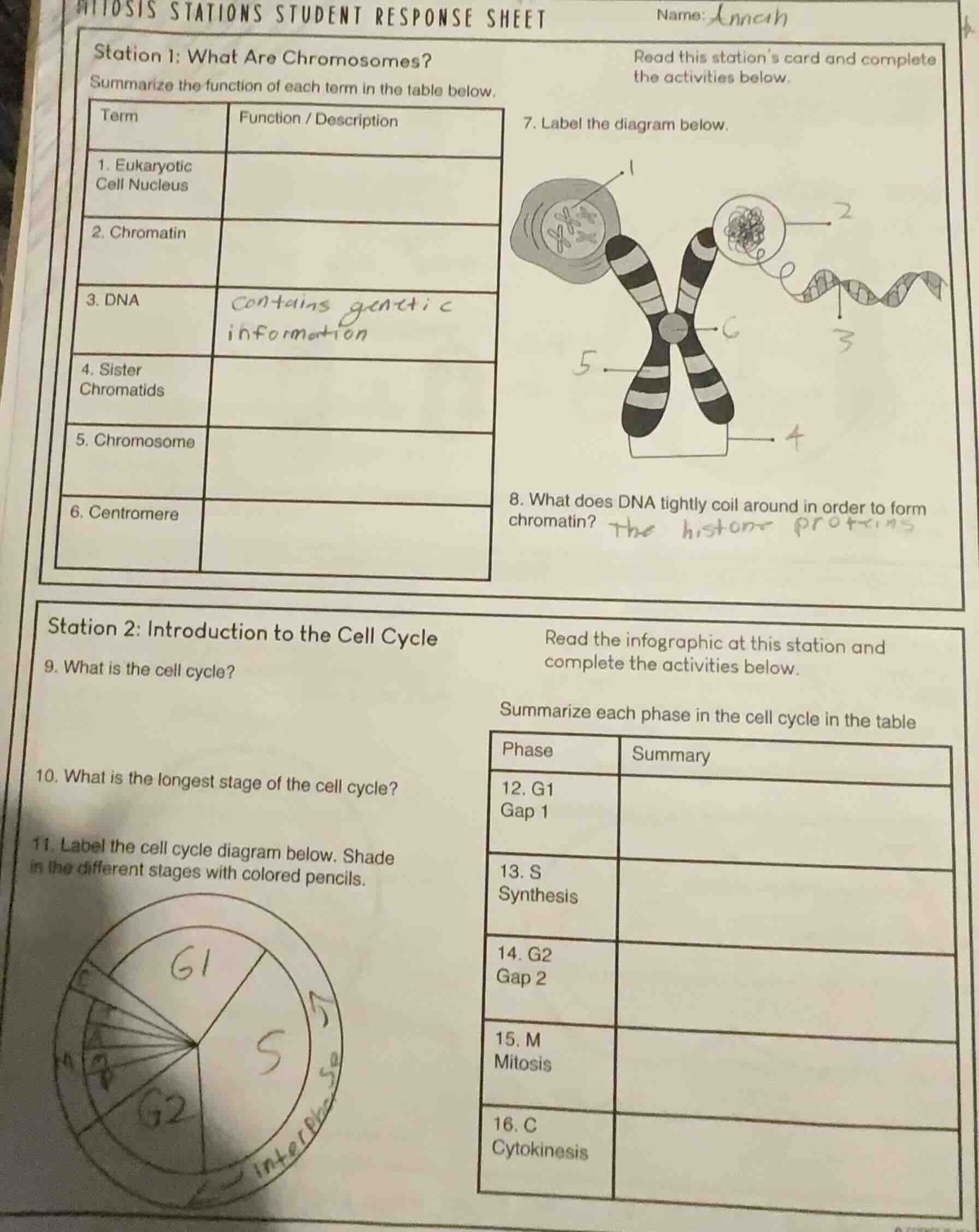
- label the diagram below.
diagram of chromosome structure with labels 1,2,3,4,5,6
- what does dna tightly coil around in order to form chromatin? the histone proteins
station 2: introduction to the cell cycle
read the infographic at this station and complete the activities below.
- what is the cell cycle?
- what is the longest stage of the cell cycle?
- label the cell cycle diagram below. shade in the different stages with colored pencils.
diagram of cell cycle with labels g1, s, g2, m, c
| phase | summary |
|---|---|
| 13. s synthesis | |
| 14. g2 gap 2 | |
| 15. m mitosis | |
| 16. c cytokinesis |
Step1: Fill Station 1 table terms
1. Eukaryotic Cell Nucleus:
Stores genetic material (DNA/chromatin)
2. Chromatin:
Loosely coiled DNA + proteins
3. DNA:
Contains genetic information (already completed)
4. Sister Chromatids:
Identical replicated DNA strands
5. Chromosome:
Tightly condensed chromatin (for cell division)
6. Centromere:
Joins sister chromatids together
Step2: Label Station 1 diagram
- Nucleus (contains chromosomes)
- Chromatin (loose DNA-protein complex)
- DNA (raw genetic material strand)
- Chromosome (condensed structure)
- Sister Chromatid (one half of chromosome)
C. Centromere (joins sister chromatids)
Step3: Answer Station 1 Q8
DNA coils around histone proteins (already completed correctly)
Step4: Answer Station 2 Q9
The cell cycle is the sequence of growth, DNA replication, and division that a eukaryotic cell undergoes to produce two identical daughter cells.
Step5: Answer Station 2 Q10
The longest stage of the cell cycle is Interphase (which includes G1, S, and G2 phases; G1 is typically the longest sub-phase).
Step6: Label Station 2 diagram
- Largest segment: G1 (Gap 1)
- Next largest: S (Synthesis)
- Next: G2 (Gap 2)
- Smallest segments: M (Mitosis) and C (Cytokinesis)
Step7: Fill Station 2 phase table
12. G1 Gap 1:
Cell grows, carries out normal functions, prepares for DNA replication
13. S Synthesis:
Cell replicates its entire DNA genome
14. G2 Gap 2:
Cell grows more, produces organelles/proteins for cell division
15. M Mitosis:
Nucleus divides; sister chromatids separate into two new nuclei
16. C Cytokinesis:
Cytoplasm divides, forming two identical daughter cells

Snap & solve any problem in the app
Get step-by-step solutions on Sovi AI
Photo-based solutions with guided steps
Explore more problems and detailed explanations
Station 1: What Are Chromosomes?
| Term | Function / Description |
|---|---|
| 2. Chromatin | Loose DNA + protein complex |
| 3. DNA | Contains genetic information |
| 4. Sister Chromatids | Identical replicated DNA strands |
| 5. Chromosome | Condensed chromatin for division |
| 6. Centromere | Joins sister chromatids |
- Diagram Labels:
- Nucleus
- Chromatin
- DNA
- Chromosome
- Sister Chromatid
C. Centromere
- Histone proteins
---
Station 2: Introduction to the Cell Cycle
- The cell cycle is the ordered sequence of cell growth, DNA replication, and division to produce two identical daughter cells.
- Interphase (specifically the G1 sub-phase)
- Diagram Labels (match segments):
- Largest segment: G1 (Gap 1)
- Next largest: S (Synthesis)
- Next: G2 (Gap 2)
- Smallest segments: M (Mitosis), C (Cytokinesis)
| Phase | Summary |
|---|---|
| 13. S Synthesis | DNA genome is fully replicated |
| 14. G2 Gap 2 | Cell prepares for mitosis |
| 15. M Mitosis | Nucleus divides into two identical nuclei |
| 16. C Cytokinesis | Cytoplasm splits into two daughter cells |