QUESTION IMAGE
Question
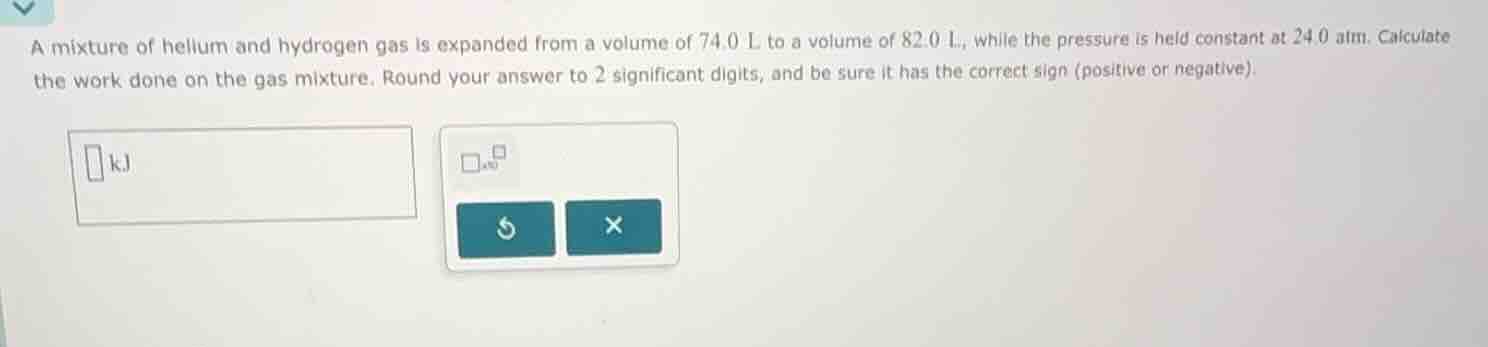
a mixture of helium and hydrogen gas is expanded from a volume of 74.0 l to a volume of 82.0 l, while the pressure is held constant at 24.0 atm. calculate the work done on the gas mixture. round your answer to 2 significant digits, and be sure it has the correct sign (positive or negative).
Step1: Recall the formula for work at constant pressure
The formula for work done by a gas at constant pressure is \( W = -P\Delta V \), where \( P \) is the pressure and \( \Delta V = V_2 - V_1 \) is the change in volume. When we want the work done on the gas, we can use \( W_{\text{on gas}} = P\Delta V \) (with sign considerations: if the gas expands, \( \Delta V \) is positive, and work done on the gas will be negative because the gas is doing work on the surroundings, or we can derive it from the sign convention). First, calculate \( \Delta V \).
\( \Delta V = V_2 - V_1 = 82.0\space L - 74.0\space L = 8.0\space L \)
Step2: Convert pressure and volume to appropriate units for work in joules
We know that \( 1\space atm \cdot L = 101.325\space J \). The pressure \( P = 24.0\space atm \), volume change \( \Delta V = 8.0\space L \). The work done by the gas is \( W_{\text{by gas}} = -P\Delta V \) (from thermodynamics, work done by gas is \( P\Delta V \) with sign: if volume increases, work done by gas is positive, work done on gas is negative). Wait, let's clarify the sign convention. The formula for work done on the gas: when the gas expands (\( V_2 > V_1 \)), the surroundings do negative work on the gas (or the gas does positive work on the surroundings). So \( W_{\text{on gas}} = -P\Delta V \) (since \( W_{\text{by gas}} = P\Delta V \), and \( W_{\text{on gas}} = -W_{\text{by gas}} \)).
First, calculate \( P\Delta V \) in \( atm \cdot L \):
\( P\Delta V = 24.0\space atm \times 8.0\space L = 192\space atm \cdot L \)
Now convert to joules:
\( 192\space atm \cdot L \times 101.325\space J/(atm \cdot L) = 192 \times 101.325\space J \)
\( 192 \times 101.325 = 19454.4\space J \)
But since the gas is expanding, work done on the gas is negative (because the gas is doing work on the surroundings). So \( W_{\text{on gas}} = -P\Delta V \) (in terms of the formula for work on gas, when volume increases, \( \Delta V \) is positive, so \( W = -P\Delta V \) gives negative work on gas). Wait, let's re - express:
The work done by the gas is \( W_{\text{by}} = P\Delta V \) (when pressure is constant, \( W = \int P dV = P\Delta V \) for constant \( P \)). So work done on the gas is \( W_{\text{on}} = -W_{\text{by}} = -P\Delta V \).
So \( W_{\text{on}} = - 24.0\space atm \times 8.0\space L \) (in \( atm \cdot L \)) then convert to joules.
Wait, no, first compute \( P\Delta V \) in \( atm \cdot L \), then convert to joules, then apply the sign.
So \( P\Delta V = 24.0 \times 8.0 = 192\space atm \cdot L \)
Convert to joules: \( 192 \times 101.325 = 19454.4\space J = 19.4544\space kJ \)
But since the gas is expanding, work done on the gas is negative. So \( W_{\text{on gas}} = - 19.4544\space kJ \approx - 19\space kJ \) (rounded to 2 significant digits)? Wait, wait, 24.0 has 3 significant digits, 8.0 has 2? Wait, 74.0 and 82.0 have 3 significant digits, so \( \Delta V = 8.0\space L \) (2 significant digits? Wait, 82.0 - 74.0 = 8.0, which has 2 decimal places? No, 82.0 - 74.0 = 8.0, so two significant digits? Wait, 74.0 and 82.0 are three significant digits, so \( \Delta V = 8.0\space L \) (three significant digits? 82.0 - 74.0 = 8.0, the trailing zero is significant because the original volumes have one decimal place. So \( \Delta V = 8.0\space L \) (three significant digits? Wait, 74.0 is three sig figs, 82.0 is three sig figs, so subtraction: 82.0 - 74.0 = 8.0 (the decimal place is from the original numbers, so 8.0 has two sig figs? Wait, no, 74.0 and 82.0 have three significant digits, so the result of subtraction is 8.0 (two decimal pla…

Snap & solve any problem in the app
Get step-by-step solutions on Sovi AI
Photo-based solutions with guided steps
Explore more problems and detailed explanations
\boxed{-19}