QUESTION IMAGE
Question
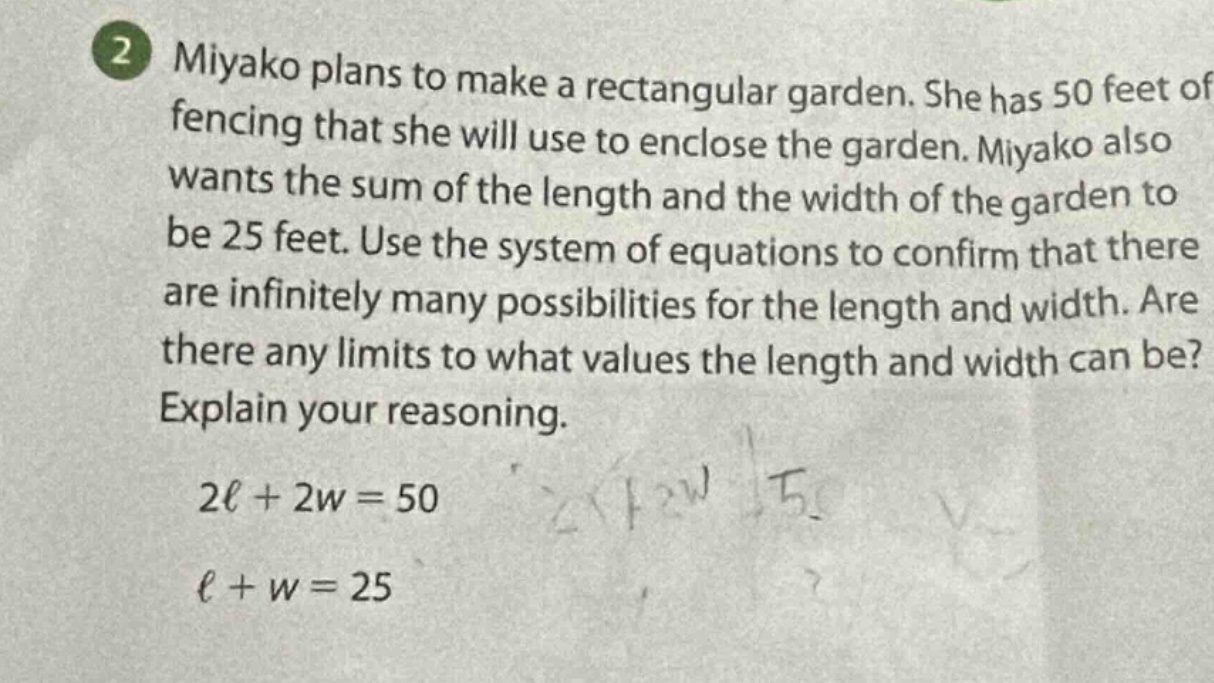
2 miyako plans to make a rectangular garden. she has 50 feet of fencing that she will use to enclose the garden. miyako also wants the sum of the length and the width of the garden to be 25 feet. use the system of equations to confirm that there are infinitely many possibilities for the length and width. are there any limits to what values the length and width can be? explain your reasoning.
$2\ell + 2w = 50$
$\ell + w = 25$
Step1: Simplify the first equation
The first equation is \(2\ell + 2w = 50\). We can divide the entire equation by 2.
\(\frac{2\ell + 2w}{2}=\frac{50}{2}\)
Which simplifies to \(\ell + w = 25\).
Step2: Analyze the system of equations
Now we have two equations:
- \(\ell + w = 25\) (from simplifying the first equation)
- \(\ell + w = 25\) (the second given equation)
This means both equations are identical. In a system of linear equations in two variables, if the two equations are the same (dependent equations), then there are infinitely many solutions. For any value of \(\ell\) (length), we can find \(w\) (width) by using \(w = 25-\ell\).
Step3: Determine limits on length and width
However, since length and width represent the dimensions of a garden, they must be positive real numbers. So we have the following inequalities:
\(\ell> 0\) and \(w=25 - \ell>0\)
From \(w = 25-\ell>0\), we can solve for \(\ell\):
\(25-\ell>0\)
\(-\ell>- 25\)
Multiplying both sides by - 1 (and reversing the inequality sign), we get \(\ell < 25\)
Combining with \(\ell>0\), we have \(0 < \ell<25\)
Similarly, for \(w\), since \(w=25 - \ell\) and \(0 < \ell<25\), when \(\ell = 0\), \(w = 25\) (but \(\ell\) can't be 0) and when \(\ell=25\), \(w = 0\) (but \(w\) can't be 0), so \(0 < w<25\)

Snap & solve any problem in the app
Get step-by-step solutions on Sovi AI
Photo-based solutions with guided steps
Explore more problems and detailed explanations
The two equations in the system are dependent (they are the same after simplifying the first equation), so there are infinitely many solutions for \(\ell\) (length) and \(w\) (width) in the form \(w = 25-\ell\). However, there are limits: both the length and the width must be positive real numbers. So \(0<\ell < 25\) and \(0 < w<25\) because a length or width of 0 or negative would not make sense for the dimensions of a garden.