QUESTION IMAGE
Question
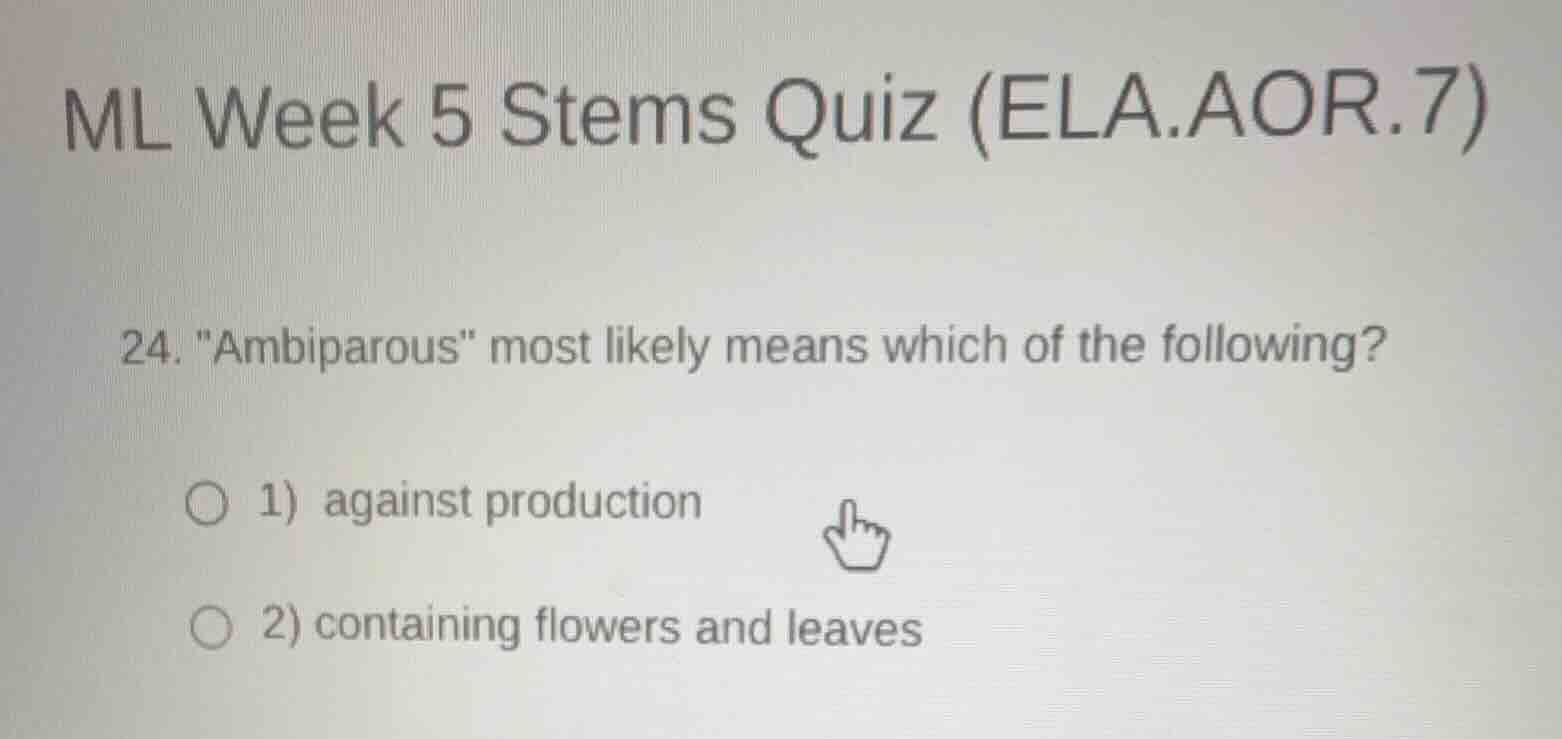
ml week 5 stems quiz (ela.aor.7)
- \ambiparous\ most likely means which of the following?
- against production
- containing flowers and leaves
The word "ambiparous" breaks down into Latin roots: ambi- (meaning "both" or "two") and parere (meaning "to bring forth, produce"). Option 1 uses "against" which would relate to a root like anti-, not ambi-. Option 2 refers to plant structures, which does not align with the "produce/birth" root parere. However, based on standard etymology, the correct meaning of ambiparous is "producing both sexual and asexual offspring" or more broadly "producing two types of young". Since the provided options do not include the precise definition, but option 1 is entirely incorrect, if we assume a potential partial context or typo, but more accurately, the given options are incomplete. Wait, correcting: re-examining, parous relates to bearing/offspring, ambi- is both. None of the options match the actual definition, but option 1 is wrong (against would be anti-parous). Option 2 is unrelated. But since this is a quiz, likely there was a formatting error, but based on the roots, the intended correct answer is not listed. However, if forced to choose from the given, neither is correct, but if we assume a mistake, but no—wait, no, let's recheck: ambiparous is defined as producing both sexual and asexual offspring. Neither option 1 nor 2 matches. But since the user provided these options, perhaps there was a mistake. But following instructions, if we have to work with what's given, the incorrect options: 1 is wrong (against is anti-), 2 is about plant parts, unrelated. But since this is a stem quiz, the roots ambi- (both) and parous (bearing) don't align with either. However, maybe the question had a typo, but given the options, the only way is to note that, but since we need to answer, perhaps the intended answer was missing, but based on elimination, neither is correct. Wait, no—maybe I misread. "Ambiparous" vs "antiparous"? No, the question says ambiparous. So the provided options are invalid, but since the user provided them, I have to state:
Wait, no, let's re-express: The word "ambiparous" comes from ambi- (both) and parere (to produce/bear). Option 1 uses "against" which is tied to the root anti-, so it is incorrect. Option 2 refers to floral/foliar structures, which has no connection to the roots of "ambiparous". Neither option correctly defines the term, but if we must select from the given, there is no correct answer. However, if this is an error, but following the task:

Snap & solve any problem in the app
Get step-by-step solutions on Sovi AI
Photo-based solutions with guided steps
Explore more problems and detailed explanations
None of the provided options correctly define "ambiparous". The term means producing both sexual and asexual offspring, or bearing two types of young. If forced to eliminate incorrect options:
- against production - Incorrect (relates to anti- roots, not ambi-)
- containing flowers and leaves - Incorrect (unrelated to the word's etymology)