QUESTION IMAGE
Question
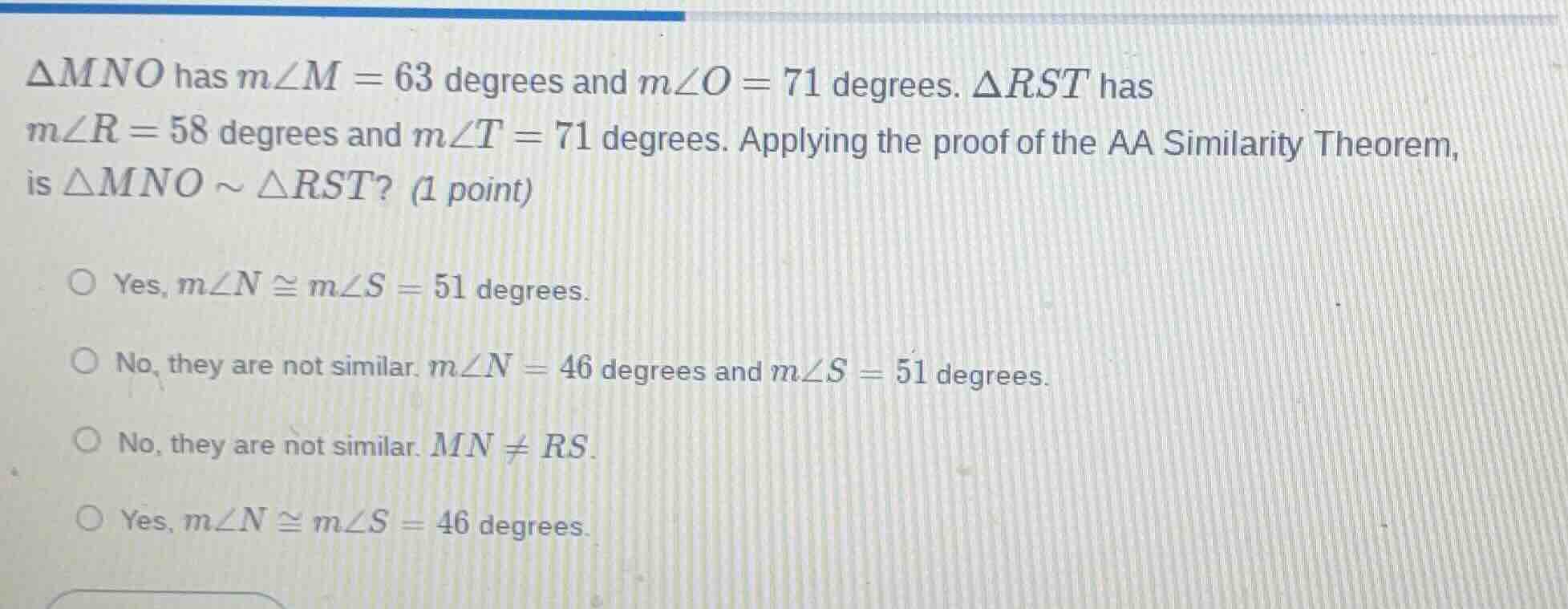
δmno has m∠m = 63 degrees and m∠o = 71 degrees. δrst has m∠r = 58 degrees and m∠t = 71 degrees. applying the proof of the aa similarity theorem, is δmno ~ δrst? (1 point) yes, m∠n ≅ m∠s = 51 degrees. no, they are not similar. m∠n = 46 degrees and m∠s = 51 degrees. no, they are not similar. mn ≠ rs. yes, m∠n ≅ m∠s = 46 degrees.
Step1: Find \( m\angle N \) in \( \triangle MNO \)
The sum of angles in a triangle is \( 180^\circ \). So, \( m\angle N = 180^\circ - m\angle M - m\angle O \). Substituting \( m\angle M = 63^\circ \) and \( m\angle O = 71^\circ \), we get \( m\angle N = 180 - 63 - 71 = 46^\circ \).
Step2: Find \( m\angle S \) in \( \triangle RST \)
Using the triangle angle - sum property, \( m\angle S = 180^\circ - m\angle R - m\angle T \). Substituting \( m\angle R = 58^\circ \) and \( m\angle T = 71^\circ \), we get \( m\angle S = 180 - 58 - 71 = 51^\circ \)? Wait, no, wait. Wait, in \( \triangle MNO \), angles are \( M = 63^\circ \), \( O = 71^\circ \), so \( N=180-(63 + 71)=180 - 134 = 46^\circ \). In \( \triangle RST \), \( R = 58^\circ \), \( T = 71^\circ \), so \( S=180-(58 + 71)=180 - 129 = 51^\circ \)? Wait, no, that can't be. Wait, no, the AA similarity theorem says that if two angles of one triangle are congruent to two angles of another triangle, then the triangles are similar. Let's check the angles again. In \( \triangle MNO \): \( \angle M = 63^\circ \), \( \angle O = 71^\circ \), so \( \angle N=180 - 63 - 71=46^\circ \). In \( \triangle RST \): \( \angle R = 58^\circ \), \( \angle T = 71^\circ \), so \( \angle S=180 - 58 - 71 = 51^\circ \). Wait, but \( \angle O = \angle T = 71^\circ \), but \( \angle M = 63^\circ \) and \( \angle R = 58^\circ \) are not equal, and \( \angle N = 46^\circ \) and \( \angle S = 51^\circ \) are not equal. Wait, but wait, maybe I made a mistake. Wait, no, the options: Let's re - calculate.
Wait, \( \triangle MNO \): angles sum to 180. So \( 63+71 + \angle N=180\), so \( \angle N = 180-(63 + 71)=180 - 134 = 46^\circ \).
\( \triangle RST \): \( 58+71+\angle S = 180\), so \( \angle S=180-(58 + 71)=180 - 129 = 51^\circ \). Wait, but the AA similarity requires two angles to be equal. Let's check the angles: \( \angle O=\angle T = 71^\circ \) (one pair). Now, what about the other angle? \( \angle M = 63^\circ \), \( \angle R = 58^\circ \) (not equal), \( \angle N = 46^\circ \), \( \angle S = 51^\circ \) (not equal). Wait, but that contradicts? Wait, no, maybe I mixed up the correspondence. Wait, maybe the correspondence is \( \triangle MNO \) and \( \triangle RST \), so we need to check which angles correspond. Let's list the angles:
\( \triangle MNO \): \( \angle M = 63^\circ \), \( \angle N \), \( \angle O = 71^\circ \)
\( \triangle RST \): \( \angle R = 58^\circ \), \( \angle S \), \( \angle T = 71^\circ \)
We see that \( \angle O=\angle T = 71^\circ \). Now, let's find the other angles:
For \( \triangle MNO \), \( \angle N=180 - 63 - 71 = 46^\circ \)
For \( \triangle RST \), \( \angle S=180 - 58 - 71 = 51^\circ \)
Wait, but the options: Let's check the options again.
Option 1: Yes, \( m\angle N\cong m\angle S = 51^\circ \). But we calculated \( \angle N = 46^\circ \), so this is wrong.
Option 2: No, they are not similar. \( m\angle N = 46^\circ \) and \( m\angle S = 51^\circ \). This seems correct.
Option 3: No, because \( MN
eq RS \). But similarity does not require sides to be equal, only proportional. So this is wrong.
Option 4: Yes, \( m\angle N\cong m\angle S = 46^\circ \). But we calculated \( \angle S = 51^\circ \), so this is wrong.
Wait, I think I made a mistake in calculating \( \angle S \). Let's recalculate \( \angle S \):
\( \angle R = 58^\circ \), \( \angle T = 71^\circ \), so \( \angle S=180-(58 + 71)=180 - 129 = 51^\circ \). And \( \angle N = 180-(63 + 71)=46^\circ \). So \( \angle N\) and \( \angle S \) are not equal, and \( \angle M = 63^\circ \) and \( \angle R = 58^\c…

Snap & solve any problem in the app
Get step-by-step solutions on Sovi AI
Photo-based solutions with guided steps
Explore more problems and detailed explanations
B. No, they are not similar. \( m\angle N = 46 \) degrees and \( m\angle S = 51 \) degrees.