QUESTION IMAGE
Question
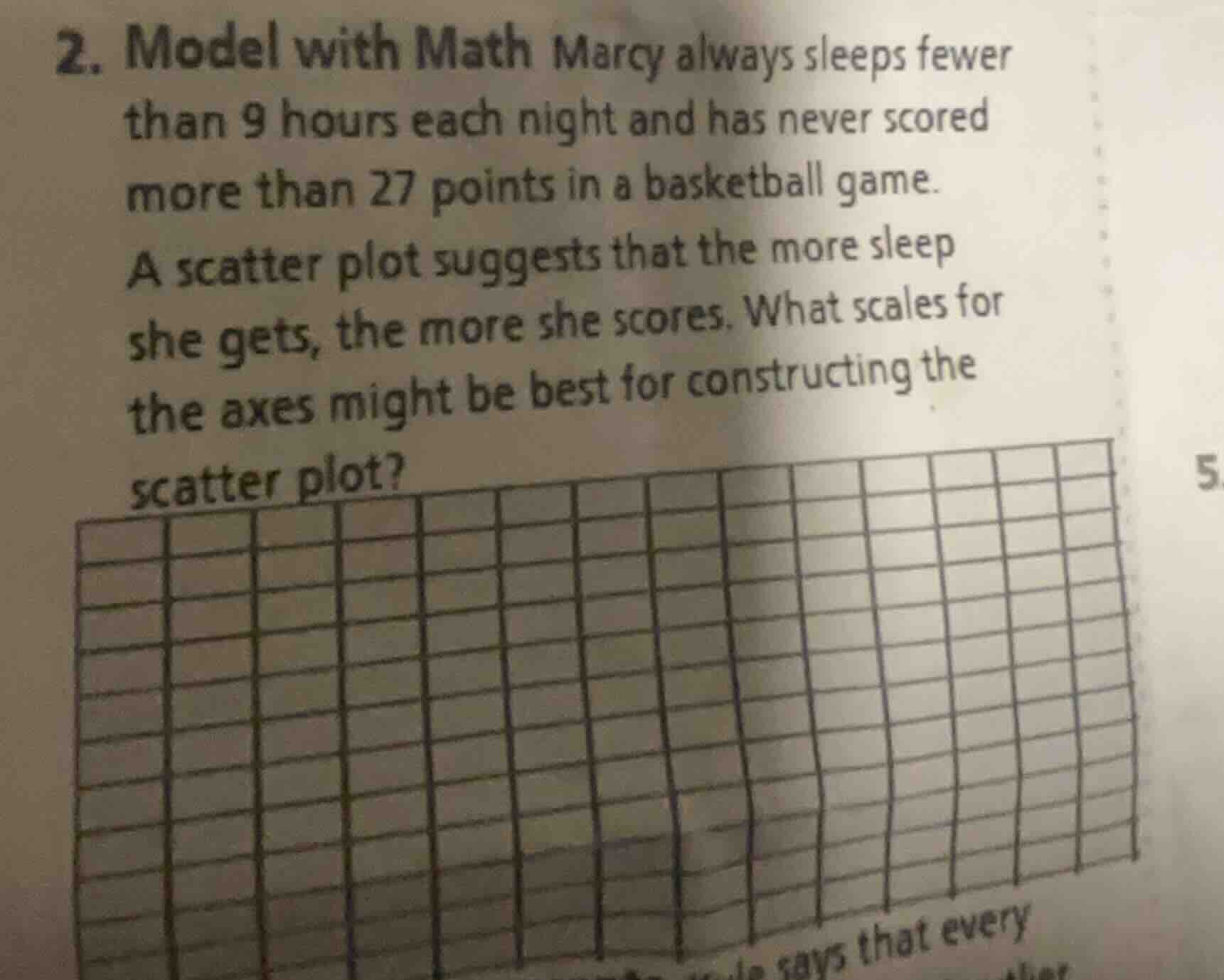
- model with math marcy always sleeps fewer than 9 hours each night and has never scored more than 27 points in a basketball game. a scatter plot suggests that the more sleep she gets, the more she scores. what scales for the axes might be best for constructing the scatter plot? says that every
Step1: Analyze sleep time range
Marcy sleeps fewer than 9 hours, so sleep time (x - axis) range is 0 - 9 (or reasonable sleep values, e.g., 4 - 9). A scale with interval 1 (e.g., 0 - 10, each grid 1 unit) works as 9 is small, 1 - unit scale shows details.
Step2: Analyze points scored range
She scores at most 27 points, so points (y - axis) range is 0 - 27. A scale with interval 3 (since 27 ÷ 9 = 3, or interval 1, but 27 with 1 - unit is long; 3 - unit: 0 - 30, each grid 3 units) is good. Or interval 1 for more detail, but 3 is efficient.
Step3: Recommend axes scales
For x - axis (sleep hours): 0 to 10, scale of 1 (covers <9, shows each hour). For y - axis (points): 0 to 30, scale of 3 (covers ≤27, 3 - unit intervals fit 27 (9 intervals) or scale of 1 (0 - 30, 1 - unit, more detailed). Common best: x - axis: 0–10 (scale 1), y - axis: 0–30 (scale 3) or 0–30 (scale 1).

Snap & solve any problem in the app
Get step-by-step solutions on Sovi AI
Photo-based solutions with guided steps
Explore more problems and detailed explanations
For the x - axis (sleep hours), a scale from 0 to 10 with an interval of 1 (each grid line represents 1 hour) is suitable. For the y - axis (basketball points), a scale from 0 to 30 with an interval of 3 (each grid line represents 3 points) or from 0 to 30 with an interval of 1 (for more detail) works well. A common optimal choice is: x - axis (sleep): 0–10, scale = 1; y - axis (points): 0–30, scale = 3 (or 1).