QUESTION IMAGE
Question
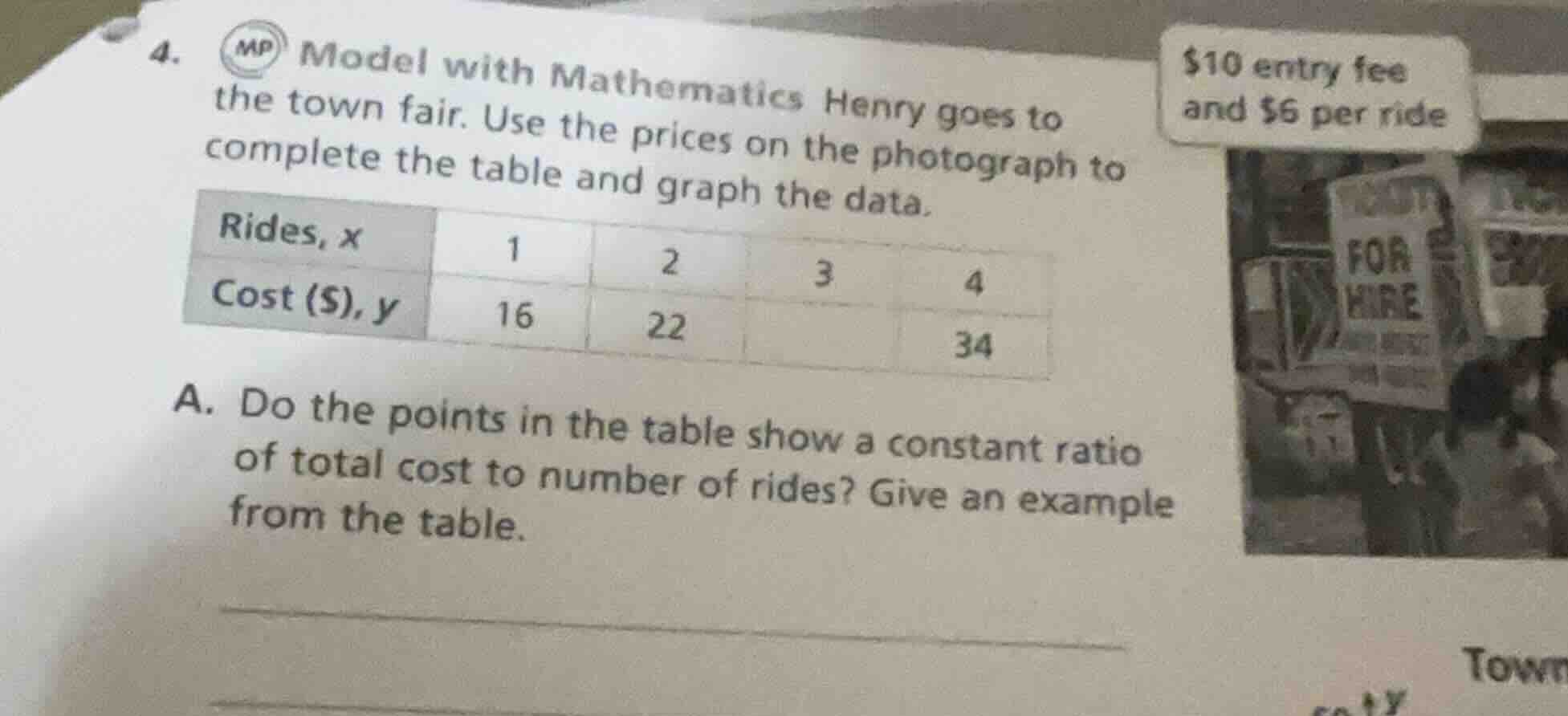
- model with mathematics henry goes to the town fair. use the prices on the photograph to complete the table and graph the data. $10 entry fee and $6 per ride
| rides, x | 1 | 2 | 3 | 4 |
|---|
a. do the points in the table show a constant ratio of total cost to number of rides? give an example from the table.
Step1: Recall the cost formula
The total cost \( y \) is given by the entry fee plus the cost per ride times the number of rides. So the formula is \( y = 10 + 6x \), where \( x \) is the number of rides. First, let's find the cost for 3 rides.
Step2: Calculate cost for 3 rides
Substitute \( x = 3 \) into the formula \( y = 10 + 6x \). So \( y = 10 + 6\times3 = 10 + 18 = 28 \). Now, let's check the ratios. For \( x = 1 \), \( y = 16 \), ratio \( \frac{16}{1}=16 \). For \( x = 2 \), \( y = 22 \), ratio \( \frac{22}{2} = 11 \). For \( x = 3 \), \( y = 28 \), ratio \( \frac{28}{3}\approx9.33 \). For \( x = 4 \), \( y = 34 \), ratio \( \frac{34}{4}=8.5 \). These ratios are not constant. An example is \( \frac{16}{1}=16 \) and \( \frac{22}{2}=11 \), which are different.

Snap & solve any problem in the app
Get step-by-step solutions on Sovi AI
Photo-based solutions with guided steps
Explore more problems and detailed explanations
First, complete the table: when \( x = 3 \), \( y = 10 + 6\times3 = 28 \). The points do not show a constant ratio. For example, the ratio of total cost to number of rides for 1 ride is \( \frac{16}{1}=16 \) and for 2 rides is \( \frac{22}{2}=11 \), which are not equal.