QUESTION IMAGE
Question
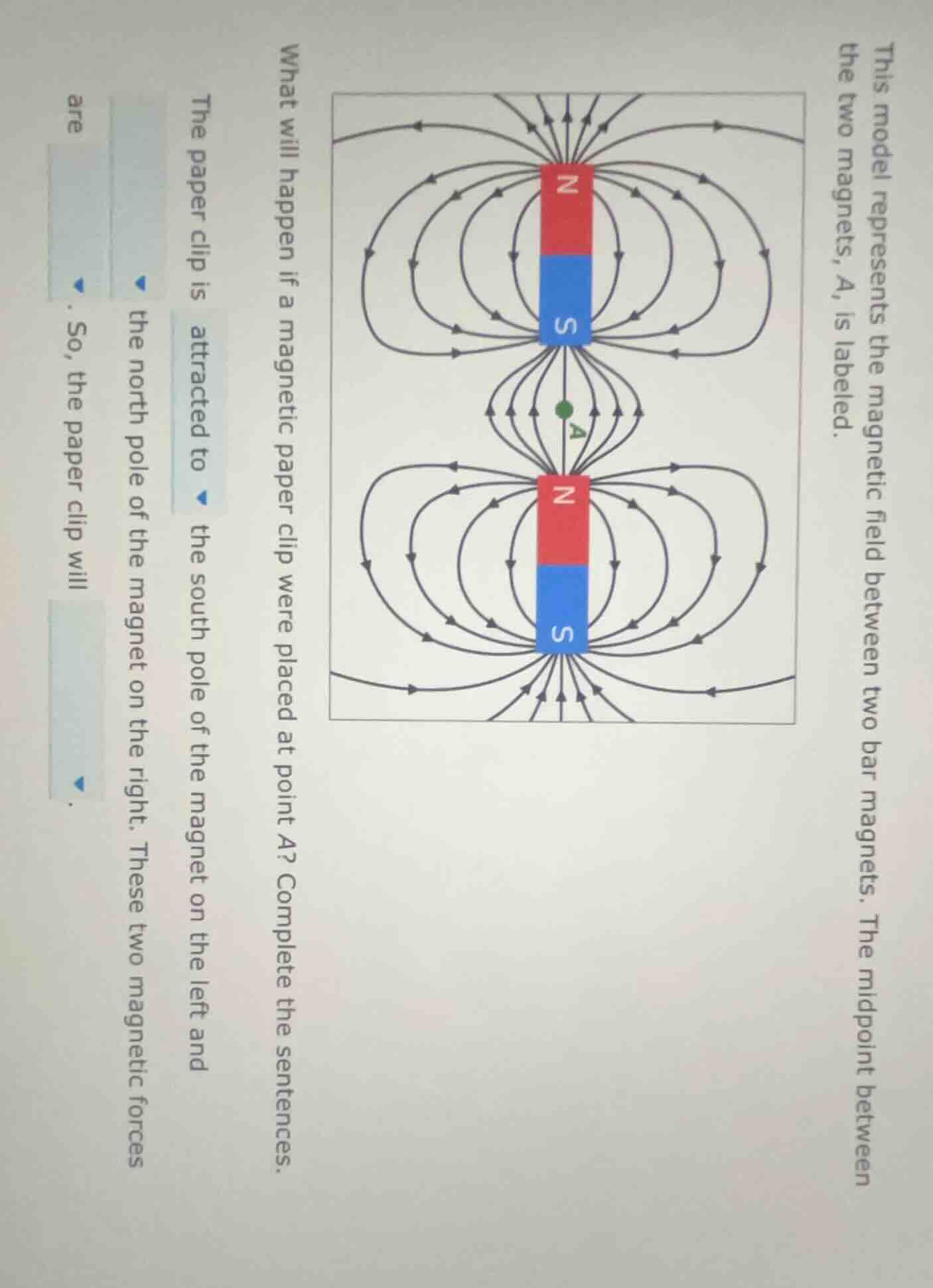
this model represents the magnetic field between two bar magnets. the midpoint between the two magnets, a, is labeled.
what will happen if a magnetic paper clip were placed at point a? complete the sentences.
the paper clip is attracted to the south pole of the magnet on the left and the north pole of the magnet on the right. these two magnetic forces are. so, the paper clip will.
- First blank: At point A, the magnetic field lines go from the N pole of the right magnet to the S pole of the left magnet? Wait, no, looking at the diagram: the top magnet has S at the bottom, bottom magnet has N at the top. So the magnetic field lines between them: from the N of the bottom magnet (right magnet's top is N) to the S of the top magnet (left magnet's bottom is S). So a paper clip (magnetic material) will be attracted to both poles? Wait, no, the first sentence: "The paper clip is attracted to the south pole of the magnet on the left and the north pole of the magnet on the right. These two magnetic forces are in the same direction (since both pull the clip towards the middle? Wait, no, the top magnet's bottom is S, bottom magnet's top is N. So the S of the top (left) magnet and N of the bottom (right) magnet. So the paper clip at A: the S pole of the top magnet attracts it (since paper clip is magnetic, will be induced with N pole near S, so attracted), and the N pole of the bottom magnet: paper clip will be induced with S pole near N, so attracted. So the forces: the S of top pulls it up? No, wait the top magnet is above A, bottom is below? Wait the diagram: top magnet is N (top) and S (bottom), bottom magnet is N (top) and S (bottom). So A is between the S of top and N of bottom. So the S of top magnet: magnetic field lines go into S, so towards S. The N of bottom magnet: magnetic field lines go out of N, so towards S (since field lines go from N to S). Wait, no, field lines go from N to S outside the magnet. So between the S of top (which is a S pole, so field lines go into it) and N of bottom (field lines go out of it). So the field lines between them go from N (bottom magnet's top) to S (top magnet's bottom). So the direction of field lines is upward (from bottom N to top S). Now, a paper clip at A: when placed in a magnetic field, it will be magnetized. The part near the S pole (top) will become N (since opposite poles attract), and the part near the N pole (bottom) will become S (opposite poles attract). So the S pole of the bottom magnet? Wait no, bottom magnet's top is N. So the paper clip: near the top S (of top magnet), the clip's top part is N (attracted to S), and near the bottom N (of bottom magnet), the clip's bottom part is S (attracted to N). Now, the force from the top S: pulls the clip up (towards S), and force from bottom N: pulls the clip down (towards N)? Wait no, that can't be. Wait maybe I got the magnets reversed. Wait the top magnet: red is N (top), blue is S (bottom). Bottom magnet: red is N (top), blue is S (bottom). So A is between the S (bottom of top magnet) and N (top of bottom magnet). So the S pole (bottom of top) and N pole (top of bottom). Now, magnetic attraction: a magnetic material (paper clip) near a S pole: the clip will have a N pole induced near the S, so attracted (pulled towards S). Near a N pole: the clip will have a S pole induced near the N, so attracted (pulled towards N). Wait, but S is above A, N is below A. So pulling towards S (up) and towards N (down)? That would be opposite directions. But that can't be. Wait maybe the magnets are arranged with top magnet's S and bottom magnet's N facing each other? Wait no, the top magnet's bottom is S, bottom magnet's top is N. So they are opposite poles (S and N) facing each other? Wait S and N: that would be attracting, so the field lines between them are from N (bottom) to S (top)? No, field lines go from N to S, so from bottom N to top S. So the field lines are upward (from bottom to top). Now, a paper clip in this field: th…

Snap & solve any problem in the app
Get step-by-step solutions on Sovi AI
Photo-based solutions with guided steps
Explore more problems and detailed explanations
- First blank: At point A, the magnetic field lines go from the N pole of the right magnet to the S pole of the left magnet? Wait, no, looking at the diagram: the top magnet has S at the bottom, bottom magnet has N at the top. So the magnetic field lines between them: from the N of the bottom magnet (right magnet's top is N) to the S of the top magnet (left magnet's bottom is S). So a paper clip (magnetic material) will be attracted to both poles? Wait, no, the first sentence: "The paper clip is attracted to the south pole of the magnet on the left and the north pole of the magnet on the right. These two magnetic forces are in the same direction (since both pull the clip towards the middle? Wait, no, the top magnet's bottom is S, bottom magnet's top is N. So the S of the top (left) magnet and N of the bottom (right) magnet. So the paper clip at A: the S pole of the top magnet attracts it (since paper clip is magnetic, will be induced with N pole near S, so attracted), and the N pole of the bottom magnet: paper clip will be induced with S pole near N, so attracted. So the forces: the S of top pulls it up? No, wait the top magnet is above A, bottom is below? Wait the diagram: top magnet is N (top) and S (bottom), bottom magnet is N (top) and S (bottom). So A is between the S of top and N of bottom. So the S of top magnet: magnetic field lines go into S, so towards S. The N of bottom magnet: magnetic field lines go out of N, so towards S (since field lines go from N to S). Wait, no, field lines go from N to S outside the magnet. So between the S of top (which is a S pole, so field lines go into it) and N of bottom (field lines go out of it). So the field lines between them go from N (bottom magnet's top) to S (top magnet's bottom). So the direction of field lines is upward (from bottom N to top S). Now, a paper clip at A: when placed in a magnetic field, it will be magnetized. The part near the S pole (top) will become N (since opposite poles attract), and the part near the N pole (bottom) will become S (opposite poles attract). So the S pole of the bottom magnet? Wait no, bottom magnet's top is N. So the paper clip: near the top S (of top magnet), the clip's top part is N (attracted to S), and near the bottom N (of bottom magnet), the clip's bottom part is S (attracted to N). Now, the force from the top S: pulls the clip up (towards S), and force from bottom N: pulls the clip down (towards N)? Wait no, that can't be. Wait maybe I got the magnets reversed. Wait the top magnet: red is N (top), blue is S (bottom). Bottom magnet: red is N (top), blue is S (bottom). So A is between the S (bottom of top magnet) and N (top of bottom magnet). So the S pole (bottom of top) and N pole (top of bottom). Now, magnetic attraction: a magnetic material (paper clip) near a S pole: the clip will have a N pole induced near the S, so attracted (pulled towards S). Near a N pole: the clip will have a S pole induced near the N, so attracted (pulled towards N). Wait, but S is above A, N is below A. So pulling towards S (up) and towards N (down)? That would be opposite directions. But that can't be. Wait maybe the magnets are arranged with top magnet's S and bottom magnet's N facing each other? Wait no, the top magnet's bottom is S, bottom magnet's top is N. So they are opposite poles (S and N) facing each other? Wait S and N: that would be attracting, so the field lines between them are from N (bottom) to S (top)? No, field lines go from N to S, so from bottom N to top S. So the field lines are upward (from bottom to top). Now, a paper clip in this field: the magnetic forces. Wait, maybe the two forces (from S of top and N of bottom) are in the same direction. Wait, no, S of top: attracts the clip (pulls it up towards S), N of bottom: attracts the clip (pulls it down towards N)? That would be opposite. But that doesn't make sense. Wait maybe the magnets are arranged with top magnet's S and bottom magnet's N, so they are attracting each other (since S and N attract), so the field between them is strong, and the paper clip is attracted towards the middle (both magnets pull it towards the middle? Wait no, top magnet is above, bottom below. If S (top) and N (bottom) are attracting, the distance between them is small, and the clip is in between. So the S of top pulls the clip up, N of bottom pulls it down? No, that's opposite. But maybe the forces are in the same direction. Wait, maybe I made a mistake. Let's re-express: the top magnet's bottom is S, bottom magnet's top is N. So the S pole and N pole are facing each other (since S and N attract), so the magnetic field between them is from N (bottom) to S (top) (since field lines go from N to S). So the paper clip at A: when placed in this field, it will be magnetized. The end near the S (top) will be N (attracted to S), and the end near the N (bottom) will be S (attracted to N). Now, the force from S (top) on the clip's N end: pulls it up (towards S). The force from N (bottom) on the clip's S end: pulls it down (towards N). Wait, that's opposite directions. But that can't be. Wait maybe the magnets are arranged with top magnet's S and bottom magnet's N, so the field lines between them are in the same direction (both pulling the clip towards the middle? No, top is above, bottom below. Wait maybe the two forces are in the same direction, meaning they add up. Wait, maybe the S of top and N of bottom are both pulling the clip towards the middle (the area between them). Wait, no, S is above A, N is below A. So pulling towards S (up) and towards N (down) would be opposite. But maybe I got the magnets' positions wrong. Wait the diagram: top magnet is N (top) and S (bottom), bottom magnet is N (top) and S (bottom). So A is between the S of top and N of bottom. So the S pole (top magnet's bottom) and N pole (bottom magnet's top) are facing each other. So they are opposite poles, so the magnetic field between them is strong, and the field lines go from N (bottom) to S (top). Now, a paper clip in this field: the magnetic forces. The key is that the two magnetic forces (from S and N) are in the same direction. Wait, maybe the S of top magnet attracts the clip (pulls it up) and the N of bottom magnet attracts the clip (pulls it down), but that's opposite. Wait, no, maybe the clip is attracted to both poles, and the forces are in the same direction (both towards the middle, i.e., the clip is pulled towards the S and N, but since S is above and N is below, maybe the forces are along the line connecting the two poles, so the clip is pulled towards the middle, so the forces are in the same direction (both towards the center between the two magnets). So the first blank: "attracted to" the south pole of the left (top) magnet and the north pole of the right (bottom) magnet. The second blank: the two magnetic forces are "in the same direction" (or "balanced"? No, same direction). Then the third blank: "so the paper clip will move towards the middle" (or "be pulled towards the magnets" or "experience a net force towards the center"). Wait, but the original sentences: "The paper clip is attracted to the south pole of the magnet on the left and the north pole of the magnet on the right. These two magnetic forces are [blank]. So, the paper clip will [blank]." So first, the paper clip is attracted to the S of left (top) and N of right (bottom). Then the forces: since S is above and N is below, the force from S pulls up, force from N pulls down? No, that's opposite. Wait, maybe the magnets are arranged with the top magnet's S and bottom magnet's N, so the field lines between them are from N to S, so the direction of the field is upward (from bottom N to top S). The paper clip, being a magnetic material, will align with the field. So the clip will be magnetized, with its N pole pointing up (along the field) and S pole down. Then the S pole of the top magnet (which is a S pole) will attract the N pole of the clip (upward force), and the N pole of the bottom magnet will attract the S pole of the clip (upward force? Wait, no: N pole of bottom magnet: field lines go out of N, so upward (towards S of top). So the S pole of the clip (downward part) is near N pole of bottom: N attracts S, so upward force. The N pole of the clip (upward part) is near S pole of top: S attracts N, so upward force. Oh! So both forces are upward? Wait, that makes sense. Because the field lines are upward (from bottom N to top S), so the clip's N pole is up, S pole down. Then S of top (which is a S pole) attracts the N pole of the clip (upward), and N of bottom (N pole) attracts the S pole of the clip (upward, since N attracts S, so pulls the S pole up, which is the same as pulling the clip up). So both forces are in the same direction (upward), so the clip will move upward? Wait, but the top magnet is above A, so moving upward would be towards the top magnet. Wait, maybe I messed up the field direction. Let's re-express: magnetic field lines go from N to S outside the magnet. So the bottom magnet's top is N, so field lines go out of it (upward) towards the top magnet's bottom (which is S, so field lines go into it). So the field direction between them is upward (from N of bottom to S of top). So the paper clip, when placed in this field, will have its magnetic moment aligned with the field (N pole up, S pole down). Now, the S pole of the top magnet (which is a S pole) will exert a force on the clip's N pole (since opposite poles attract): S attracts N, so upward force. The N pole of the bottom magnet will exert a force on the clip's S pole (N attracts S), so upward force (since S is below N, N pulls S up). So both forces are upward, in the same direction. Therefore, the paper clip will move upward (towards the top magnet's S pole) or be pulled towards the top magnet? Wait, but the top magnet's bottom is S, so the clip is attracted to the S pole (upward) and N pole (upward), so net force upward. So the first blank: "the south pole of the magnet on the left (top) and the north pole of the magnet on the right (bottom)". The second blank: "in the same direction" (since both forces are upward). The third blank: "move towards the magnet above it" (or "be pulled towards the top magnet" or "experience a net force and move in the direction of the forces"). But the original sentences: "The paper clip is attracted to the south pole of the magnet on the left and the north pole of the magnet on the right. These two magnetic forces are [blank]. So, the paper clip will [blank]." So filling in: first, "attracted to" (already given? Wait the first blank is after "is attracted to", no, the first sentence: "The paper clip is attracted to the south pole of the magnet on the left and the north pole of the magnet on the right. These two magnetic forces are [blank]. So, the paper clip will [blank]." Wait, maybe the first blank is "in the same direction" (or "balanced"? No, same direction). Then the second blank: "move towards the middle" or "be pulled towards the magnets" or "experience a net force and move". Wait, maybe the correct answers are: first, the paper clip is attracted to the south pole of the left and north pole of the right. The two forces are "in the same direction" (since both pull the clip towards the top magnet? Or towards the middle? Wait, no, if both forces are upward, then the clip moves up. But maybe the intended answer is that the forces are in the same direction (so add up) and the clip moves towards the magnet (either top or bottom). Wait, maybe the key is that opposite poles (S and N) are facing each other, so the magnetic field between them is strong, and the paper clip is attracted to both poles, with forces in the same direction, causing it to move towards the magnets (or along the field). So to fill the blanks:
- The paper clip is attracted to the south pole of the magnet on the left and the north pole of the magnet on the right. These two magnetic forces are in the same direction (or "equal" or "balanced"? No, same direction).
- So, the paper clip will move towards the magnet (or "be pulled towards the middle" or "experience a net force").
But maybe the intended answers are:
- First blank (after "are"): "in the same direction"
- Second blank (after "will"): "move towards the magnet" (or "be attracted towards the middle")
Alternatively, maybe the forces are "in the same direction" and the clip "move towards the top magnet" (since S is above, N below, and both forces pull up).
But to get the exact answer, let's recall: when two opposite poles (S and N) are facing each other, the magnetic field between them is uniform (approximately) and the forces on a magnetic object are in the same direction, causing it to move towards the region of stronger field (or along the field). So the paper clip will be attracted to both poles, with forces in the same direction, so it will move towards the middle (or towards the magnets).
So putting it together:
The paper clip is attracted to the south pole of the magnet on the left and the north pole of the magnet on the right. These two magnetic forces are in the same direction (or "balanced" is wrong, same direction). So, the paper clip will move towards the magnet (or "be pulled towards the middle").
But maybe the correct answers are:
- The two magnetic forces are in the same direction (or "equal in magnitude and direction").
- The paper clip will move towards the magnet (or "experience a net force and move").
Alternatively, maybe the forces are "in the same direction" and the clip "move towards the top magnet" (since S is above).
But given the diagram, the top magnet's bottom is S, bottom magnet's top is N. So A is between S (top) and N (bottom). The field lines go from N (bottom) to S (top), so upward. The paper clip, being magnetic, will be pulled along the field, so upward, towards the S pole of the top magnet.
So the sentences:
The paper clip is attracted to the…