QUESTION IMAGE
Question
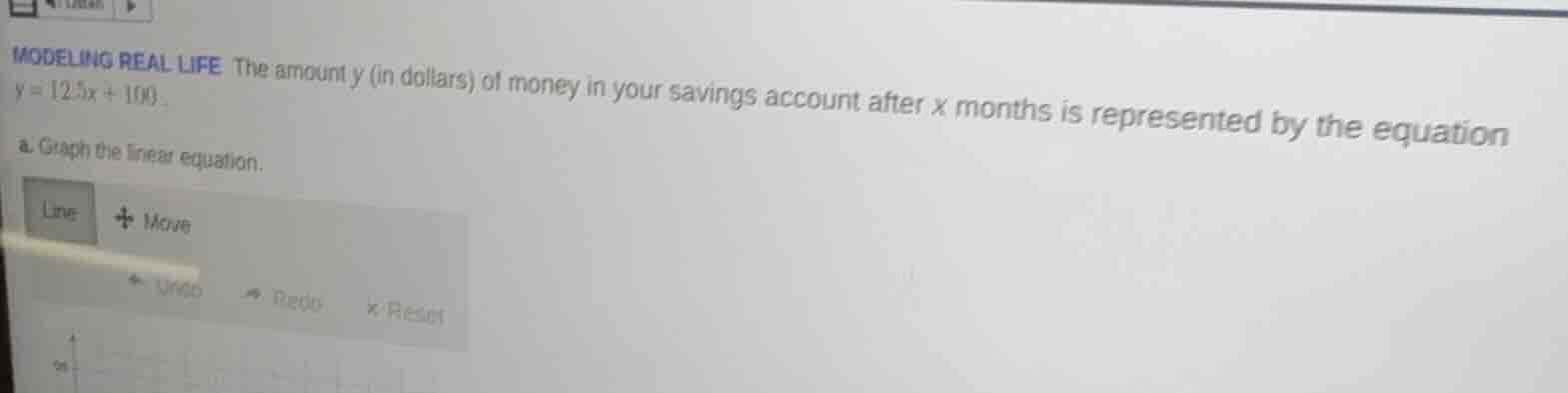
modeling real life the amount y (in dollars) of money in your savings account after x months is represented by the equation $y = 12.5x + 100$.
a. graph the linear equation.
To graph the linear equation \( y = 12.5x + 100 \), we can use the slope - intercept form of a linear equation \( y=mx + b \), where \( m \) is the slope and \( b \) is the y - intercept.
Step 1: Identify the y - intercept
In the equation \( y = 12.5x+100 \), the y - intercept \( b = 100 \). This means that when \( x = 0 \) (at the start, 0 months), the amount of money in the savings account \( y=100 \) dollars. So, we have a point \( (0,100) \) on the line.
Step 2: Identify the slope
The slope \( m = 12.5=\frac{25}{2} \). The slope is the ratio of the change in \( y \) to the change in \( x \), \( m=\frac{\Delta y}{\Delta x} \). A slope of \( 12.5 \) means that for every 1 - unit increase in \( x \) (every additional month), \( y \) (the amount of money in the account) increases by 12.5 units (12.5 dollars).
To find another point on the line, we can use the slope. Starting from the point \( (0,100) \), if we increase \( x \) by 2 (to make the calculation easier since the slope has a decimal), then \( \Delta x=2 \). Using the slope formula \( \Delta y=m\times\Delta x \), we have \( \Delta y = 12.5\times2=25 \). So, when \( x = 0 + 2=2 \), \( y=100 + 25 = 125 \). So, we get another point \( (2,125) \).
Step 3: Plot the points and draw the line
- Plot the point \( (0,100) \) on the coordinate plane (where the x - axis represents the number of months \( x \) and the y - axis represents the amount of money \( y \) in dollars).
- Plot the point \( (2,125) \) (or any other point obtained using the slope).
- Then, draw a straight line passing through these two (or more) points. The line should extend in both directions to represent all possible values of \( x\geq0 \) (since the number of months \( x \) cannot be negative in this real - life context, but mathematically, for the linear equation, it can extend for all real values of \( x \)).
If we want to use a table of values:
Step 1: Choose some values of \( x \)
Let's choose \( x = 0, x = 4, x=- 8\) (we choose \( x=-8 \) to show the line extends in the negative \( x \) direction mathematically, although in the context of months, \( x\geq0 \))
- When \( x = 0 \):
Substitute \( x = 0 \) into \( y=12.5x + 100 \), we get \( y=12.5(0)+100=100 \), so the point is \( (0,100) \)
- When \( x = 4 \):
Substitute \( x = 4 \) into \( y = 12.5x+100 \), \( y=12.5\times4 + 100=50 + 100 = 150 \), so the point is \( (4,150) \)
- When \( x=-8 \):
Substitute \( x=-8 \) into \( y=12.5x + 100 \), \( y=12.5\times(-8)+100=- 100 + 100=0 \), so the point is \( (-8,0) \)
After plotting these points \( (0,100) \), \( (4,150) \), \( (-8,0) \) (and others if needed), we draw a straight line through them.
The graph of the line \( y = 12.5x + 100 \) is a straight line with a y - intercept at \( (0,100) \) and a slope of 12.5, passing through points like \( (0,100) \), \( (2,125) \), \( (4,150) \) etc. (for non - negative \( x \) values in the context of the savings account problem).

Snap & solve any problem in the app
Get step-by-step solutions on Sovi AI
Photo-based solutions with guided steps
Explore more problems and detailed explanations
To graph the linear equation \( y = 12.5x + 100 \), we can use the slope - intercept form of a linear equation \( y=mx + b \), where \( m \) is the slope and \( b \) is the y - intercept.
Step 1: Identify the y - intercept
In the equation \( y = 12.5x+100 \), the y - intercept \( b = 100 \). This means that when \( x = 0 \) (at the start, 0 months), the amount of money in the savings account \( y=100 \) dollars. So, we have a point \( (0,100) \) on the line.
Step 2: Identify the slope
The slope \( m = 12.5=\frac{25}{2} \). The slope is the ratio of the change in \( y \) to the change in \( x \), \( m=\frac{\Delta y}{\Delta x} \). A slope of \( 12.5 \) means that for every 1 - unit increase in \( x \) (every additional month), \( y \) (the amount of money in the account) increases by 12.5 units (12.5 dollars).
To find another point on the line, we can use the slope. Starting from the point \( (0,100) \), if we increase \( x \) by 2 (to make the calculation easier since the slope has a decimal), then \( \Delta x=2 \). Using the slope formula \( \Delta y=m\times\Delta x \), we have \( \Delta y = 12.5\times2=25 \). So, when \( x = 0 + 2=2 \), \( y=100 + 25 = 125 \). So, we get another point \( (2,125) \).
Step 3: Plot the points and draw the line
- Plot the point \( (0,100) \) on the coordinate plane (where the x - axis represents the number of months \( x \) and the y - axis represents the amount of money \( y \) in dollars).
- Plot the point \( (2,125) \) (or any other point obtained using the slope).
- Then, draw a straight line passing through these two (or more) points. The line should extend in both directions to represent all possible values of \( x\geq0 \) (since the number of months \( x \) cannot be negative in this real - life context, but mathematically, for the linear equation, it can extend for all real values of \( x \)).
If we want to use a table of values:
Step 1: Choose some values of \( x \)
Let's choose \( x = 0, x = 4, x=- 8\) (we choose \( x=-8 \) to show the line extends in the negative \( x \) direction mathematically, although in the context of months, \( x\geq0 \))
- When \( x = 0 \):
Substitute \( x = 0 \) into \( y=12.5x + 100 \), we get \( y=12.5(0)+100=100 \), so the point is \( (0,100) \)
- When \( x = 4 \):
Substitute \( x = 4 \) into \( y = 12.5x+100 \), \( y=12.5\times4 + 100=50 + 100 = 150 \), so the point is \( (4,150) \)
- When \( x=-8 \):
Substitute \( x=-8 \) into \( y=12.5x + 100 \), \( y=12.5\times(-8)+100=- 100 + 100=0 \), so the point is \( (-8,0) \)
After plotting these points \( (0,100) \), \( (4,150) \), \( (-8,0) \) (and others if needed), we draw a straight line through them.
The graph of the line \( y = 12.5x + 100 \) is a straight line with a y - intercept at \( (0,100) \) and a slope of 12.5, passing through points like \( (0,100) \), \( (2,125) \), \( (4,150) \) etc. (for non - negative \( x \) values in the context of the savings account problem).