QUESTION IMAGE
Question
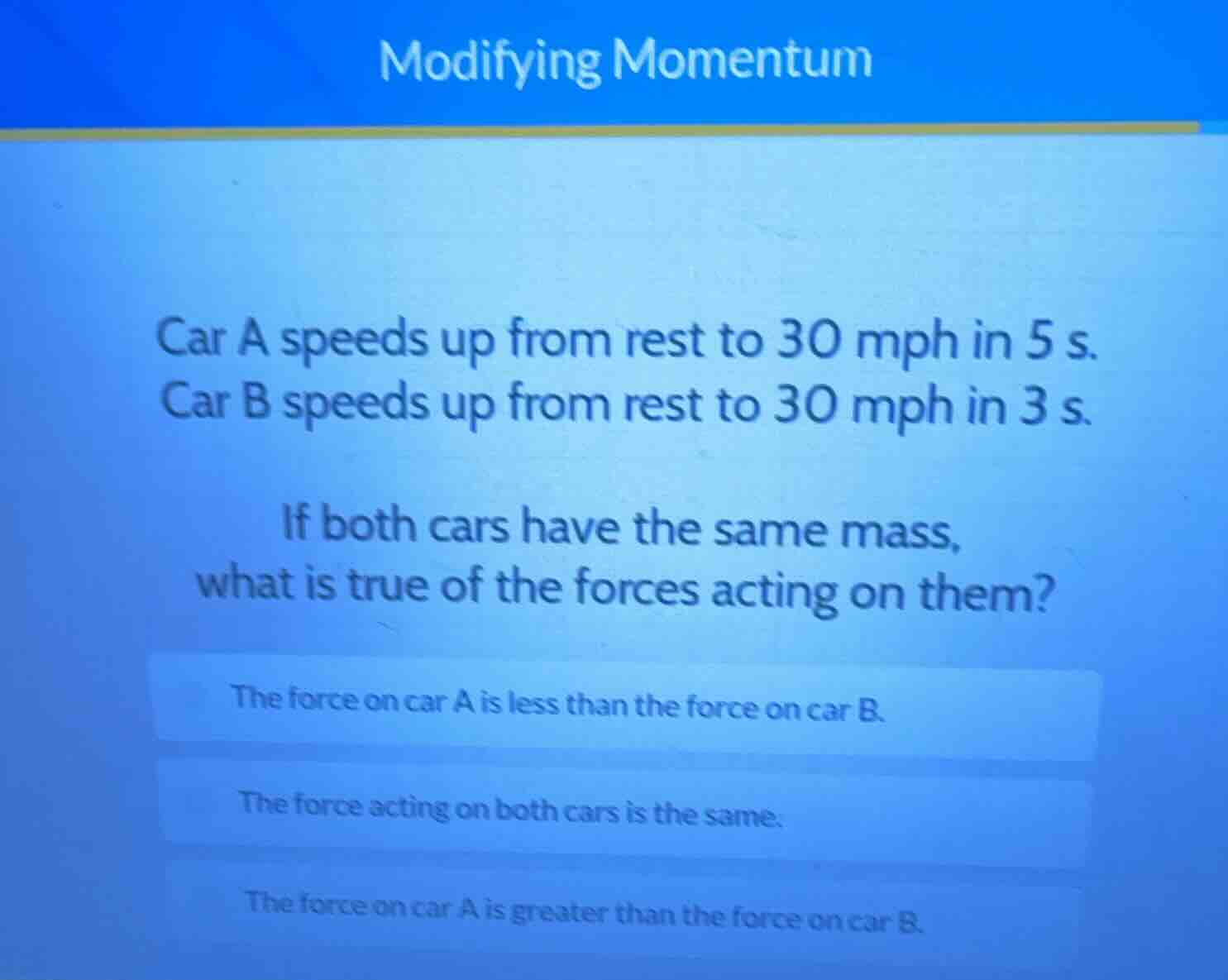
modifying momentum
car a speeds up from rest to 30 mph in 5 s.
car b speeds up from rest to 30 mph in 3 s.
if both cars have the same mass,
what is true of the forces acting on them?
the force on car a is less than the force on car b.
the force acting on both cars is the same.
the force on car a is greater than the force on car b.
Step1: Recall the formula for force
Force \( F \) is related to mass \( m \) and acceleration \( a \) by Newton's second law: \( F = ma \). Acceleration \( a \) is the change in velocity \( \Delta v \) over time \( \Delta t \), so \( a=\frac{\Delta v}{\Delta t} \). Thus, \( F = m\frac{\Delta v}{\Delta t} \).
Step2: Analyze the velocity change and time for each car
Both cars start from rest (initial velocity \( v_i = 0 \)) and reach a final velocity \( v_f = 30 \) mph. So, \( \Delta v = v_f - v_i = 30 - 0 = 30 \) mph for both cars. The mass \( m \) is the same for both cars.
For Car A: \( \Delta t_A = 5 \) s. For Car B: \( \Delta t_B = 3 \) s.
Step3: Compare the accelerations (and thus forces)
Since \( F = m\frac{\Delta v}{\Delta t} \), and \( m \) and \( \Delta v \) are the same for both cars, the force is inversely proportional to the time taken to achieve the velocity change.
For Car A: \( F_A = m\frac{30}{5} = 6m \) (in appropriate units). For Car B: \( F_B = m\frac{30}{3} = 10m \) (in appropriate units).
Since \( 6m < 10m \), \( F_A < F_B \).

Snap & solve any problem in the app
Get step-by-step solutions on Sovi AI
Photo-based solutions with guided steps
Explore more problems and detailed explanations
The force on car A is less than the force on car B.