QUESTION IMAGE
Question
modifying momentum
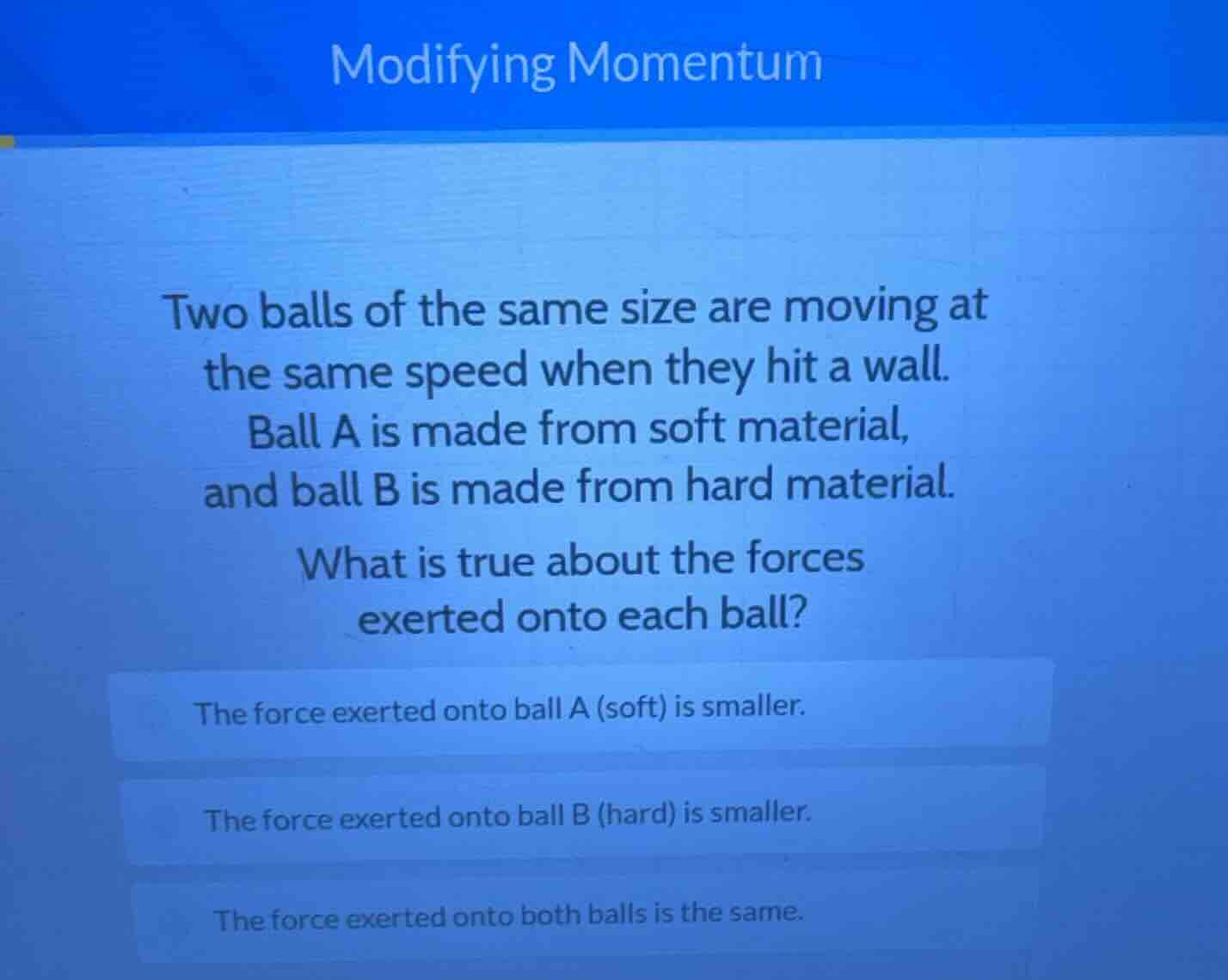
two balls of the same size are moving at
the same speed when they hit a wall.
ball a is made from soft material,
and ball b is made from hard material.
what is true about the forces
exerted onto each ball?
the force exerted onto ball a (soft) is smaller.
the force exerted onto ball b (hard) is smaller.
the force exerted onto both balls is the same.
To determine the force on each ball, we use the impulse - momentum theorem, \(J = \Delta p=F\Delta t\), where \(J\) is impulse, \(\Delta p\) is change in momentum, \(F\) is force, and \(\Delta t\) is time of interaction. Both balls have the same mass (\(m\)) and initial speed (\(v\)), so initial momentum \(p_i = mv\) and final momentum \(p_f = 0\) (since they hit the wall and stop, assuming), so \(\Delta p=|p_f - p_i| = mv\) for both, meaning \(\Delta p\) is the same.
Ball A is soft, so it will deform more and the time of collision \(\Delta t_A\) is longer. Ball B is hard, so \(\Delta t_B\) is shorter. From \(F=\frac{\Delta p}{\Delta t}\), when \(\Delta p\) is constant, a larger \(\Delta t\) gives a smaller \(F\). Since \(\Delta t_A>\Delta t_B\), \(F_A < F_B\), so the force on ball A (soft) is smaller.

Snap & solve any problem in the app
Get step-by-step solutions on Sovi AI
Photo-based solutions with guided steps
Explore more problems and detailed explanations
The force exerted onto ball A (soft) is smaller.